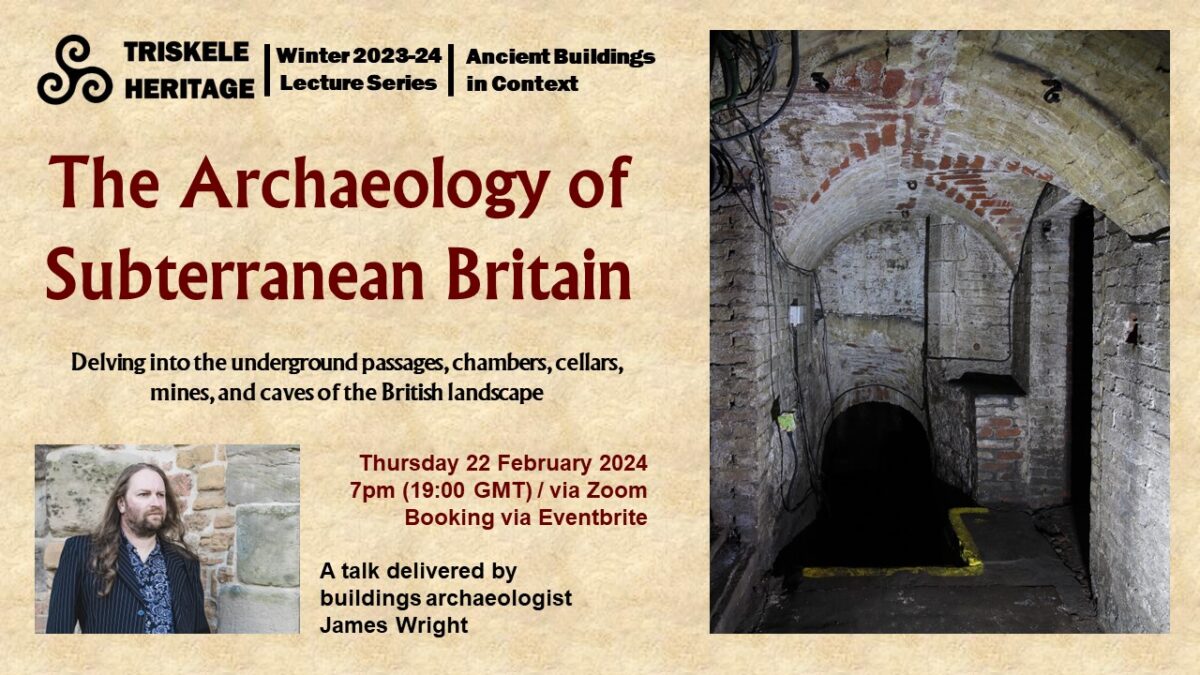
Delving into the underground passages, chambers, cellars, mines, and caves of the British landscape
There are many stories told about secret passages and hidden tunnels said to link our historic buildings. However, almost all of these tales fall into the category of folklore and myth. Yet there are genuine examples of subterranean landscapes beneath the ground and this talk will seek to delve into the archaeology of these very real spaces.
The talk will consider examples such as prehistoric copper mines in Cheshire, the caves riddling the rock upon which the city of Nottingham is built, passages beneath several British castles, chalk extraction pits in the south of England, and cellars beanth both great and little known houses.
The speaker, James Wright (Triskele Heritage), is an award winning buildings archaeologist. He has two decades professional experience of ferreting around in people’s cellars, hunting through their attics and digging up their gardens. He hopes to find meaningful truths about how ordinary and extraordinary folk lived their lives in the mediaeval period. He is the author of the popular Mediaeval Mythbusting Blog.
All you need to do is register via Eventbrite and – when the time for the talk rolls around – grab your favourite beverage of choice, get comfy and enjoy.
The event will take place at 19:00 GMT on Thursday 22 February 2024 via Zoom. There will be a talk until approximately 20.15 GMT and then a questions and answer session. It will end around 21.00 GMT.
This lecture is crowdfunded through donation. It will be the debut of a new bespoke talk. There is no minimum donation so its possible to contribute as little or as much as you want. Your donation is your ticket and you will be sent a link to access the event by Eventbrite.
Please note that this live event will not be recorded and made available online afterwards.
If you have a question about the event – in the first instance please see our FAQs section. The answer will almost certainly be in there.
Eventbrite recommend using the most up to date version of Google Chrome to access the meeting.
If you have any problems accessing the eventplease email: james@triskeleheritage.com This address will be monitored until the event begins at 7pm GMT.
The study of paranormal activity has played a significant role in the cultural experience of heritage. For proponents of paranormal research, the discipline is seen as a science. Yet, for many others, the subject is seen as fringe and scepticism remains high. I confess that, as a buildings archaeologist with over twenty years of experience, I have yet to encounter any paranormal activity within the ancient structures that I have researched. The most disturbing encounter of my career was when a pigeon unexpectedly erupted out of a seventeenth century roof structure and flew into my head! Nevertheless, it is a careless researcher who fails to gather the stories of place when trying to understand a structure.
I have a healthy appetite for the gothic. I write this blog on a literal dark and stormy night from a book-lined study covered with drawings of mediaeval buildings. I’m also wearing a band t-shirt from those stalwarts of goth rock – The Mission – whilst listening to The Fields of the Nephilim. I appreciate the darker side of life (and death), although I have never seen a ghost, spotted a UFO, or been contacted by spirits. Yet I can appreciate the earnestly told experiences of others, especially when they are relayed authentically.
Regrettably, some curators of paranormal experiences may choose to try and create romantic and gruesome backgrounds for their properties which cannot be supported by research. Invented history is paranormal’s dark problem and I will try to articulate those issues in this blog.
The buildings that I have worked at vary enormously – mediaeval castles, Tudor houses, eighteenth century mills, Victorian hospitals, and fin de siècle railway stations. These also have the potential to be of interest to paranormal researchers, who are sometimes welcomed in alongside archaeologists. Given the liminal nature of paranormal research it is perhaps imperative that the historical context for that work is firmly established and that inaccuracies are not included in its presentation.
It is not uncommon to discover that there are significant anomalies in the presentation of the history of an ancient building. Historians and paranormal researchers frequently deliver rather different information. Somewhat unfortunately paranormal histories might tend to include exaggeration or the insertion of unverified stories. This trend might include claims that a building is far older than the evidence supports, that a structure is built on top of prehistoric remains, that a particularly gruesome event occurred at the site, that historic personages with a dark reputation have a connection to the property, or that a stain on the floorboards was the result of a murder on that very spot.
I’m fairly sure that you will have read or heard several versions of such stories. In some, limited, cases they might even be entirely accurate. However, from the vantage of someone who makes a living by painstakingly assembling verified evidence for the history and development of ancient buildings, I can sadly relay that all too often the reported history for many sites of paranormal interest is tragically inaccurate.
It is difficult to ascertain how and why the disconnect between real and invented histories came to be, so I will avoid speculation. Yet I would argue that the creation of a romantic, bizarre, or gothic history for a site is doing that property, and paranormal enterprise, a great disservice. Given the extensive scepticism, for what is widely seen as a fringe subject, it does the study of the paranormal no favours in the eyes of both heritage professionals and the public if the presented history for a site is inappropriately false. Trying to persuade people of the reality and value of paranormal studies when the background history has been demonstrably invented is not a strong business model.
This point is especially true given the nature of most historic buildings which are of interest to the paranormal community. I cannot think of a single building that I have researched which did not have a deeply compelling history attached to it. These have included a railway tunnel which was the scene of a murder-suicide, the place where Guy Fawkes was interrogated, and the spot where Charles I was executed. Most buildings have good stories attached to them; it is just a matter of digging into the archives to uncover them.
There really is no need to invent tales when reality is usually every bit as intriguing. Instead of potentially damaging the cause of paranormal research by inserting false narratives to big up the site, it is surely better to create a bedrock of factual research which can then help to support the interest of visitors who may well be sceptical of the supernatural. By dealing honestly with the history of a building curators of paranormal sites can potentially belay the eyes-rolling-back-into-the-head of those who have heard just one too many tall tales.
Acknowledgements
This article was originally penned as a guest post for the now-defunct UK Paranormal Society blog. A big thanks to Leanne Burnam-Richards for commissioning the piece.
About the author
James Wright (Triskele Heritage) is an award-winning buildings archaeologist who frequently writes and lectures on the subject of mediaeval building myths. He has two decades professional experience of ferreting around in people’s cellars, hunting through their attics and digging up their gardens. He hopes to find meaningful truths about how ordinary and extraordinary folk lived their lives in the mediaeval period.