Author: Triskele Heritage

  • Mediaeval Mythbusting Blog #33: Who Invented the Corridor?

    Mediaeval Mythbusting Blog #33: Who Invented the Corridor?

    6 May 2026

    I recently gave an online talk which looked at The Surprising Secrets of Ancient Corridors. What do you mean, you missed it!? That’s a pity as folk seem to really enjoy the more obscure reaches of buildings archaeology. The opening section of the lecture examined claims that the corridor was a physical concept invented by, the surveyor, John Thorpe in 1597. I thought that might make a good subject for the blog;* so here we are…

    I first came across the notion that John Thorpe (c 1564/65 – 1655) invented the corridor in an article published by The Observer in 2024. It had the headline: ‘Some people’s ancestors are kings or poets. I’m proud my family invented… the corridor’. Within, a descendant of the surveyor, the journalist Vanessa Thorpe, claimed that: ‘an eminent Elizabethan designer and surveyor called John Thorpe, is the man credited with inventing the corridor.’ She went on to note that: ‘Until John Thorpe, rooms in the great houses of England used to lead on, one from another, all grouped around a central entrance hall’. She also indicated that the function of the corridor was to ‘let servants pop in and out of rooms without disturbing the grandees gliding from one salon to another.’ 

    An Early Modern Surveyor

    John Thorpe is a shadowy historical figure. In the Oxford Dictionary of National Biography, the eminent architectural historian, Professor Malcolm Airs sketched out what little is known of his life. Thorpe was born at King’s Cliffe in Northamptonshire in 1564/65 and, aged 5, laid the foundation stone at Kirby Hall with his master mason father. He followed a different path and became a clerk in the Office of Works, responsible for royal buildings, between 1583 and 1601. During this time, he often moonlighted as a surveyor for private clients. A good deal of his drawings can now be found in the collection of Sir John Soane’s Museum. From 1601, Thorpe was a self-employed surveyor and worked on buildings including Thornton College (Lincolnshire), Dowsby Hall (Lincolnshire), Audley End (Essex), Aston Hall (Birmingham) and Belvoir Castle (Leicestershire). From 1611, he also acted as assistant to Robert Treswell – the surveyor-general of woods south of the Trent. Thorpe died in 1655 and was buried at St Paul’s in Covent Garden (London).

    Aston Hall, Birmingham (Picture Source: Tony Hisgett / Wikimedia Commons)

    The claim that Thorpe invented the corridor is widespread. Examples of its repetition include architectural historians (Gomme & Maguire 2008, 126), estate agents, architects, bloggers, and… The QI Elves. Yes, you read that last bit correctly. The researchers for the long-running BBC television programme – QI (which stands for Quite Interesting) – Tweeted the following on 25 July 2020: ‘The first recorded use of a corridor was in 1597, when the architect John Thorpe designed one to allow “independent access to individual rooms”’. So, is this true?

    Thorpe’s Drawings

    The earliest citation of the 1597 claim, that I have been able to determine, may come from an article by, the architect and lecturer, Robin Evans. In an article entitled Figures, Doors and Passages, published in 1978, Evans (1978, 267-77) noted that: ‘The history of the corridor as a device for removing traffic from rooms has yet to be written. From the little evidence I have so far managed to glean, it makes its first recorded appearance in England at Beaufort House, Chelsea, designed around 1597 by John Thorpe’ (Evans 1978, 271-72).

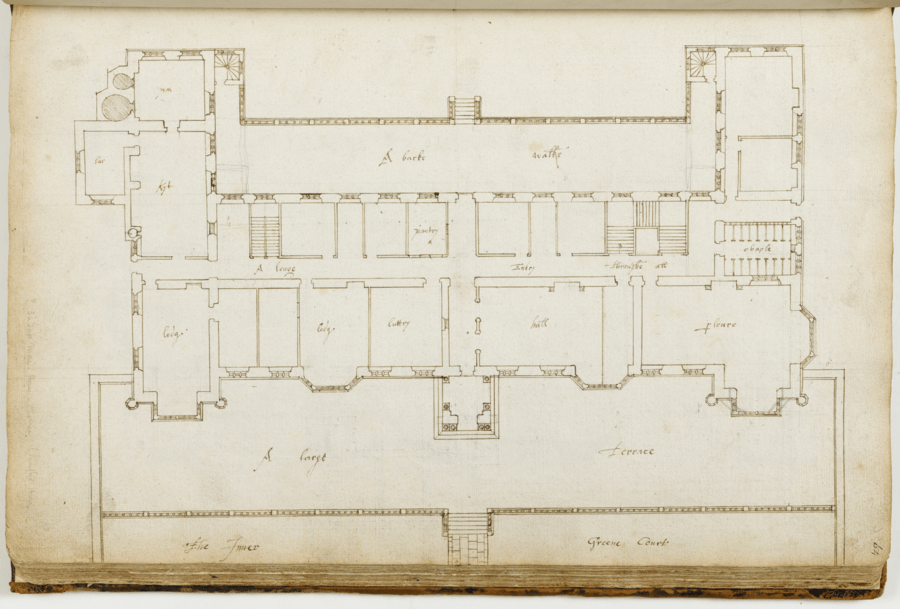
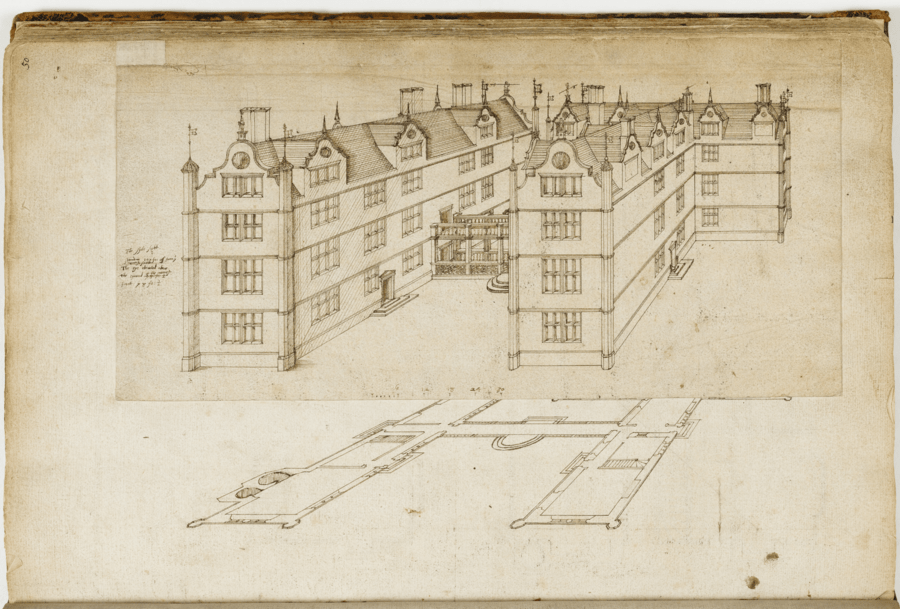
    The collection of Sir John Soane’s Museum contains Thorpe’s drawing of the ground plan for Beaufort House (SM Volume 101/63-64), dated c 1595 – 1603. An online article, published by the museum in connection with an exhibition of Thorpe’s work, noted that it ‘is likely to be a presentation drawing showing a design for the reconstruction of Beaufort House for Sir Robert Cecil, who became 1st Earl of Salisbury in 1605.’ It went on to state: ‘The use of a central corridor was innovative. Combined with the lateral axis of the main entrance, the corridor creates a cruciform plan, a layout favoured by Thorpe for both large and small houses.’ The piece ventured that the corridor was ‘innovative’, in the context of early modern great houses, but did not extent to crediting Thorpe with invention.

    Plan of Beaufort House, Chelsea, London, c 1595-1603, by John Thorpe (Picture Source: Sir John Soane’s Museum SM Volume 101/63-64)

    Prior to Evans, commentators tended to stress Thorpe’s innovative thinking in relation to a ground floor plan (SM Volume 101/30) and perspective drawing (SM Volume 101/50) for a building in the form of John Thorpe’s initials: IT (at the time, the letter I was interchangeable for the letter J). Writing in The Journal of the British Archaeological Association for 1895, C. R. B. Barrett described the arrangement: ‘The offices, I, being joined to the main house, T, by a corridor, represented by the hyphen.’ However, rather than the use of a corridor, it was the idea that Thorpe had designed a building in the shape of his initials which was considered remarkable: ‘This is a most singular example of a monogram for a dwelling-house, but unfortunately it was never completed, or even begun’ (Barrett 1895, 64). Such writers did not claim that Thorpe invented the corridor.

    Design for the ground-floor plan of a house in the form of ‘IT’, c 1595-1603, by John Thorpe (Picture Source: Sir John Soane’s Museum SM Volume 101/30)

    Instead, the source of the 1597 claim, now widely repeated, seems to have been Robin Evans in 1978. However, even he admitted that he was not on solid ground. Evans (1978, 271-72) prefaced the identification with the phrase: ‘From the little evidence I have so far managed to glean’. This would seem to indicate that he was far from certain given a lack of detailed study. It could be seen as the mid-twentieth century researcher’s equivalent of ‘doing a quick Google’. Unfortunately, later commentators seem to have overlooked Evans’ caveat and concentrated entirely on the section which reads: ‘it makes its first recorded appearance in England at Beaufort House, Chelsea, designed around 1597 by John Thorpe’ (Evans 1978, 271-72). Dogmatic certainty has been upheld over initial ambiguity.

    Defining the Corridor

    Dig a little deeper in Vanessa Thorpe’s article for The Observer and there are traces of this uncertainty. Despite the section of the headline which reads: ‘I’m proud my family invented… the corridor’, Thorpe also noted that in the mediaeval period ‘some buildings had monastery-style external covered cloisters bordering central courtyards, these were always too nippy for a northern climate. Roman villas in Britain, it’s true, had also sported mediterranean colonnades, open on one side’. Here lies the problem. The 1597 claim for John Thorpe may be guilty of cherry-picking and overstating the evidence. Corridors were clearly in existence before the 1590s.

    The definition of the corridor is complex, and the term has been employed in several contexts. The Oxford English Dictionary (OED) points towards a now-obsolete usage to mean: ‘A path that surrounds a fortified castle, town, etc., running along the top of the outer bank of the moat, and defended by a parapet formed by the top edge of the glacis.’ This meaning could be found in fourteenth century Italy, by 1572 in France, and (the earliest citation) in English from 1591. An approximation of this feature may be the Moat Walk surrounding the Yellow Tower of Gwent at Raglan Castle (Monmouthshire), built c 1600 (Kenyon 2003, 54).

    Moat Walk around the Yellow Tower of Gwent at Raglan Castle, Monmouthshire (Picture Source: James Wright / Triskele Heritage)

    The word also has a domestic definition: ‘A covered passageway, gallery, or cloister connecting one part of a building with another, esp. forming the edge of an inner quadrangle or courtyard.’ This can be found in use in Italy from the 1250s, in French by at least 1602, and in English by 1623. However, so far, we have only looked for the existence of corridors using evidence gleaned from written sources (earliest known citation: 1257) and drawings identified by architectural historians (earliest claim: 1597). If we accept that there are several historic terms for corridors (as exemplified in the OED) – colonnades, cloisters, passages, pentices, balconies or galleries – then buildings archaeology can push these dates back significantly.

    Roman Corridors

    One commentator on The QI Elves tweet simply said: ‘Didn’t the Romans have corridors?’ Yes, they did. Given that I am far from being a Romanist, I am not going to attempt to identify the earliest Roman example of a corridor. However, it is worth noting that the House of the Faun at Pompeii, dated c 180 BCE, included two colonnaded gardens and a corridor which granted access to the services on the east side of The First Peristyle (Dwyer 2001, 332). Elsewhere, if we want to consider an early example of a corridor in the Roman province of Britannia, Fishbourne Palace (West Sussex) was full of them. Originally built in the mid-first century CE, and remodelled successively in the second and third centuries CE, Fishbourne included numerous open-sided colonnades and enclosed corridors, including one from the principal courtyard to the bath house (Cunliffe 1998).

    Floor plan of Fishbourne Palace, West Sussex (Picture Source: Sussex Archaeological Society)

    Monastic Cloisters

    If we allow that The Observer article may have been primarily dealing with corridors in England (‘Until John Thorpe, rooms in the great houses of England used to lead on, one from another’), there is still the problem that such features could be found in the country during the early mediaeval period. In a book on England’s Abbeys, Philip Wilkinson (2006, 97) noted that cloisters were common across continental Europe by the ninth century and were ‘taken up extensively in England after the reforms of St Dunstan in the mid-10th century.’ Both the OED and Wilkinson were emphatic that cloisters are corridors. The latter noted that cloisters allowed circulation from the church and around ‘the main monastic apartments – including the chapter house, parlour, dormitory, refectory and, in Cistercian houses, the lay brothers’ accommodation’ (Wilkinson 2006, 95).

    Cloisters were present in England during the late Anglo-Scandinavian phase at St Augustine’s Abbey in Canterbury (Kent) and became an essential component of post-Conquest monasteries such as Rievaulx Abbey (North Yorkshire), where a reconstruction of part of the Romanesque cloistral arcade can be seen (Wilkinson 2006, 97). A roughly contemporary pair of cloisters are featured on Prior Wilbert’s Waterworks Plan of Canterbury Cathedral (Kent), made in the 1160s (Kerr 2012, 205-08). Most Romanesque cloisters have been lost because of Dissolution demolition or due to rebuilding. Consequently, it is cloisters from the Gothic era of architecture which are most well-known in England; such as those of c 1297 – 1430 at Norwich Cathedral (Norfolk) or Gloucester Cathedral (Gloucestershire), built in two phases of c 1350 and c 1381-1412 (Sansbury 2013, 42; Thomson 2011, 39-41).

    Cloisters at Norwich Cathedral(Picture Source: James Wright / Triskele Heritage)

    Cross Passages

    The most common form of corridor in mediaeval England was the cross passage. These corridors led from the front door of domestic houses, directly through the property, out to a garden or courtyard beyond. On one side would be the services – potentially including buttery, pantry, and perhaps a kitchen. On the other would be the hall, with a solar or parlour beyond. Cross passages acted as a functional access between the various areas of the house. They also delineated social separation: lower status services from higher status hall and parlour. Which way people turned on entering a cross passage may have been determined by their social function and status.

    Drawings of a three-cell house in which (c) is the cross passage (Picture Source: Vernacular Building Glossary / Vernacular Architecture Group)

    Cross passages could be found in domestic houses regardless of status. Therefore, a yeoman house such as Bayleaf from Chiddingstone in Kent (now located at the Weald and Downland Living Museum in West Sussex), dated 1405-30, features a cross passage (Zeuner 1990, 3). So also does the hall range, built c 1325-50, for Sir Richard Vernon IV at Haddon Hall in Derbyshire (Emery 2000, 383-391). At Bayleaf, the cross passage linked the front door and the back garden. At Haddon Hall, the cross passage linked the Lower Court to the Upper Court. In both cases, the services lay on one side of the corridor and the hall on the other.

    The cross passage at Bayleaf from Chiddingstone, Kent – the doorways to the services are on the left and the entrance to the hall on the right (Picture Source: James Wright / Triskele Heritage)

    An early example of such an arrangement in a non-elite domestic residence, dated by dendrochronology, is Tudor House at Steventon (Oxfordshire), which has a felling date of 1355-56 (Alcock & Miles 2013, 30). Meanwhile, cross passages were still current during the 1640s at places such as Laverock Hall in Keighley, West Yorkshire (Giles 1986, 202). This was despite the growing early modern popularity of the lobby entrance. The new planform consisted of a front doorway which accessed a small lobby, formed by the transverse end of a chimney directly opposite the door, with rooms (usually a hall and kitchen) opening off to the left and right. One of the earliest known examples of this new form was Old Hall Farm House at Kneesall (Nottinghamshire), which was built in the 1520s (Mercer 1975, 60). Nevertheless, the cross passage was clung to in new builds, especially in the north, well into the seventeenth century.

    Drawings of a three-cell house in which (c) is the lobby entrance( Picture Source: Vernacular Building Glossary / Vernacular Architecture Group)

    Pentices and Galleries

    Alternatively, corridors could also be found at secular residences in the form of pentices. These are defined as consisting of a ‘Narrow roof projecting from a wall… also used of a covered way between separated buildings.’ In 1251-52, there is a documented account of Henry III ordering the construction of a pentice ‘at Clipstone from the entry of the king’s chamber to the gable of the hall, and another passage to the new chapel’ (Turner 1851, 236). This corridor may have resembled the fifteenth century pentice at the Hospital of St Cross in Winchester (Hampshire) which links the church and the gatehouse (Emery 2006, 425-28).

    Fifteenth century pentice at the Hospital of St Cross in Winchester, Hampshire (Picture Source: James Wright / Triskele Heritage)

    Meanwhile, upper chambers were sometimes accessed via open-sided galleries. These were essentially raised pentices that may overhang the ground floor supported on jetties. Such features can be seen surviving from the fifteenth century at Abingdon Abbey in Oxfordshire and Llys a Chastell Tre-tŵr in Powys (Alcock & Tyers 2013, 104; Emery 2000, 669-71). Galleries were also known at mediaeval inns and provided access between the courtyard and bedchambers. Perhaps the best-preserved example of an inn gallery is the one which survives at first floor on three sides of the courtyard at The New Inn at Gloucester (Gloucestershire), a building which has been tree-ring dated to 1432 (Nayling 2002, 79). An open-sided gallery is also known from a similar period at the George Hotel at Dorchester-on-Thames in Oxfordshire (Wright 2024, 172). Elsewhere, a fifteenth century gallery has been infilled at the Bull Hotel in Ludlow, Shropshire (Moran 2003, 163); whereas there is an open-sided example surviving from the early sixteenth century at the George Inn, Norton St Philip, Somerset.

    Gallery at The New Inn, Gloucester (Picture Source: James Wright / Triskele Heritage)

    Raised Corridors

    In high-status dwellings, raised corridors became a marker of prestige. An early example of this is the 13.6-metre-long, vaulted, brick corridor on the second floor of the great tower at Tattershall Castle, dated c 1425-50 (Wright 2021a, 62-63). This linked the staircase to a heated ante-chamber furnished with a latrine. Here, guests of Ralph Lord Cromwell would await summons into the adjacent Great Chamber. On entering, visitors would find themselves at the low end of the chamber with the Lord Treasurer of England at the high end beneath a tester canopy, next to a carved chimneypiece, and illuminated by substantial tracery windows filled with stained glass. The ceremonial nature of this arrangement was intended to heighten the theatricality of access to Cromwell in a manner that may have recalled liturgical procession. Meanwhile, at the summit of the tower there was a covered brick walkway, highly reminiscent of a monastic cloister, which enabled Cromwell to show off views of his landscape of lordship, to his most honoured guests, under cover from the weather (Wright 2021b, 313-16). Posh stuff.

    Corridor on the second floor of Tattershall Castle, Lincolnshire (Picture Source: James Wright / Triskele Heritage)

    Parapets of Tattershall Castle, Lincolnshire (Picture Source: James Wright / Triskele Heritage)

    Elevated corridors, known as long galleries, gathered in popularity at elite houses through the early modern period. Long galleries – such as the five sixteenth and seventeenth century examples at Knole, near Sevenoaks in Kent, or the late sixteenth century instance at Haddon Hall (Derbyshire) – were ostensibly created to provide an internal exercise space for high status occupants (Fleming, Honour & Pevsner 1980, 129). However, they also provided venues for the landowners to show off their artistic patronage via panelling, plasterwork, paintings, glazing, and sculpture. It was the term long gallery which leant itself to the phrase ‘art gallery’.

    Brown Gallery at Knole, near Sevenoaks, Kent (Picture Source: James Wright / Triskele Heritage)

    Even the humbler corridors which access the upper chambers at Harvington Hall (Worcestershire) – the Mermaid Passage and the Nine Worthies Passage – can be found daubed with impressive survivals of late Tudor painting, dated c 1580 and c 1600 respectively (Anon 2023, 25, 43). This brings us, finally, to the period when John Thorpe is supposed to have invented the corridor.

    Nine Worthies Passage at Harvingon Hall, Worcestershire (Picture Source: James Wright / Triskele Heritage)

    Conclusions

    Since at least the 1970s, it has been suggested that, the surveyor, John Thorpe invented the corridor on a drawing of Beaufort House, made c 1595 – 1603. However, this identification, by Robin Evans, was acknowledged even at the time to be uncertain. The belief that the corridor was invented by Thorpe seems to be based on an architectural historian’s limited view based entirely on surviving documentation for elite houses of the early modern period.

    Dig a little deeper, using the discipline of buildings archaeology, and a different picture emerges. From this perspective, there is a wealth of evidence from the Roman, Anglo-Scandinavian, mediaeval, and early modern periods to indicate the presence of corridors – in sacred and secular buildings of both the elites and non-elites – which pre-date Thorpe. Corridors were there, standing in plain sight, in the form of colonnades, cloisters, passages, pentices, balconies or galleries. All are genuine forms of corridors which were in existence across Britain and Europe long before Thorpe. We might not be able to directly name the person who invented the corridor, but we can be sure that the job was done long before 1597.

    – – –

    * Yes, 1597 is technically after the mediaeval period (c 410 – c 1550) and you might ask why this subject is on the Mediaeval Mythbusting Blog. In answer: 1) my blog, my rules; 2) I’m sticking up for mediaeval corridors.

    – – –

    Dedication

    This blog is dedicated to the memory of my dear friend Nick “Ringo” Southall, who died on this day 11 years ago. He would have been exquisitely puzzled as to why I was interested in writing about corridors. It would have led to an immense barrage of ribbing that would probably have gone on for years. I miss him dearly.

    Nick “Ringo” Southall (Picture Source: ENPR)

    References

    Primary Sources:

    Sir John Soane’s Museum

    SM Volume 101/30: John Thorpe; Design for the ground-floor plan of a house in the form ‘I T’; Design for or study of the ground floor of a small compact house, 1596-1603

    SM Volume 101/50: John Thorpe; Perspective plan and, on additional attached sheet, perspective of a house in the form ‘I T’, 1596-1603

    SM Volume 101/63-64: John Thorpe; Plan of Beaufort House, Chelsea, London, 1595-1603

    Secondary Sources:

    Alcock, N. & Miles, D., 2013, The Medieval Peasant House in Midland England. Oxbow. Oxford and Philadelphia.

    Alcock, N. & Tyers, C. (ed.’s), 2013, ‘Tree-ring Date Lists 2013’ in Vernacular Architecture Volume 44. Vernacular Architecture Group / Routledge. London and New York. pp82-111.

    Anon, 2023, Harvington Hall. Archdiocese of Birmingham. Birmingham.

    Barrett, C. R. B., 1895, ‘Riding Skimmington and Riding the Stang’ in The Journal of the British Archaeological Association New Series Volume I. British Archaeological Association. London. pp58-68.

    Cunliffe, B. W., 1998, Fishbourne Roman Palace. Tempus. Stroud.

    Dwyer, E., 2001, ‘The Unified Plan of the House of the Faun’ in Journal of the Society of Architectural Historians Volume 60 Number 3. University of California Press / Society of Architectural Historians. pp328-343.

    Emery, A., 2006, Greater Medieval Houses of England and Wales, 1300-1500: Volume 3 – Southern England. Cambridge University Press. Cambridge.

    Emery, A., 2000, Greater Medieval Houses of England and Wales, 1300-1500: Volume 2 – East Anglia, Central England and Wales. Cambridge University Press. Cambridge.

    Evans, R., 1978, ‘Figures, Doors and Passages’ in Architectural Design Volume 48. pp267-77.

    Fleming, J., Honour, H. & Pevsner, N., 1980 (third ed.), The Penguin Dictionary of Architecture. Penguin. London.

    Giles, C. (ed.), 1986, Rural Houses of West Yorkshire, 1400-1830. Her Majesty’s Stationery Office. London.

    Gomme, A. & Maguire, A., 2008, Design and Plan in the Country House: From Castle Donjons to Palladian Boxes. Yale University Press. New Haven & London.

    Kenyon, J. R., 2003 (revised ed.), Raglan Castle. Cadw. Cardiff.

    Kerr, J., 2012, Monastic Hospitality. Boydell & Brewer. Woodbridge.

    Mercer, E., 1975, English Vernacular Houses. RCHME. London.

    Moran, M., 2003, Vernacular Buildings of Shropshire. Logaston Press. Logaston.

    Nayling, N., 2002, ‘List 125: Tree-ring dates from the University of Wales Lampeter Dendrochronology Laboratory’ in Vernacular Architecture Volume 33. Vernacular Architecture Group. pp78-81.

    Sansbury, E., 2013 (revised ed.), An Historical Guide to Norwich Cathedral. Swallowtail. Drayton.

    Thomson, C., 2011, ‘The Benedictine Inheritance’ in Gloucester Cathedral – Faith, Art and Architecture: 1000 Years. Scala. London.

    Turner, T. H., 1851, Some Account of Domestic Architecture in England, from the Conquest to the End of the Thirteenth Century. J. H. Parler. Oxford & London.

    Wilkinson, P., 2006, England’s Abbeys – Monastic Buildings and Culture. English Heritage. Swindon.

    Wright, J., 2024, Historic Building Mythbusting – Uncovering Folklore, History and Archaeology. The History Press. Cheltenham.

    Wright, J., 2021a, Tattershall Castle: Building a History. Unpublished doctoral thesis. University of Nottingham.

    Wright, J., 2021b, ‘Tattershall Castle and the Newly-Built Personality of Ralph Lord Cromwell’ in The Antiquaries Journal Volume 101. Society of Antiquaries of London / Cambridge University Press. London and Cambridge. pp301-332.

    Zeuner, D., 1990, The Bayleaf Medieval Farmstead. Weald and Downland Open Air Museum. Singleton.

    About the author

    James Wright is an award-winning buildings archaeologist. He has two decades professional experience of ferreting around in people’s cellars, hunting through their attics and digging up their gardens. He hopes to find meaningful truths about how ordinary and extraordinary folk lived their lives in the mediaeval period.

    He welcomes respectful contact through email or on TwitterInstagram & Bluesky

    The Mediaeval Mythbusting Blog is the basis of the book – Historic Building Mythbusting – Uncovering Folklore, History and Archaeology  which was released via The History Press in June 2024. More information can be found here:

  • Mediaeval Mythbusting Blog #32: Priest Holes

    Mediaeval Mythbusting Blog #32: Priest Holes

    21 April 2026

    Back in January 2026, I visited some dear friends who live in the delightful North Yorkshire market town of Pickering. Whilst I waited for them to finish work, I pottered around the castle (brilliant garderobes), church (excellent wall paintings), and local bookshop (fabulous folklore section). The latter really was amazing, and I was very much taken with the redundant roof structure that dominates the upper floor. I got talking with the shop attendant who repeated a now familiar phrase: “Oh, those timbers are supposed to come from old ships, and the house opposite has got a priest hole!” Anyone familiar with my work may know that I’ve investigated ship timber rumours a fair bit, including for this blog, but I haven’t yet addressed the subject of priest holes…

    Diate Hill Tower at Pickering Castle (left), wall painting at St Peter & St Paul at Pickering (centre), and the roof structure of The Pickering Book Tree (right); (Picture Source: James Wright / Triskele Heritage)

    There are a couple of reasons that I have previously overlooked priest holes. First, their use falls outside the mediaeval period. Second, although I wanted to discuss them in the Historic Building Mythbusting book, I had reached the publisher’s word limit and couldn’t fit the subject in. The motive for picking up on priest holes now is because, whenever I talk about the lack of evidence for secret passages at public events, many people ask: ‘But what about priest holes!?’ Well, the time has come to look at them in connection to both vernacular architecture and hidden tunnel rumours.

    Terminology

    The first recorded use of the term ‘priest hole’ was by the diarist Samuel Pepys in 1660. According to the Oxford English Dictionary, it is understood to mean: ‘A secret chamber or similar hiding place for a Roman Catholic priest, esp. in Elizabethan and Jacobean England.’ However, Pepys was writing decades after the heyday of such features. During the late sixteenth and early seventeenth century, a variety of terms were employed in accounts by priests, landowners, and spies to describe hiding places including: ‘more retired places’, ‘secret convenience’, and – especially – ‘secret place’ (quoted in Hodgetts 1989, 9, 10, 12). In more recent times, the alternative phrase ‘priest hide’ reflects that many were ingenious constructions rather than mere holes. Nonetheless, in this blog, I’m going to use Pepys’ near-contemporary early modern terminology – priest hole – as it is the most familiar phrasing to modern readers.

    Vernacular Assumptions

    Unlike secret passages, priest holes are Very Definitely An Actual Thing. The problem is that their existence is assumed to be far more common in all types of houses than historic reality supports. In his book Secret Hiding Places, Michael Hodgetts (1989, iv) noted that priest holes are usually only to be found within the high-status properties of the early modern recusant Catholic gentry. This level of society was more capable of financially supporting their own recusancy (which was punishable by high financial penalties), accommodating priests, and patronising master carpenters to create ingenious hiding places. With a very small number of exceptions, priest holes are not generally anticipated in non-elite vernacular houses. This would tend to rule out 41, 42 and 44, Burgate which the bookseller in Pickering suggested as having a priest hole. Aside from the building falling below the social status which would normally contain one, the Burgate property is probably eighteenth century in date – a period long after priest holes were constructed.

    41, 42, and 44, Burgate, Pickering, North Yorkshire (Picture Source: Rightmove)

    I have encountered rumours of priest holes in vernacular buildings too numerous to quantify. The landowner of a timber-framed farmhouse in Worcestershire showed me a space beneath a staircase barely big enough to contain a domestic cat. Despite the apparent lack of archaeological evidence, a sign outside the Red Lion in York claims that there is ‘a priest hole on the 1st floor which leads to a hidden room up in the attic’. Meanwhile, pretty much any aperture of uncertain function seems to be assigned as a priest hole by commentators on internet discussion groups. One such example comes from a Welsh farmhouse considered on the Medieval & Tudor Period Buildings Group. A horizontal slot measuring approximately 0.3m (width) x 1.5m (length) was conjectured to be a priest hole because: ‘People were known to be smaller in medieval times’. Aside from the fact that priest holes are an early modern phenomenon, the latter is also a fallacy as my colleague, the osteoarchaeologist, Dr Lauren McIntyre can testify. The mean height for English males alive between 1400 and 1650 was 1.73-1.74m (Galofré-Vilà, Hinde, & Guntupalli 2018, 67-98). Too big for the slot in Wales.

    This is not to say that priest holes were never a feature in vernacular properties. In his biography of the sixteenth century Catholic martyr Margaret Clitherow (c 1556-1586), the fugitive priest, John Mush described a hiding place in a York house. Clitherow, who lived at 10-11 Shambles, arranged access from her property into the adjacent attic above her neighbour’s house. Mush indicated that it was then possible to climb down from the attic into the chamber below (quoted in Hodgetts 1989, 120-21). Although this does sound, at face value, to be a description of a priest hole in a vernacular building there may be other factors at play. First, Clitherow was of relatively high social standing – her father was Sheriff of York in 1564, and her husband was Chamberlain of the City. Second, it has been conjectured that Margaret’s conversion to Catholicism, and support for priests, may have been encouraged by Dorothy Vavasour. She was the wife of the socially prominent, Cambridge-educated physician, Dr Thomas Vavasour. The latter was himself arrested, in 1574, within what may have been the earliest priest hole known to the documentary record. Third, I am not certain that Mush’s description reads that much like a genuine priest hole. Instead, it may have been a rudimentary access between two attics which then communicated, via a hatch, with the bedchamber below. Although some care may have been taken to mask the entrances the ad hoc engineering may have been too primitive to be considered a priest hole proper.

    10-11 Shambles, York, North Yorkshire (Picture Source: Warofdreams / Wikimedia Commons)

    Lingering doubts about the Clitherow hiding place aside, there are relatively few priest holes in vernacular buildings which are known from documentary or archaeological evidence. Most claims from vernacular houses can be rejected as a misunderstanding of more prosaic architectural features. Instead, as many authors have noted, priests were hidden ‘uncomfortably about the country houses of Elizabethan England’ (Errand 1974, 14).

    Real Priest Holes

    The material existence of priest holes is tangible evidence for the Counter-Reformation in England. Following the Rising in the North (1569), excommunication of Elizabeth I by Pius V (1570), and the secretive re-introduction of Catholic seminary and Jesuit priests to England during the 1570s and 1580s; the Elizabethan state made the shelter of clerics an offence of high treason in 1584. A resultant conference of recusant Catholic families, held at Harleyford Manor (Buckinghamshire) in 1586, decided to covertly position priests within households for long periods of time. This was to avoid the suspicion created by constant movement between locations. Additionally, it led to the need for clever hiding places in case of government sponsored searches (Hodgetts 1989, 3-9).

    Although priest holes were known prior to 1586, at places such as Ripley Castle (North Yorkshire) and Lyford Grange (Oxfordshire), they became more common after this date (Hodgetts 1989, 9, 12). The heyday for their construction was the period between the Harleyford conference of 1586 and the Gunpowder Plot of 1605. It probably included those constructed at Coughton Court (Warwickshire), Scotney Castle (Kent), and Speke Hall (Merseyside). All three are managed by the National Trust and can sometimes be seen by the public.

    Priest hole at Coughton Court, Warwickshire (Picture Source: Brian Robert Marshall / Wikimedia Commons)

    The acknowledged master craftsman of priest holes was the carpenter and Jesuit lay brother Nicholas Owen (c 1562 – 1606). Between 1588 and 1606, he constructed numerous examples across the country; although documentary evidence can only link him directly to those at Baddesley Clinton (Warwickshire) and Broadoaks Manor (Essex). At the former, Owen remodelled a sewer outfall, 0.5m wide by 1.2-1.8m in height, which discharged into the moat. Initially, he constructed a new garderobe turret with a separate chute. Then he blocked up the older outlet and created a hidden entrance within the original garderobe. The ruse worked so well that Father John Gerard, and around 8 or 9 others, successfully hid from a party of ‘four Priest-hunters’ in October 1591 (Reynolds 2014, 41-46). Gerard was similarly successful in evading capture at Broadoaks Manor during the spring of 1594. Here, the chapel was at the top of the house. Beneath the hearth of a fireplace in the room, Owen dug a hole in the masonry measuring approximately 2m (length) x 0.6m, (width) x 1.9m (height). The hiding place was concealed so adeptly that it foiled the pursuivants during an extended search that lasted four days (Reynolds 2014, 48-54).

    Priest hole at Baddesley Clinton, Warwickshire (Picture Source: James Wright / Triskele Heritage)

    A priest hole, that is also suspected to have been created by Owen, at Oxburgh Hall (Norfolk), relied on the conversion of another garderobe (Forest 2014, 25). Located within a chamber off the late fifteenth century brick gatehouse, the hiding place was created by digging down and then into the masonry for approximately a metre. The aperture then opened upwards into a relatively large space – 1.3m (length) x 0.9m (width) x 2.5m (height). Within, the chamber was provided with a wooden seat, recesses for books, a secondary cavity for vestments, and even a concealed tube for the supply of liquid refreshment from the adjacent bedroom. The entrance was hidden behind an oak frame, clad with floor tiles, which pivoted open. So well-appointed was this hiding place that it has been described as ‘a palace among priest-holes’ (Reynolds 2014, 106-08).  

    Priest hole at Oxburgh Hall, Norfolk (Picture Source: James Wright / Triskele Heritage)

    The house that is perhaps best known for priest holes is Harvington Hall (Worcestershire). Between his inheritance in 1578 and death in 1631, the landowner, Humphrey Pakington patronised the creation of no less than eight surviving hidden spaces at the house (Reynolds 2014, 111-15; Anon 2023, 7, 11, 19, 27, 29, 33, 37, 45, 47). They include:

    1. A priest hole, measuring 0.8m x 1.1m x 1.5m, above the bread oven in the Great Kitchen which was accessed from a garderobe off the South Room Bedchamber.
    2. A pair of steps at the top of the Great Staircase which were hinged to allow access to a small chamber beneath.
    3. Beyond the latter was a secondary hiding place, measuring 1.5m x 1.8m x 1.8m, accessed via a door camouflaged with brickwork.
    4. A pivoting false wall stud in Dr Dodd’s Library allowed access to a chamber 0.9m x 2.4m 1.5m in dimension.
    5. A passageway off the Withdrawing Room contained a trapdoor that opened on to a ladder down into a chamber, measuring 0.6m wide x 1.3m in length, which was created by building a false sandstone wall against a chimney.
    6. In the Chapel was a small recess under the floorboards, just 0.18m deep, probably used for hiding priest’s vestments.
    7. In the Marble Room was a false fireplace, artificially smoke-blacked, that granted access into the roof structure. After negotiating a crawl space, the priest could then drop down into a large chamber measuring 5m x 4m x 2m.
    8. Also within the roof structure was another small chamber, measuring 1m x 1m x 2.4m, probably used for hiding massing equipment.

    Priest hole at Harvington Hall, Worcestershire (Picture Source: James Wright / Harvington Hall)

    It is no wonder that commendations for the ingenious hiding places at Harvington Hall are legion: ‘the finest collection of hides surviving in Britain’ (Reynolds 2014, 112); ‘the most celebrated priests’ holes’ (Errand 1974, 18); and ‘The finest surviving series of hiding-places under one roof’ (Hodgetts 1989, 81).

    Jumping to Conclusions

    Despite the reality of priest holes in some early modern houses, the discovery of almost any hidden space, of apparently uncertain provenance, can lead to erroneous identification. Whilst I was working on an archaeological building survey at Knole (Sevenoaks, Kent), in 2013, the chance discovery of a void led to such speculation. A 0.48-metre-wide cavity was recorded between the roof structures of the Pheasant Court Building, to the west, and the Chapel, to the east. During a site meeting between the MOLA archaeologists, conservation practitioners, and the National Trust one of our number said: “Surely, it’s a priest hole!” Everyone became immediately animated and excited. Priest holes cast a spell.

    Detail of roof structures of the Chapel and Pheasant Court Building at Knole, Sevenoaks, Kent (Picture Source: James Wright / MOLA)

    Chronologically, the Pheasant Court Building dates to the period 1445-50 and it had a gable end with moulded principal trusses. Stratigraphically, the cavity was created in the 1460s when the Chapel was added to the east of the Pheasant Court Building and blocked the view of the mouldings. This was more than a century before the first known priest hole, at a time when England was firmly Catholic. Furthermore, even after the Reformation, Knole was in the hands of the Lennards and then Sackvilles – both staunchly Protestant families unlikely to have been harbouring Catholic priests (Topsell 1597, no page number; Town 2010, 88).

    The cavity was probably incorporated between the two builds as an inspection chamber for the roof structure of the Chapel. There was a doorway from the gable of the Pheasant Court Building which led into the cavity. From the cavity was a hatch which accessed the Chapel roof. Although the latter did not incorporate a floorboarded attic, it was meant to be accessible as indicated by the presence of a small window lighting the east gable. The value of such an inspection chamber can be proven by the charred timbers on some of the rafters of the Chapel – evidence of fire damage which did not take hold more significantly. However, there is no evidence for a priest hole, and we must be careful not to jump to conclusions.

    The Link to Secret Passages

    The author, Allan Fea (1901, 19-20) believed that priest holes were abundantly common: ‘In the mansions of the old Roman Catholic families we often find an apartment in a secluded part of the house or garret in the roof named “the chapel,” where religious rites could be performed with the utmost privacy, and close handy was usually an artfully contrived hiding-place, not only for the officiating priest to slip into in case of emergency, but also where the vestments, sacred vessels, and alter furniture could be put away at a moment’s notice’ (emphasis my own). Meanwhile, Granville Squiers (1934, 16) was confident that: ‘It is noticeable in [Nicholas] Owen’s work that he nearly always contrived an emergency exit or bolt-hole to his hides’. Here we see the published basis of two assumptions which have filtered into common beliefs about priest holes: 1) that they were very common and, 2) that they were connected to escape routes.

    It is tricky to gauge the number of priest holes. Tony Reynolds (2014, 103) made ‘a reasonable guess’ that Nicholas Owen was responsible for the construction of ‘perhaps 150-200 hides of various sizes in the course of his career.’ This is perhaps an optimistic upper limit. Writing with typical good-humoured scepticism, Jeremy Errand (1974, 14) estimated ‘More than a hundred ancient Catholic houses in this country have crannies that are claimed to be priests’ ‘holes’ or hiding-places and scores of them are genuine.  A large proportion of the houses are also endowed with legends of secret passages. The authenticity of these is more doubtful.’ Such cynicism was matched by, the great cataloguer of priest holes, Michael Hodgetts, who regretted that ‘Victorian owners of country houses convinced themselves that every old closet was a priest-hole and every old conduit or sewer a secret tunnel’ (Hodgetts 1989, 1). It is significant that both Errand and Hodgetts recorded the popular assumption that priest holes were routinely furnished with secret passages to facilitate escape.

    Fea (1901, 79) recorded an early example of this belief at Harvington Hall: ‘A subterranean passage is said to run under the moat from a former hiding place’. Meanwhile, the website Occult World repeated the popular belief in ‘a stone-lined pit called the Kennels, which was said to be linked to the Hall itself by an underground tunnel passing under the moat.’ Elsewhere, Phil Downing (pers. comm., email 26/06/2025), the current manager at Harvington Hall, has reported: ‘Local legend holds that a secret tunnel once ran from Harvington Hall to the Dog pub in the village, offering a hidden escape route for fugitive priests.’ Stories of secret passages are legion. Virtually every single hamlet, village, town, and city in the land has such rumours. It is difficult to think of a country house without an example of such folklore. Harvington Hall is no exception.

    Harvington Hall, Worcestershire (Picture Source: James Wright / Triskele Heritage)

    Yet, unlike most ancient buildings, Harvington Hall genuinely does have several priest holes. It is suggested that the reality of these hiding places has assisted belief in the unfounded tales of secret passages leading out from the hall. Visitors can inspect most of the hiding places in the house. Many will contemplate the energy-sapping terror that ensnared the clerics hidden within as they listened to the searches which could lead to their excruciating torture and gruesome deaths. It is perhaps natural to project a desire for escape from the enclosed hiding places which might have felt like traps. However, the archaeology does not seem to support this wish. Neither do the engineering practicalities – the house is surrounded by a wet moat, on all sides, that is up to 46 metres wide in places. Meanwhile, Tony Reynolds (2014, 119-20) has noted: ‘It is clear that having two access points would double the chances of discovery and given that up to a hundred men were deployed in searches, making a dash for it from an exit only a few metres away would almost certainly be futile.’

    Conclusions

    So, when attendees at my talks ask: ‘But what about priest holes!?’, I acknowledge their existence. However, I also note their rarity and the fact that they were confined hiding places rather than escape routes. Yet the presence of these real, secretive, spaces within ancient buildings has helped to give licence for wilder beliefs in hidden tunnels.

    The tangible existence of underground features, blocked doors, and mysterious enclosed spaces are always likely to provoke an excited response linked to a fascination with arcane esoterica. As Anthony Clayton (2015, 5) put it in Secret Tunnels of England: ‘the vast majority of these tantalizing tales clearly belong in the realm of folklore, or are fanciful misinterpretations of shallow mines, sewers, drainage tunnels, underground conduits, or closely adjacent undercrofts and cellars with vaults and arches.’ To this list, we can perhaps add: priest holes.

    References

    Anon, 2023, Harvington Hall. Archdiocese of Birmingham. Birmingham.

    Clayton, A., 2015, Secret Tunnels of England – Folklore and Fact. Accumulator Press. London, Hastings & Cosmopoli.

    Errand, J., 1974, Secret Passages and Hiding Places. David & Charles. Newton Abbot & London.

    Fea, A., 1901, Secret Chambers and Hiding Places. S. H. Bousfield. London.

    Forest, A., 2014, Oxburgh Hall. National Trust. Swindon.

    Galofré-Vilà, G., Hinde, A. & Guntupalli, A. M., 2018, ‘Heights Across the Last 2,000 Years in England; in Hanes, C. & Wolcott, S., Research in Economic History Volume 34. Emerald Publishing. Leeds. pp67-98.

    Hodgetts, M., 1989 (2nd edition, 2024), Secret Hiding Places – Priest Holes: The Incredible True Story of Faith, Courage and Ingenuity. Veritas. Dublin. (2nd edition self-published).

    Reynolds, T., 2014, St Nicholas Owen: Priest-hole Maker. Gracewing. Leominster.

    Squiers, G., 1934, Secret Hiding Places: The Origins, Histories, and Descriptions of English Secret Hiding Places Used by Priests, Cavaliers, Jacobites and Smugglers. Paul Stanley. London.

    Topsell, E., 1597, The Reward of Religion. John Windet. London.

    Town, E., 2010, A House ‘Re-edified’ – Thomas Sacville and the Transformation of Knole, 1605-08. Unpublished doctoral thesis. University of Sussex.

    Acknowledgements

    Thanks to Gary & Clare for inviting me to Pickering; Michelle-Louise for the trips to York, Baddesley Clinton & Oxburgh Hall; Phil Downing and James Brogan for the backstage access to Harvington Hall during May 2025; additional thanks to Dr Martin Toms for being my adventure buddy that day; and to Nathalie Cohen for commissioning the Knole survey.

    About the author

    James Wright is an award-winning buildings archaeologist. He has two decades professional experience of ferreting around in people’s cellars, hunting through their attics and digging up their gardens. He hopes to find meaningful truths about how ordinary and extraordinary folk lived their lives in the mediaeval period.

    He welcomes respectful contact through email or on TwitterInstagram & Bluesky

    The Mediaeval Mythbusting Blog is the basis of the book – Historic Building Mythbusting – Uncovering Folklore, History and Archaeology which was released via The History Press in June 2024. More information can be found here:
  • Mediaeval Mythbusting Blog #31: Myths, Media & Money

    Mediaeval Mythbusting Blog #31: Myths, Media & Money

    7 September 2025

    To celebrate the fifth anniversary of the Mediaeval Mythbusting Blog, I am going to ask an awkward question. Users of both traditional and social media love a good heritage story… but can we trust those stories when there is money involved?

    The sad fact is that facts can sometimes be rejected in favour of an eye-catching headline or attention-grabbing content. There is an assumption that readers and viewers will only engage with a story if it is outrageous or bold. In this heady mix, the truth can frequently be overlooked. Sometimes this could be an innocent repetition of “common knowledge” yet, sometimes, the audacious may be cynically deployed for financial gain.

    This mythbusting blog will look at how the spread of unverified stories and pseudo-archaeology, connected to ancient buildings, might be linked to monetised content.

    Origin Stories

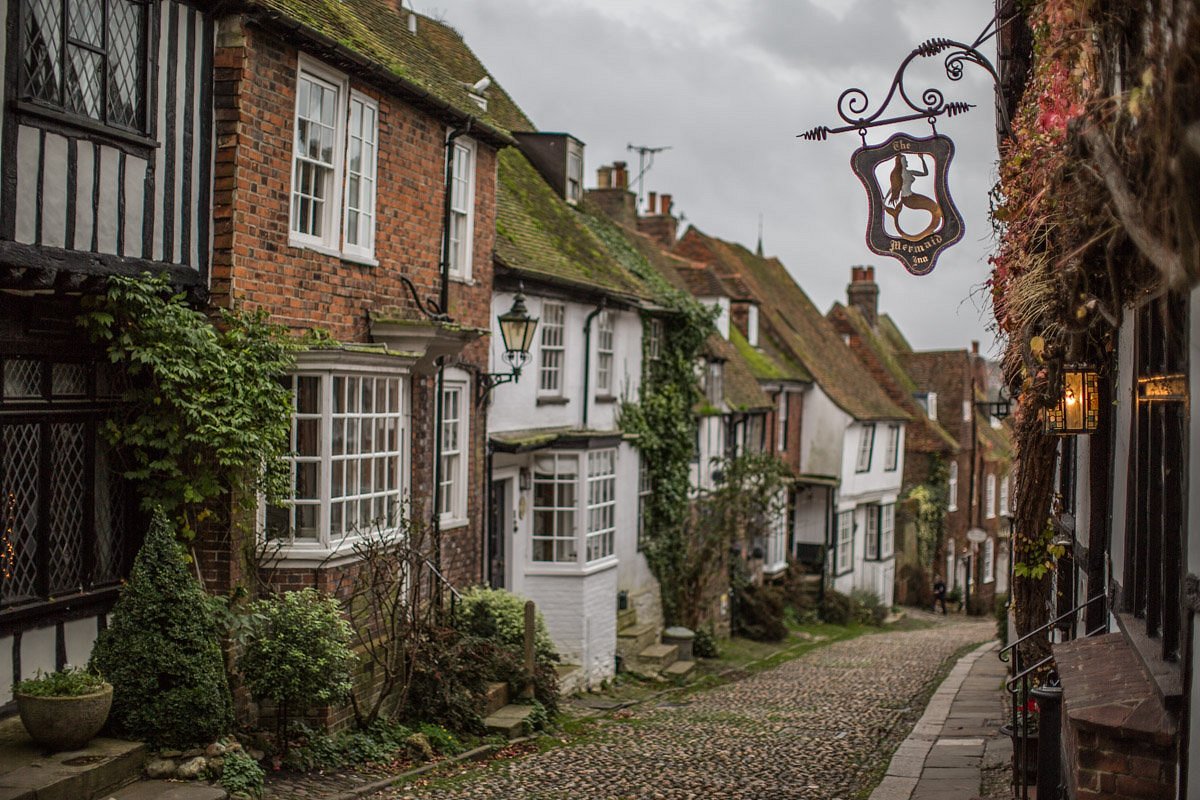
    The Mermaid Inn, Rye, East Sussex (Picture Source: Tony Hisgett / Wikimedia Commons)

    Looking for the origin of stories can reveal a great deal about the individuals, communities, and societies that relay them. I’m interested in the nuts and bolts of tales. Frequently, I want to find the stories behind the stories about mediaeval buildings.

    The origins of some of the myths that I’ve looked at on the blog probably lie in the more distant past. Secret passage rumours at Stone Priory (Staffordshire) have been repeated since at least 1719. The belief that ship timbers were very commonly reused on land has some limited basis in the practises of coastal populations from the later eighteenth century. The idea that stonemason’s marks were akin to artist’s signatures seems to have a source during the nineteenth century.

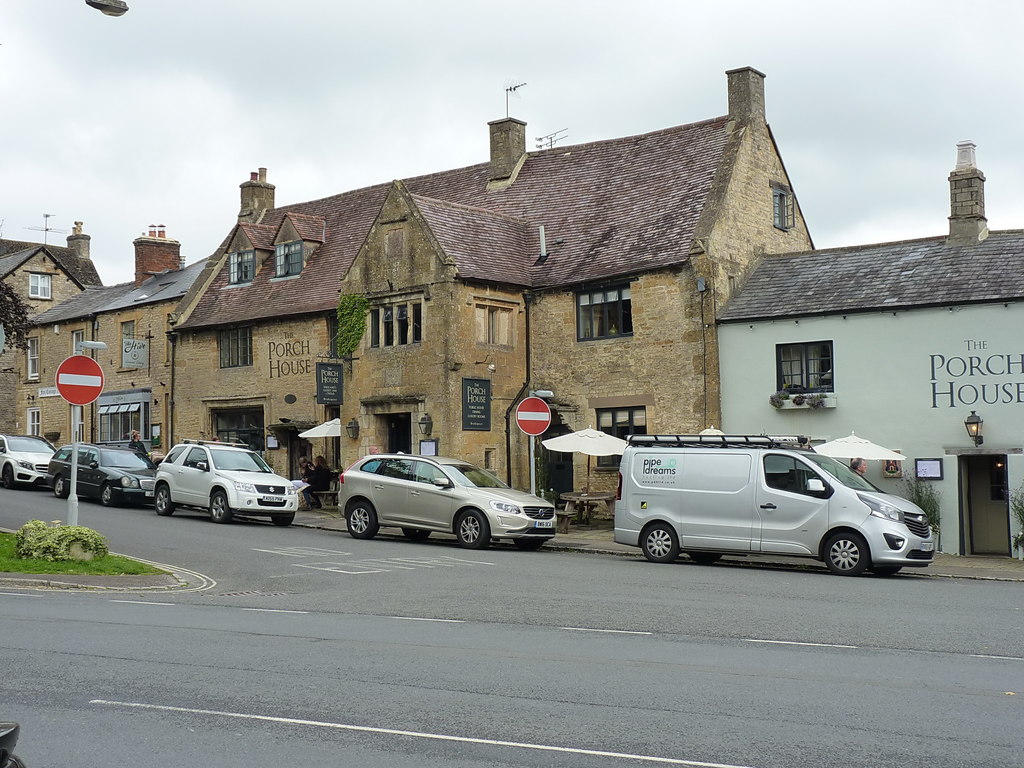
    However, many of the myths about buildings could have much more recent, and perhaps financially driven, sources. For example, I’ve looked at the claims to antiquity made by the licensees of some pubs which may be linked to marketing strategies. The assertion that the Mermaid Inn at Rye (East Sussex) dates to 1156 and 1420 seems to have first been made during a promotional campaign after the pub changed hands in the mid-1990s. Similar stories may have been developed by the incoming licensees at Sean’s Bar (Athlone, County Westmeath, Ireland) and Porch House (Stow-on-the-Wold, Gloucestershire). In all three cases, the claims that the buildings had been active as pubs from questionably early dates seem to have emerged very soon after new owners took on the businesses. It is compelling to consider that this could have happened as part of a deliberate scheme to appeal to customers by creating a novel “history” of the property for financial gain.

    The Value of Heritage

    MB Archaeology and Triskele Heritage community outreach project at Old Hall Barn, Dronfield, Derbyshire (Picture Source: James Wright / Triskele Heritage)

    Establishing heritage offers the possibility of profit. Using the latest available data, gleaned during 2022, Historic England have estimated that the heritage sector contributes approximately £44.9 billion in Gross Value Added to the British economy. They concluded that: ‘The economic value of heritage stems from various sectors and subsectors; from archaeology and conservation, to hospitality, construction, and public services.’

    Many individuals, companies, and organisations take their responsibilities to heritage seriously and offer factually accurate information to the public based on solid research. However, a significant amount of heritage presentation is inaccurate. Unfortunately, misleading or unverified stories may be part of the business model of a company.

    ‘Publish and be damned!’

    Bingley Arms, Bardsey-cum-Rigton, West Yorkshire (Picture Source: Ian S / Wikimedia Commons)

    Heritage stories are popular in the media and there is an understandable expectation that traditional media outlets, such as newspapers and television stations, will fact-check rigorously. Many organisations claim to make a virtue of their accuracy. For example, the Yorkshire Evening Post are signed up to the Independent Press Standards Organisation’s Editor’s Code of Practice. They promise that ‘When alerted to errors, we should correct the record promptly and transparently’.

    Sadly, this has not been my experience with the Yorkshire Evening Post. In March 2023, they published an article which claimed that the Bingley Arms at Bardsey-cum-Rigton (West Yorkshire) ‘has stood strong for over 1000 years, dating back to sometime between AD 905 and AD 953’. Furthermore, ‘it was utilised as a hiding place for Catholic priests and those threatened by the Dissolution of the Monasteries in 1536.’ I contacted the newspaper several times, via their recommended channels, to offer a fully referenced debunking of the claims. The building probably dates to no earlier than the mid-eighteenth century and does not seem to contain any priest hides. Yet my communications were completely ignored. So much for journalistic integrity and promises to abide by a code of conduct.

    The claims that the Bingley Arms is a tenth century building did not originate in a peer-reviewed archaeological journal article. Instead, they seem to have first appeared in The Sun newspaper (4 November 1979, page 12). There is possibly no evidence to back up the story. We might ask if The Sun – a paper with a questionable history of publishing misleading stories – is even a reliable source? However, with the story established, it may be that the later licensees of the pub have been playing along because the claims potentially give them an advantage for drawing in customers.

    Meanwhile, a partisan local media, such as the Yorkshire Evening Post, may also have much to gain by repeating the story. As a commercial media outlet, with a strong online presence, much of the business model of the newspaper may be largely driven by advertising, subscriptions, and sponsored content. The published stories must be eye-catching to attract readers. Once the newspaper has been bought, or the article clicked, the reader is essentially exposed to paid for content. It is in the financial interest of the media outlet to sensationalise stories to justify their revenue – the more sales or clicks for the story, the greater the reach and the bigger the revenue. It’s an old game in a new world.

    It’s not just local media that may have sensationalised heritage. In February 2022, it was announced that The Fighting Cocks at St Albans (Hertfordshire) was ‘forced to close after 1,229 years’ of service. National media, including the Daily Mail, picked up the story uncritically. So did international outlets such as The Washington Post. This was a big scoop. ‘Britain’s oldest pub’ – alleged to have been established in 793 – was closing. There does not seem to have been room in the copy to include fiddly details such as fact-checking based on research. The pub historian Jon Mein has demonstrated that The Fighting Cocks began life as a monastic dovecote, dated c 1400, which was re-sited for use as a domestic house around 1600. It was open as an alehouse, known as The Three Pigeons, by 1756 and was called as The Fighting Cocks by 1806. The claims to be an early mediaeval pub did not begin to appear until a marketing campaign in the 1890s (Wright 2024, 174-75). The closure of an obscure eighteenth century alehouse was probably never going to attract those all-important clicks so, it seems, there was no need for fact-checking.

    Auntie Beeb

    The industrial water conduit at Tintern, Monmouthshire (Picture Source: Western Power Distribution)

    If we take away the immediate financial incentive out of sales and clicks – by removing advertising, subscriptions, and sponsored content – does this improve the accuracy? Unfortunately, it seems this may not be the case. If the publicly funded BBC can opt for a spooky, mysterious, or arcane headline they absolutely will. Their journalists have an especial fascination with secret passages. In March 2021, the BBC reported on a ‘secret medieval tunnel’ at Tintern (Monmouthshire). This turned out to be an industrial water conduit for a post-mediaeval mill. In May 2023, Auntie Beeb went for ‘House over Reformation tunnel goes on the market’ at Fowlmere (Cambridgeshire). Further research demonstrated that the ‘Reformation tunnel’ was probably some chalk adit mines.

    My favourite BBC example comes from July 2006. The hapless national broadcaster reported on ‘Man’s bid for Holy Grail search’ in tunnels alleged to lie beneath Lincoln Cathedral. If the journalist had considered the story in any depth, they would have realised that the claims for the Holy Grail to be hidden below Lincoln originated just a few short months after the release of the film of Dan Brown’s The Da Vinci Code. In the movie, Lincoln Cathedral featured as a location in an imagined story about the hunt for the Holy Grail. The plot seems to have inspired local speculation which the BBC then reported uncritically.

    Is this just innocent fun, though? Potentially not. It is a matter of public record that: ‘Trust is the foundation of the BBC – we’re independent, impartial and truthful’.  Yet, as an organisation supported by the licence payer, the BBC also has an imperative to ensure its content has sufficient reach to justify its funding. Consequently, the decision to uncritically publish dubious stories about secret passages may once again be driven by clicks despite an Editorial Policy which claims to prize accuracy. Its both maddening and saddening.

    Mitigating Circumstances?

    The Four Crosses, Hatherton, Staffordshire (Picture Source: Row17 / Geograph)

    Perhaps I’m being cynical. Are there sometimes mitigating circumstances for the inaccurate presentation of heritage by landowners, journalists, and other content creators?

    In late October 2013, The Independent published a piece about The Four Crosses at Hatherton (Staffordshire) under the headline ‘Britain’s most haunted pub goes on sale in time for Halloween’. It included the following claims: ‘The pub was built in 1636 as a coaching inn from shipping timbers almost 1,000 years old, according to Haunted Rooms, and several secret passages have been discovered within the building during the twentieth century.’ It seems that the only accurate statement here is that the building probably does date to 1636. The rest is likely unfounded hearsay.

    How might such errors have been made? Probably through the nature of the story itself – a quick seasonal piece about a haunted pub for the Halloween period. The journalist was a digital reporter hired to create relentless popular copy to drive website clicks. It seems inevitable that the hard-pushed writer probably did not have time in the budget for much fact-checking as deadlines were looming.

    The inaccurate data was lifted entirely from the Haunted Rooms website – which is usually the first result that comes up on an internet search for the building. Haunted Rooms is a company that sells paranormal experiences in ancient buildings. Historical accuracy may not be the driving force behind this commercial enterprise, whereas creating an intriguing and spooky ambiance seems to be part of the business plan. Reference to ship timbers and secret passages is exactly the right sort of atmosphere to complement a paranormal experience. A busy journalist seems to have mistakenly trusted an unreliable source and repeated what may be inaccurate information as fact.

    Unfortunately, fact-checking may even be overlooked by historians creating online content. The story that all castle spiral staircases turned clockwise to advantage right-handed defenders is a simple tale that can be relayed quickly and easily. Yet it has also been thoroughly debunked. However, the historian and social media content creator, Alice Loxton repeated this story in October 2022, via a monetised TikTok account, to approximately 881.8K followers. The video went viral. Similar happened when an anonymous man on the Knockderry Castle Instagram account also explained the story in May 2024. Fifteen months on and that video has garnered 686, 782 “likes”.

    Knockderry Castle and Alice Loxton’s followers expressed agreement with the spiral staircase story in their comments under the videos. This probably happened because the popular tale confirms what most people understand about mediaeval castles – that they were military defensive fortifications. However, this is a questionable assertion that I have looked at on the blog previously. I have attempted to contact both Alice Loxton and Knockderry Castle to discuss their inaccurate content but neither has responded or edited their videos.

    Perhaps we can give some social media content creators the benefit of the doubt? Their online reach is generally a good thing for the heritage world. They are putting British history in front of a worldwide audience. The factual errors are unlikely to be malicious and are probably accidental. In repeating a story that is “common knowledge” it may not have occurred that incorrect information was being passed on. When producing significant quantities of viral videos fact-checking may be a limited priority.

    Hmmm. Not sure that justification stacks up.

    The problem is that when repeated by a media outlet, a historian, or a heritage attraction the stories were put into the public domain by apparent trustworthy figures of authority. The result is that the tales have garnered a certain level of respectability and legitimacy by association. Fact-checking resources are out there, and it is genuinely the responsibility of content creators to use them. Equally, there is a responsibility to respond, and edit where appropriate, when inaccuracies are brought to light. Unfortunately, I think that the mitigating circumstances might have vanished. Ultimately, the truth matters and should not be rejected due to tight deadlines, revenue streams, and virality. Such decision-making pushes us into a post-truth environment where the rapid creation of monetised content rejects accuracy for the clicks.

    Pseudo-archaeology

    Sinai House, Burton-on-Trent, Staffordshire (Picture Source: Historic Houses)

    Potentially, there may also be an even darker aspect present. It is entirely possible that the deliberate spread of unverified claims, fabrications, and conspiracy theories could be cynically harnessed for financial gain. One monetised organisation with a dubious reputation for spreading misinformation is Ancient Origins. They claim to: ‘highlight the very latest archaeological findings, peer-reviewed academic research and evidence, as well as offering alternative viewpoints and explanations of science, archaeology, mythology, religion and history around the globe.’ Here we see ‘peer-reviewed academic research’ given equal weighting to ‘alternative viewpoints’. That is a major red flag.

    Those ‘alternative viewpoints’ may come across as speculative through to distinctly suspect. For example, the posts made by Ancient Origins betray a wild fascination with the Knights Templar. One theory that they have popularised is that the Templars were founded by ‘a wave of European royalty descended from Jewish Elders that had fled the Holy Land around 70 AD, when it was invaded by the Romans.’ Elsewhere, Ancient Origins have speculated that the Templars were the guardians of the Holy Grail, Ark of the Covenant, and the Ten Commandments. In another article, it is claimed that the treasures of the Templars were deliberately hidden at locations including Rosslyn Chapel (Scotland), Oak Island (Canada) and Bornholm (Denmark).

    Such esoteric conspiracy theories about the Templars are widespread. They were first introduced by German Freemasons in the 1760s to justify and legitimise their own activities as the apparent successors of Templar knowledge. This narrative later came to prominence due to criticisms levelled by the historian Joseph von Hammer-Purgstall in the 1810s. By the later part of the century the popular connection between the Templars and esoterica, including the Holy Grail, had become established. This undercurrent of belief eventually went mainstream in 1983 with the publication of Michael Baigent, Richard Leigh and Henry Lincoln’s The Holy Blood and the Holy Grail. This book later formed the basis for Dan Brown’s novel The Da Vinci Code. Since the release of these bestsellers, the Templar historian Helen Nicholson (Cardiff University) has noted that: ‘Many ‘discoveries’ about the Templars have followed, many of which are little more than fantasy, with less basis in actual historical events than most historical novels’ (Nicholson 2010, 268-72).

    The reach of Ancient Origins is significant. As of August 2025, their followers numbered 24.6K, on Youtube, 38.3K on TikTok, 325K on X (which I still prefer to call Twitter), and 1.3 million on Facebook. And there lies a great problem. The reach of clickbait accounts, peddling what may well be pseudo-archaeology, is much greater than those trying to counter the misinformation. Twitter may be a platform in decline, but what appears to be a pseudo-archaeology account – Historic Vids – still has a staggering 5.5 million followers. Meanwhile, my fellow mythbuster, the Fake History Hunter has a relatively modest 269.8K followers and I am languishing with just 16.6K followers.

    We live in an age when the widely-discredited journalist Graham Hancock received a reported 25 million viewing hours in a single week for his Netflix series Ancient Apocalypse. In this series, Hancock peddled stories, which have been entirely debunked, of how non-European civilisations were taught to construct impressive structures by a technologically advanced culture of white people which survived an Atlantean-style flood. Furthermore, Hancock’s profile has been given further boost by no less than twelve appearances on the Joe Rogan Experience. This is currently ranked, globally, as the most listened to podcast with followers numbering 14.5 million on Spotify, 16.4 million on Youtube, and 18.9 million on Instagram. The truth is being outstripped by pseudo-archaeology.

    Meanwhile, what were once fringe beliefs have apparently become conventional. In July 2021, the enduring fascination for tales of hidden tunnels and the Templars was demonstrated by The Daily Star in a front page article that proclaimed ‘Raiders of the Lost Park – Holy Grail and lost Ark of the Covenant hidden under a crumbling country estate in, er, Burton-on-Trent’. In reality, this claim was probably not true and I attempted to debunk it in the Mediaeval Mythbusting Blog #9. The real concern is that the story went so far.  Not only was it picked up by a national tabloid newspaper, it was also run as the front-page headline. There was no real attempt to fact-check, to critically evaluate, or to consult dissenting voices. The piece was published as if there was never any doubt about its accuracy. The article comes across as pure pseudo-archaeology, worthy of Ancient Origins or Graham Hancock, yet it was being reported as the lead story by a national newspaper. Pseudo-archaeology has become mainstream and is entirely monetised. We must be very careful who we can trust.

    Conclusions

    Ye Olde Trip to Jerusalem, Nottingham (Picture Source: James Wright / Triskele Heritage)

    There seems to be a culture present in which misinformation about ancient buildings can be spread, consciously or unconsciously, through traditional media, social media, and a hybrid of both. When there is criticism of the stories it is often lost due to the overwhelming reach of the organisations pumping the stuff out or to lax editorial policy. Unfortunately, there are some apparent figures of authority who have repeated dubious stories. This muddies the water by giving them a sheen of respectability which can then be used against those who base their work on painstaking research: ‘Well, [insert: media outlet / historian / content creator / heritage attraction] said its true, so it must be!’

    This has left a knowledge vacuum where businesses can apparently run off the back of stories that may not be true. Now, stories are not inherently bad, and folklore is a deeply valuable cultural resource. However, many of the tales seem to have suspiciously recent origins and may have been cynically concocted to create an atmosphere conducive to drawing in the punters.

    I really hope that, over the last five years, this blog has helped to illustrate that the truth is out there. It genuinely is possible to track down verifiable histories for ancient buildings. The problem is that the evidence is often buried below a deep layer of pseudo-archaeology and lazy repetition of myths. Algorithms are designed to boost the superficial, the outrageous, and the eye-catching. AI is only making this trend worse. Expert and specialist voices are underrepresented in search results – frequently hidden far down in the rankings. Equally concerning is a trend in social media comments, a kind of anti-intellectualism, which instantly dismisses learning, research or academic study out of hand.

    Despite all this, there has been a relatively effective rear-guard action from the heritage community. The archaeologist David Connolly has recently published a superb challenge to pseudo-archaeology via the British Archaeology Jobs and Resources platform. It has been encouraging to see fact-checking by, the historian, Jo Hedwig Teeuwisse go viral and that her book Fake History – 101 Things That Never Happened became a bestseller. Meanwhile, since the publication of my book Historic Building Mythbusting, I have been amazed to see that Greene King have rowed back on claims that Ye Olde Trip to Jerusalem in Nottingham dates to 1189. Instead, the pub’s website now acknowledges a lack of evidence for that claim and goes on to outline the verified history of the building. The fightback against pseudo-archaeology is underway, but it remains to be seen if we can close the floodgates.

    Ultimately, I love knowledge, research, and learning. I’m also entirely fallible myself but have tried hard to accept a well-crafted argument which counters my own views. It is important to take on board criticism and to push for accuracy. The truth matters. Buildings matter. Let’s get the story straight… whether there is money involved or not.

    Acknowledgements

    This blog is not monetised. It doesn’t aim to be clickbait. No one is funding it in the furtherance of an agenda. However, I did write a book which was based on the blog. It is called Historic Building Mythbusting. It would be great if you considered reading it. I don’t mind whether you download it, buy it from a shop, or borrow it from a library. Please, just do it legally and respectfully 😊

    References

    Nicholson, H., 2010, The Knights Templar. Robinson. London.

    Wright, J., 2024, Historic Building Mythbusting – Uncovering Folklore, History and Archaeology. The History Press. Cheltenham.

    About the author

    James Wright is an award-winning buildings archaeologist. He has two decades professional experience of ferreting around in people’s cellars, hunting through their attics and digging up their gardens. He hopes to find meaningful truths about how ordinary and extraordinary folk lived their lives in the mediaeval period.

    He welcomes respectful contact through email or on TwitterInstagram & Bluesky

    The Mediaeval Mythbusting Blog is the basis of the book – Historic Building Mythbusting – Uncovering Folklore, History and Archaeology which was released via The History Press in June 2024. More information can be found here:

  • Mediaeval Mythbusting Blog #30: Some Thoughts on Cellars

    Mediaeval Mythbusting Blog #30: Some Thoughts on Cellars

    15 July 2025

    Recently, I have been clearing out the junk-ridden cellar of my home in Nottingham. This has helped to focus my mind on the underground elements of houses. Generally, my interest in domestic cellars has been a tad muted. In most cases, they offer relatively little information about the dating and development of historic houses. Consequently, this blog will do something slightly unusual – I am going to challenge and mythbust myself.

    An Overfamiliarity?

    My apparent indifference toward cellars can bewilder and even disappoint clients who are keen and excited to show me their underground world. For many landowners the awe shown towards cellars may be connected to a sense of mystery, perhaps a hint at fears of the dark, or the simple romance of an underground space. As most people do not spend a lot of time in their own cellars (let alone those belonging to others) this sense of awe remains intact.

    Meanwhile, after 20+ years of working in ancient buildings, my own judgement of subterraneous spaces had become clouded by over-familiarity. When I survey a cellar, I usually trudge down the steps to look at the foundations of a chimney stack, note the presence of a segmental-arched brick vault or the underside of the floorboards, and have a quick look at the stillage (a raised platform that was usually for keeping barrels on). My formerly lacklustre response to cellars may have come across as jaded to most people.

    Dating a Cellar

    Ye Olde Salutation Inn, Nottingham (Picture Source: James Wright / Triskele Heritage)

    For many, there is an assumption that the cellar must be the oldest part of the property therefore it is the most exciting bit. Potentially, it could even be older than the structure standing above ground. Sometimes this is true. The entrance to the double basement underneath Ye Olde Salutation Inn at Nottingham is blocked by the  timber-framed structure above (Waltham 2018, 18-19).  Attempts have been made by the pub’s licensees to state that the origins of the cellars lie in the fifth or the ninth century (Mooney 2019, 24-25). However, all that can be confidently said is that they pre-date the standing building; which has been tree-ring dated to c 1440.

    Most cellars were conventionally excavated during construction projects for the building above. Recently, I surveyed Lydes House at Great Malvern, Worcestershire. Here, the cellar was found directly beneath the earliest standing part of the house, a cruck-framed bay dated 1447-77 (Bridge 2021). Although cellar and cruck frame were probably contemporary analysis of the former added very little to the knowledge of the latter. The significant evidence for the date of the building came from its above-ground structure.

    Sometimes, basements are excavated when a pre-existing building is already standing. I once worked on a planning application for an eighteenth-century house at Hampstead, London, where the landowners wished to extend the cellar to create a “man cave”. This type of project is rare, due to planning, financial and engineering issues.  

    The Inevitable Secret Passage Rumour

    The author (right) examining the cellars of the Star Inn at Guildford with local historian Sophie Garrett (centre) and the licensee Pip (left) (Picture Source: James Wright / Triskele Heritage)

    One of the reasons that I may have come across as world-weary, regarding cellars, are the well-trodden rumours that they contain the entrance to secret passages. This is something that I’ve looked at many times on this blog and again in my book, Historic Building Mythbusting, so I won’t delve into this folklore too much again. Suffice to say that stories of hidden tunnels, built to facilitate covert access or secret escape, that wind miles under the landscape are usually unverified.

    I could find no trace whatsoever in the cellar of The Star Inn at Guildford, Surrey, of the tunnel rumoured to connect with the parish church of Holy Trinity. In Essex, I was shown a feature purported to be the entrance to a secret passage which turned out to be a small stormwater drain just eight inches in height. The lengthy passage, now accessible from The Bell Inn at Nottingham, which is said to lead as far as the castle, is really a series of vaults created for Hickling Laing wine merchants around the year 1800 (Waltham 2018, 29-30).

    Pushing Back the Date

    Cellars beneath the North Range of Stone Court at Knole (Picture Source: James Wright / Triskele Heritage)

    Stories aside, sometimes there can be elements of real intrigue within cellars. It is by considering these pieces of evidence that I have been able to lighten up a little. During an inspection of the Old Rectory at Teversal in Nottinghamshire, which is largely early eighteenth century in date, I spotted a cambered timber reused as a spine beam to support floor joists in the cellar. It may have originated as a tie beam in a mediaeval timber-framed house. Now we’re talking.

    In 2018, I was asked to look at the basements underneath Kelham Hall, also in Nottinghamshire. The Neo-Gothick building dates mostly to the mid-nineteenth century. However, at least three earlier phases of the hall, none of which remain standing above ground, were identified within the cellars (Beresford 2019, 39-56).

    A detailed survey of the basement beneath the North Range of Stone Court at Knole, Kent, has helped to revise the dating and understanding of the early planform of the house. Based on extant wall paintings, the basement was formerly thought to date to the 1460s expansion of the house under Archbishop Thomas Bourchier (Oxford Archaeology 2010, 4). However, a more recent survey by Triskele Heritage concluded that doorways dating to the primary phase of construction, which had been blocked during the 1460s expansion of the site, pointed to an earlier date of origin for the basement. This was interpreted as having taken place during the 1440s when the house was being developed for Sir James Fiennes, the Lord Treasurer of England. The basement may have been part of a great house which was planned to have at least three courtyards from the outset (Wright 2022, 20-21).

    By the 1460s, the basement at Knole probably functioned as a buttery cellar or lesser hall – essentially a drinking den for members of the household. Perhaps it was this connection with drinking that has also helped to renew my interest in cellars.

    Drinking and Status

    Undercroft below the great hall at Wingfield Manor, Derbyshire (Picture Source: James Wright / Triskele Heritage)

    I write ‘renew my interest in cellars’ because I grew up in an 1850s Staffordshire public house. It had a two-room cellar beneath the main bar that was accessed via a hatched drop in our back yard. Within, the ceiling was low, the lighting was dim, and there was an ever-present aroma of malted barley and hops. To a small boy it was a compelling and exciting space. I was even slightly frightened by it – especially when down there, at 6.30am, loading bottles into crates to earn my pocket money.

    Thinking again about cellars, there has been a growing realisation that some of the most impressive underground spaces that I have seen were mediaeval wine cellars. At 34 metres in length, the sheer scale of the excavated wine cellars at Clarendon Palace, Wiltshire, is staggering (James & Robinson 1988, 116-19). Meanwhile, the quality of the thin-bedded ashlar in the wine cellar at Leicester Castle is some of the finest stonemasonry that I have seen in any context.

    Anthony Emery (1985, 292) was convinced that the mid-fifteenth century undercroft below the great hall at Wingfield Manor, Derbyshire, was a lesser hall akin to the North Range basement at Knole. However, others, such as Pamela Marshall (pers. comm.), have suggested that it was more likely to have been a wine cellar. If that is the case, then Wingfield’s patron – Ralph Lord Cromwell – may have taken great pride in the wines available at his house because the potential cellar is decorated with finely moulded vaulting and sculpted bosses.

    The communication between cellars and the spaces above was an important part of the social organisation of elite architecture. For example, it has been noted that in the great tower at Warkworth Castle, Northumberland, the beer cellar had a stair connecting it to the buttery at the low end of the hall. Meanwhile, the wine cellar had a stair communicating directly with the high end of the hall (Goodall 2006, 19). Beer for lower status drinkers, wine for the elites.

    The evidence from Clarendon, Leicester, Warkworth and, perhaps, Wingfield suggests that the wines kept by English mediaeval elites necessitated an elaborate housing. These were places meant to be seen. It may be that guests were even shown the cellars as part of lordly status display.

    Everyday Drinking

    Cellar beneath Greasley Castle Farm (Picture Source: James Wright / Triskele Heritage)

    So, with my interest in cellars reignited by thoughts of drink (such a cliché for an archaeologist of a certain vintage, I know), perhaps the time has come to reconsider some of the other cellars that I have looked at over my career. For example, the mid-nineteenth century patrons of a house at Cathedine, Powys, were concerned about the security of their wine collection as the numbered bins were kept locked behind a stoutly reinforced steel door. Elsewhere, I’ve seen so many stillages during surveys, including the one at Greaseley Castle Farm, Nottinghamshire, that we must recall the strong preference for the drinking of ale and beer in the pre-modern age.

    Incidentally, and very much on brand for this blog, there is a persistent myth that folk drank only ale with such frequency during the mediaeval period because they were frightened that the water was unsafe (for example: Picard 2017, 68). Although some physicians warned that the consumption of such a cold beverage may cause melancholy humours, scientific reasoning was not sufficiently advanced to cause concerns over microbial infection. It was certainly understood that some sources of water were inherently unsafe – fenlands, standing water or streams and rivers close to settlements – but there were plenty of solutions available including drinking water from springs, digging deep wells and piping in water to settlements from safe sources (Salzman 2012, 80-81). Conduits and fountains were a relatively common sight, especially in the urban environment. It is true to say that water was considered a lower status drink than ale or wine but there were also several mediaeval tracts which praised the many health-giving and spiritual benefits of its consumption. The devotional aspect of water must not be underestimated, with water playing a strong role in church life through the rite of baptism, transubstantiation and the popular reverence for holy wells and springs (Salzman 2012, 165-69).

    The reality is that ale was favoured, not because the water was bad but, due to its refreshing calorific content, the great taste, and because of the tremendous buzz that the drinker glories in (Bruning 2014, 16-17). The suspicion that ale was only so popular because the water was unpotable smacks of the moralising temperance of the Victorian world, which was also filled with citizens desperately concerned about the cholera epidemics (spread by infected water) which were unknown to mediaeval Europe.

    Conclusions

    Base of a cheese press within the cellar of the Old Rectory at Teversal, Nottinghamshire (Picture Source: James Wright / Triskele Heritage)

    So, it really is time for me to look again at the world beneath our feet. I now appreciate that, in my line of work, I have encountered some quite startling finds below ground – a mediaeval monastic vault beneath an eighteenth-century house at Stone, Staffordshire; a natural spring at Wollaton Hall, Nottinghamshire; and a 30-metre-long service passage linking the basements of two towers at Ashby Castle, Leicestershire (Wright 2024a, 14-16, 26-27, 29).

    Yet, I believe that the real joy lies in understanding that the archaeology of cellars usually represents ordinary daily life. Routinely these are features associated with the storage of drink such as beer stillages and wine bins. Alternatively, they may incorporate structures connected to food preparation and storage such as the base of a cheese press found in the cellar of the Old Rectory at Teversal, the cold store at Strelley Hall, or the potential icehouse at Greaseley Castle Farm (all in Nottinghamshire).

    During the post-mediaeval industrial period, cellars gained a new function when coal replaced firewood as the primary method for heating homes. Coalholes were inserted at ground level so that the new fuel could be delivered directly into cellars. This happened to the cellar, which was probably constructed around 1600, below a cottage at Fen Ditton in Cambridgeshire (Wright 2024b, 17).

    As time wore on new build houses were routinely constructed with coalholes integral to the cellar. In the modern age they are now mostly redundant. However, I have just rediscovered the one in my cellar, dated c 1895-99, during the recent clear out. This served as a close reminder to try and reconnect with the wonder of the everyday lived realities of the past which can be sensed in cellars.

    References

    Beresford, M., 2019, Kelham Revealed! Archaeology Report. Unpublished archaeological report. MB Archaeology.

    Bridge, M., 2021, Dendrochronological Dating of Oak Timbers at Lydes House, 392 Pickersleigh Road, Malvern. Unpublished archaeological report. Oxford Dendrochronology Laboratory.

    Bruning, T., 2014, Merrie England – The Mediaeval Roots of the Great British Pub. Bright Pen.

    Goodall, J., 2006, Warkworth Castle and Hermitage. English Heritage. London.

    James, T. B. & Robinson, A. M., 1988, Clarendon Palace – The History and Archaeology of a Medieval Palace and Hunting Lodge near Salisbury, Wiltshire. Society of Antiquaries of London. London.

    Mooney, D., 2019, Nottingham Pubs. Amberley. Stroud.

    Oxford Archaeology [Forde, D.], 2010b, Knole Cellars in Stone Court, Sevenoaks, Kent – Building Investigation and Record. Oxford Archaeology. Unpublished archaeological report.

    Picard, L., 2017, Chaucer’s People – Everyday Lives in the Middle Ages. Weidenfeld & Nicolson. London.

    Salzman, J., 2012, Drinking Water: A History. Overlook Duckworth. New York and London.

    Waltham, T., 2018 (4th ed.), Sandstone Caves of Nottingham. East Midlands Geological Society.

    Wright, J., 2024a, Historic Building Mythbusting – Uncovering Folklore, History and Archaeology. The History Press. Cheltenham.

    Wright, J., 2024b, Honeysuckle Cottage, 6 High Ditch Road, Fen Ditton, Cambridgeshire – Historic Building Assessment. Unpublished archaeological report. Triskele Heritage.

    Wright, J., 2022, The North Range Basements at Knole: Archaeological Historic Building Survey. Unpublished archaeological report. Triskele Heritage.

    Acknowledgements

    The section on why people drank so much ale during the mediaeval period is slightly adapted from: Wright, J., 2024, Historic Building Mythbusting – Uncovering Folklore, History and Archaeology. The History Press. Cheltenham. pp161-62.

    About the author

    James Wright (Triskele Heritage) is an award-winning buildings archaeologist who frequently writes and lectures on the subject of mediaeval building myths. He has over two decades professional experience of ferreting around in people’s cellars, hunting through their attics and digging up their gardens. He hopes to find meaningful truths about how ordinary and extraordinary folk lived their lives in the mediaeval period.

    He welcomes contact through email, TwitterInstagram & Bluesky

    The Mediaeval Mythbusting Blog blog is the basis of a book – Historic Building Mythbusting – Uncovering Folklore, History and Archaeology which was released via The History Press in 2024.

  • Mediaeval Mythbusting Blog #29: Porch House

    Mediaeval Mythbusting Blog #29: Porch House

    2 January 2025

    I’ve written a fair bit about the buildings archaeology of pubs. This blog contains articles looking at the claims to antiquity of places such as Ye Olde Trip to Jerusalem, Bingley Arms and Sean’s Bar. I’ve also contributed a blog for Historic England, an article for History Extra, and there was a viral thread on Twitter last summer. Also, I penned a lengthy chapter on the claims to be the oldest pub in the country in the Historic Building Mythbusting book.

    It has struck me for a while that I should probably have a deeper look at Porch House (formerly the Royalist Hotel) at Stow-on-the-Wold (Gloucestershire) in more detail. This is a site that keeps coming up as a claimant to be the oldest pub in England. There is virtually nothing available about the pub’s history on its website, but the sign hanging over the main entrance to the building says it all: ‘The Porch House England’s Oldest Inn c.947AD’. This claim is repeated, without question, across media outlets too numerous to name, but include Gloucestershire Live, The Daily Telegraph and Exploring GB.

    Porch House signage (Picture Source: The Happy Wonderer)

    Yet Another Oldest Pub Claim

    This is one of those claims that is widely repeated, but it seems quite difficult to get at the source of the data. Mostly, what we are probably witnessing is a lot of circular referencing as one media outlet repeats or links to another. However, there is one, apparently reputable, website which develops the history of Porch House – the Stow and District Civic Society. This is the online presence for an organisation, founded in 1971, which ‘promotes the history and amenities of Stow-on-the-Wold’.

    The Civic Society make the following claims, on behalf of Porch House, which can also be found in other widespread reporting of the building:

    • The site was originally founded as a hospital, in 947, by Athelmar, Duke of Cornwall.
    • A five-bay timber-framed structure was later erected by the Knights Hospitaller
    • The building was enlarged in stone after the Dissolution of the Monasteries, in 1536
    • A stone porch was added by Thomas Shellard in 1615
    • There is a three-foot-deep animal fighting pit under what is now the restaurant
    • It is said to be the oldest pub in England, with timbers that have been carbon dated to approximately 1000 AD.’

    An enquiry to the Civic Society, made by the author via email during the summer of 2022, indicated that the information on their website largely derived from a book entitled The History of the Royalist Hotel by Ruth Stratton. Beyond this email, I have not been able to track down any further reference to the book. However, my correspondent did acknowledge that the author was “inevitably speculative at times” (Stow Civic Society, pers. comm. email, 13/05/2022). Unfortunately, there may be some inaccuracies in the presentation of the pub and it is these possible inconsistencies which will be the subject of this blog.  

    Athelmar’s Hospital

    Tomb of Edward, the Black Prince, at Canterbury Cathedral. Kent (Picture Source: Tilman2007 / Wikimedia Commons)

    There does not seem to have been such a person as Athelmar, duke of Cornwall in the mid-tenth century, who had connections to Stow-on-the-Wold. The Duchy of Cornwall was founded for Edward, the Black Prince, in 1337. It was preceded by the Earldom of Cornwall which went through various ad hoc creations and revivals between 1068 and 1336 (Ormrod 2011, 138). Crucially, there does not seem to have been either an earl or a duke of Cornwall during the early mediaeval period.

    The story of Athelmar was made popular after publication by the Victorian antiquarian David Royce. However, his identification of ‘Ethelmer’s Hospital’ as Porch House was probably plucked out of thin air in a flight of whimsy (Royce 1861, 57; Elrington 1965, 142-65). The traditional belief that Athelmar / Ethelmer granted a hospice at Stow-on-the-Wold cannot be traced any earlier than the seventeenth century. Furthermore, there may have may be a confusion over grants of land at Stow in Lincolnshire by Aethelmaer, ealdorman of Hampshire, to Eynsham Abbey in Oxfordshire (Elrington 1965, 142-65; Baggs et al 1990, 65). The presence of an early mediaeval hospital on the site seems quite suspect.

    Although there does seem to have been a late mediaeval hospital in Stow, it is unlikely to have been connected to either the Knights Hospitaller, who do not seem to have had an interest in the town, or to Porch House. Instead, it was linked to the guild or chantry of the Holy Trinity which was founded in the mid-fifteenth century and then re-founded in 1476 (Elrington 1965, 142-65).

    The notion that there was any form of foundation, whether hospital or inn, at the town during the tenth century is also open to question as the settlement did not exist then. Stow-on-the-Wold was not developed as a town until the period c 1086-1107 (Elrington 1965, 142-65; Professor Chris Dyer, pers. comm. email 06/05/2022). Meanwhile, Michael Hare, Honorary Research Fellow at the University of Bristol, has suggested that the date 947 may have been carefully selected to coincide closely with the period of an early documentary reference to the region. This took the form of a land grant to Evesham Abbey, made in 949, which included the area that eventually became Stow-on-the-Wold. However, this was a transaction of open land and makes no mention to any settlement or structure (Elrington 1965, 142-65; Michael Hare, pers. comm. email 06/05/2022).

    Bell tower at Evesham Abbey, Worcestershire (Picture Source: James Wright / Triskele Heritage)

    The selection of a chronicled early date, followed by the apparent assumption that there must have been a pub locally at around that period, is a common phenomenon when looking into the claims to great antiquity of pubs. This was observed with regard to several other businesses in the Ancient Publore blog article on this site, including the Mermaid Inn at Rye (East Sussex), Old Man & Scythe at Bolton (Lancashire), and the Bingley Arms at Bardsey-cum-Rigton (West Yorkshire).

    The real problem, of course, is that a hospital is a significantly different foundation to an inn. Even if it could be demonstrated that there was a mediaeval hospital on the site it would do nothing to back up the claim of Porch House as the oldest inn in the country.

    Buildings Archaeology

    Despite concerns about the alleged connections of the building to Athelmar / Ethelmer / Aethelmaer’s hospital or the Knights Hospitaller, the development of the structure of Porch House can be coherently described. The earliest extant fabric on the site seems to be a timber-framed domestic house, four bays wide, with close-studding to the rear and an open arch-braced collar truss beam between the two eastern bays of the roof structure with queen post trusses recorded elsewhere. This framing has been dated stylistically to the fifteenth or early sixteenth century. In the early seventeenth century, probably 1615 by reference to an in-situ date stone, the street frontage was clad in rubble stonework, a porch was added, and stone chimneys were inserted internally. Further remodelling took place in the eighteenth century when the property was briefly converted into an inn called the Eagle and Child. However, the building did not remain an inn for long and by the end of the century it had been divided into two domestic houses (King 2013, Elrington 1965, 142-65; Pevsner & Verey 1970, 425; National Heritage List for England: 1170376).

    Interior of Porch House (Picture Source: Wiltshire & Gloucestershire Standard)

    I’m not entirely sure when the building became the Royalist Hotel. The Petty Sessions, which included matters concerning licensing, for 1891 and 1903 do not contain reference to a business on the site. The earliest reference to the Royalist Hotel in the British Newspaper Archive is an advertisement for entertainment offered at the property which is dated April 1969 (Birmingham Mail, Tuesday 29 April 1969, page 2).

    The claims that there were animal fighting pits and timbers carbon dated to 1000AD fall into the remit of archaeological research. Such discoveries would ultimately make their way into the catalogues of repositories such as the Archaeology Data ServiceNational Heritage List for EnglandNational Monument Record Excavation IndexHistoric England Research Records, and the Gloucestershire County Council Historic Environment Record. However, none of these databases refer to such archaeological findings at the site. Furthermore, carbon dating is not routinely employed as a technique in buildings archaeology to date extant timbers. So curious was I about this claim that I contacted the Heritage Team Leader at Gloucestershire County Council (essentially the county archaeologist), Toby Catchpole, to find out more. After delving into the archives, he was able to confirm that there not any records of carbon samples being taken from the building or of excavations of animal fighting pits (Toby Catchpole, pers. comm. email 05/05/2022). This is despite the widespread claims to the contrary which can be found across the internet.

    Sales Pitch

    The first reference to the claims of the building, then known as the Royalist Hotel, to be the oldest pub in the country first appeared in a newspaper article in October 1974 (Birmingham Daily Post, Monday 7 October 1974, page 22). The timing is intriguing as the article was concerned with the sale of the business. It is entirely possible that the claim may have been concocted as a marketing strategy based on the premise that history can be a selling point. Prior to this no one connected to the building seems to have made a bid for the title of oldest pub. I’ve encountered such strategies elsewhere. The claims of Ye Olde Trip to Jerusalem at Nottingham to be ‘The oldest inn in England’ were first made during a marketing drive in 1909-10 after the demolition of a much bigger pub next door allowed new prominence for the surviving business. Elsewhere, the claims of the Mermaid Inn at Rye to have cellars dated to 1156, with a rebuild above dated to 1420, seem to have first been made in 1993-94, after the acquisition of the business by the present owners. There is more on both of these businesses in the Ancient Publore Mediaeval Mythbusting Blog entry.

    Ye Olde Trip to Jerusalem, Nottingham (Picture Source: James Wright / Triskele Heritage)

    It is sometimes claimed that Porch House has been accredited as the oldest pub in the country by Guinness World Records. This assertion has been made by the Daily Express and The Sun. Porch House is not alone in being spoken of as a Guinness World Record holder, it has also been said of Ye Olde Fighting Cocks at St Albans (Hertfordshire) and the Bingley Arms at Bardsey-cum-Rigton (West Yorkshire). The issue with the contention is that Guinness World Records no longer maintain a category for oldest pub… anywhere. Although they may once have done so, their website is now completely empty for such a category. They have even confirmed this via their official social media account.

    Ultimately, the claim to be the oldest pub in the country are legion. Most regions have a claimant, and Porch House is the candidate for Gloucestershire. The oldest pub in the county is probably the New Inn at Gloucester, dated to 1432. Meanwhile, on present evidence, the oldest continuously serving, purpose-built, inn in the UK is probably the George Inn at Norton St Philip (Somerset). The latter seems to have been founded during the later fourteenth century. For more on the oldest pub debate, please see my short article for History Extra and my book chapter in Historic Building Mythbusting.

    Conclusions

    Once again, I am leaning into the potential conclusion that the pub in question may not date to the period as claimed and may not be the oldest pub in the country. This has been something of a pattern on the blog! The origin of the claim seems to be a marketing strategy intended to sell on the property in the 1970s. This may have been coupled with pre-existing rumours, possibly based on a misunderstanding, about the presence of an early mediaeval hospital.

    I’ve said this before, but its worth repeating: I think that it is probably a shame that so many pubs are marketed on histories that may not be accurate. It is usually possible to access good, reliable, data about the buildings archaeology and history of a pub. Would it be too much to ask some business owners and other interested parties, including the Stow and District Civic Society, to break the mould and present verifiable histories for these buildings? After all the truth is always more interesting than the rumour.

    Dedication

    This article is dedicated to an online persona “Harry Hawker” who just kept going despite the evidence.

    Acknowledgements

    Header image: Richard Law / Geograph

    Volume 6 of the Victoria County History study of Gloucestershire proved invaluable in reconstructing the history of the town of Stow-on-the-Wold. Diana King’s heritage assessment of the site helped in clarifying some of the details of the buildings archaeology.

    References

    Baggs, A. P., Chance, E., Colvin, C., Cooper, J., Day, C. J., Selwyn, N. & Townley, S. C., A History of the County of Oxford: Volume 12, Wootton Hundred (South) including Woodstock. Victoria County History. London.

    Elrington, C. (ed.), 1965, A History of the County of Gloucester: Volume 6. Victoria County History. London.

    King, D., 2013, The Royalist Hotel, Digbeth Street, Stow-on-the-Wold, Gloucestershire, GL54 1BN – Heritage Asset Appraisal. Unpublished archaeological report. Foundations Archaeology.

    Ormrod, M., 2011, Edward III. Yale. New Haven and London.

    Royce, D., 1861, The History and Antiquities of Stow: A Paper Read in the Assembly Room, Stow, January 31st 1861. T. Clift. Stow-on-the-Wold.

    Pevsner, N. & Verey, D., 1970, The Buildings of England Gloucestershire: The Cotswolds. Penguin. London.

    About the author

    James Wright (Triskele Heritage) is an award-winning buildings archaeologist who frequently writes and lectures on the subject of mediaeval building myths. He has over two decades professional experience of ferreting around in people’s cellars, hunting through their attics and digging up their gardens. He hopes to find meaningful truths about how ordinary and extraordinary folk lived their lives in the mediaeval period.

    He welcomes contact through Twitter or email.

    The Mediaeval Mythbusting Blog blog is the basis of a forthcoming book – Historic Building Mythbusting – Uncovering Folklore, History and Archaeology which will be released via The History Press on 6 June 2024.
  • Historic Building Mythbusting Online Book Launch Events

    Historic Building Mythbusting Online Book Launch Events

    Online book launch events for archaeologist James Wright’s new book: Historic Building Mythbusting

    Go to any ancient building and there will be interesting, exciting, and romantic stories presented to the visitor. They are commonly believed and widely repeated – but are they really true? These stories include those of secret passages linking ancient buildings, spiral staircases in castles giving advantage to right-handed defenders, ship timbers used in the construction of buildings on land, blocked doors in churches which are thought to keep the Devil out and claims to be the oldest pub in the city.

    James Wright will explain the development of such myths and investigate the underlying truths behind them. Sometimes the realities hiding behind the stories are even more interesting, romantic, and exciting than the myth itself…

    The speaker, James Wright (Triskele Heritage), is an award winning buildings archaeologist. He has two decades professional experience of ferreting around in people’s cellars, hunting through their attics and digging up their gardens. He hopes to find meaningful truths about how ordinary and extraordinary folk lived their lives in the mediaeval period. He is the author of the popular Mediaeval Mythbusting Blog and his book Historic Building Mythbusting will be released via The History Press on 6 June 2024.


    There will be two separate online book launch events which will be delivered via Zoom.

    The first event takes place on Thursday 6 June at 14.00 GMT+1.
    Booking is via the Eventbrite link below:

    The second event takes place on Sunday 9 June at 20.00 GMT+1.
    Booking is via the Eventbrite link below:

    Each event will last approximately 90 minutes. The content will be identical at both events – please only book for one or the other! The presentations will be entirely different to any of the in person events on the subsequent book tour.

    This talks are crowdfunded through donation and will be a new bespoke lectures. There is no minimum donation so it is possible to contribute as little or as much as you want. Your donation is your ticket and you will be sent a link to access the event by Eventbrite.

    Please note that these are live events which will not be recorded and made available online afterwards.

    If you have a question about the events – in the first instance please see our FAQs section. The answer will almost certainly be in there.

    If you experience any problems in booking for the events then we suggest logging out and back into your Eventbrite account. If this does not work then please try booking using a different device. If problems still persist then please contact Eventbrite directly.

    Eventbrite recommend using the most up to date version of Google Chrome to access the meetings.

    If have not received the login details on the evening of the event please email james@triskeleheritage.com – this address will be monitored up until the talks begin.


  • Buildings Archaeology in Ten Structures

    Buildings Archaeology in Ten Structures

    The Story of a Career in Ruins

    The vast majority of ancient buildings have never received any meaningful research of any kind. For many this is quite the shock. Despite this, over the last 30 to 40 years, buildings archaeologists have been able to use multi-disciplinary approaches to tease out evidence for the origins, development, phasing, history and significance of structures that are both humble and grand.


    This talk will explain how the study of ancient buildings grew out of the antiquarian movement, was championed in Parliament, and eventually became an essential part of the archaeological world. It will follow research into ten structures including Nine Ladies Stone Circle, Tattershall Castle, The Rose Playhouse, Stone Priory, Strelley Hall and Knole. It will also connect directly with the career of the speaker as he uses buildings that he has personal experience of to explain the ways that we study the archaeology of ancient architecture.

    The speaker, James Wright (Triskele Heritage), is an award winning buildings archaeologist. He has two decades professional experience of ferreting around in people’s cellars, hunting through their attics and digging up their gardens. He hopes to find meaningful truths about how ordinary and extraordinary folk lived their lives in the mediaeval period. He is the author of the popular Mediaeval Mythbusting Blog.


    All you need to do is register via Eventbrite and – when the time for the talk rolls around – grab your favourite beverage of choice, get comfy and enjoy.

    The event will take place at 19:00 GMT+1 on Wednesday 22 May 2024 via Zoom. There will be a talk until approximately 20.15 GMT and then a questions and answer session. It will end around 21.00 GMT.

    Booking is now available via Eventbrite:


    This lecture is crowdfunded through donation. It will be the debut of a new bespoke talk. There is no minimum donation so its possible to contribute as little or as much as you want. Your donation is your ticket and you will be sent a link to access the event by Eventbrite.

    Please note that this live event will not be recorded and made available online afterwards.

    If you have a question about the event – in the first instance please see our FAQs section. The answer will almost certainly be in there.

    If you experience any problems in booking for the event then we suggest logging out and back into your Eventbrite account. If this does not work then please try booking using a different device. If problems still persist then please contact Eventbrite directly.

    Eventbrite recommend using the most up to date version of Google Chrome to access the meeting.

    If have not received the login details on the evening of the event please email james@triskeleheritage.com – this address will be monitored up until the talk starts at 7pm GMT+1.

  • Mediaeval Mythbusting Blog #28: Ancient Pub-lore

    Mediaeval Mythbusting Blog #28: Ancient Pub-lore

    17 April 2024

    Charting the history of ancient public houses is a minefield. On the surface, the owners and tenants of pubs usually offer an apparently straightforward outline of their history on websites, leaflets, or signs. Unfortunately, it may be that some or all of what is relayed to patrons is perhaps not reliably accurate. Despite this, the folklore of pubs, referred to in this piece as pub-lore, is widely accepted as entirely truthful.

    Using several real-world case studies, the purpose of this article will be to look at some common themes in the popular presentation of pub-lore. It will also offer advice on how and where to track down verified information on these buildings.

    The Mermaid Inn, Rye

    The Mermaid Inn, Rye, East Sussex (Picture Source: Tony Hisgett / Wikimedia Commons)

    A pub that repeatedly comes up for discussion online is the Mermaid Inn at Rye (East Sussex). This rather attractive timber-framed building is genuinely mediaeval in date, but some of the claims made about it are perhaps suspect. The official website for the Mermaid asserts that it has cellars which have been very precisely dated to 1156. The website goes on to note that the rest of the original building was destroyed in 1377, during a French raid, and was rebuilt in 1420.

    On the face of it, the story seems quite reasonable. There genuinely are vaulted cellars of mediaeval appearance beneath the Mermaid and they do pre-date the timber-framed building above. Equally, there really was a French raid on 29 June 1377 which left much of the town in smouldering ruins (Chazaud 1876, 71-2). Yet the commonly believed and repeated tales about the Mermaid can be called into question.

    The year 1156 is mentioned repeatedly across the internet. It can be found via Rye Town Guide, Kent Live, Daily Telegraph, Vintage News and Wikipedia. The problem is that none of these outlets offer a source for the information. Even Wikipedia’s citations collapse as the given source is a popular book about ancient pubs in Sussex… which itself does not offer the origin for the 1156 claim (Stuart 2005, 130). It seems that the various books and media outlets reference each other.

    Meanwhile, experienced historic building specialists point to the Mermaid’s cellars being a little later in date. The listed building description (first collated in 1951 and last amended in 1968) notes that the cellars date from the thirteenth century. Nikolaus Pevsner and Ian Nairn agreed with this attribution (Pevsner & Nairn 1965, 598). Meanwhile, Historic England’s research records point towards the cellar being thirteenth to fifteenth century in date based on work carried out by the Rape of Hastings Architectural Survey (Martin & Martin 1980).

    It is not disputed that the cellar is mediaeval – it demonstrably is. However, the very specific date of 1156 can be queried given a general lack of evidence and the later appearance of the architecture. Instead, it is suggested that the year 1156 may have been proposed to coincide with the period of Henry II’s Cinque Port charters which were granted in 1155-56 (Poole 1951, 433). Yet whoever potentially made this connection may have misunderstood the primary evidence as Rye was not formally incorporated as a Cinque Port until 1190 (Burrows 1892, 63; Hollway 1848, 4-5).

    The proposed rebuilding of 1420 has been repeated by lots of organisations including WhatPub, Haunted Rooms, Cool Places UK, The Independent, and Exploring GB. Once again, the evidence to back up the claim seems to be lacking. Given that the French raid took place in 1377, it is difficult to speculate why this particular year was chosen or why the plot of land was supposedly left empty for 43 years. Additionally, the architectural experts who have looked at the building have concluded that the Mermaid Inn was probably built even later – to the extent that there may not even be a connection to the raid of 1377. The listing description assigns the rebuilding to the late fifteenth century. Pevsner and Nairn (1965, 598) put it at c 1500. Martin and Martin (1980) concluded that a late mediaeval structure was extensively remodelled c 1530 and then extended c 1570-80. Although there is some limited room for debate, the specialists have all concluded that, on stylistic grounds, the Mermaid dates from the late fifteenth to early sixteenth century, with later remodelling,.

    The identification of very specific dates for construction, such as 1156 or 1420, can only be arrived at if there are good documentary sources available, or if the timber-frame has been successfully sampled for dendrochronology. However, neither piece of evidence is present in the case of the Mermaid, which has cellars broadly dated to the thirteenth to fifteenth century and a timber-frame from the late fifteenth or early sixteenth century.

    Dating Claims

    Sign at the Bell Inn, Nottingham (Picture Source: James Wright / Triskele Heritage)

    The discord between the claimed and verified dates for the Mermaid is not an isolated case. To the best of my knowledge, I remain sadly unaware of any historic pubs with an accurate date painted on their signs. Admittedly, sometimes the dates can be very close to archaeological reality. For example, the Bell Inn at Nottingham claims to date to 1437, but has tree-ring evidence for felling in c 1442 (Howard, Laxton & Litton 1996, 87). Elsewhere, the Henry Tudor Inn at Shrewsbury (Shropshire) goes in the other direction – the sign claims 1429, whereas the earliest dendrochronology points to felling in 1426 (Moran 2003, 235). These businesses do at least offer signage which is reasonably close to the scientific dating.

    In far more cases, the verified dates are at greater odds with the claims made by the business. Extreme examples include the Old Ferryboat at Holywell (Cambridgeshire) which is a seventeenth century building that is claimed to date to 560; Ye Olde Fighting Cocks at St Albans (Hertfordshire) is a remodelled and resited dovecote of c1400 that is claimed to date to 793; and the Bingley Arms at Bardsey-cum-Rigton (West Yorkshire) is a mid-eighteenth century building that is claimed to date to 953.

    Some people point out that it is difficult to assign dates to public houses because they may have been built for another function and were then converted into pubs at a later period. Which date should we trust – construction or conversion? For example, the timber-framed structure of Ye Olde Salutation Inn at Nottingham is claimed to date to 1240. Yet it the standing building was constructed as a domestic house c 1440 and the earliest reference to the present building’s use as a pub comes from 1725.

    Other folk note that, although more recent structures could have been built upon the site of demolished public houses, there may have been continuous service on site since the claimed date. There is some evidence that the Salutation was constructed on the site of a pub called The Archangel Gabriel Salutes the Virgin Mary which was referred to in 1414. Like the Mermaid Inn, the cellars of an earlier structure survive beneath the present building. However, despite some claims that the cellars might date to fifth or ninth centuries there is no real evidence for the year of their excavation (Mooney 2019, 24-25).

    So which date should the Salutation pick for the sign? Perhaps the fifth century, ninth century, and 1240 claims should be discounted; but maybe the business could legitimately inscribe the year 1414 or 1440 on the sign. However, it seems unlikely that 1725 would ever appear on the sign as antiquity appears to be a prized commodity.

    The Distant Past

    Porch House / The Royalist Hotel, Stow-on-the-Wold, Gloucestershire (Picture Source: Jim Linwood / Wikimedia Commons)

    At least the Salutation does have a reasonable claim to a mediaeval history, even if it might not be accurately presented. Other businesses operate upon what may be rather shakier foundations. For example, it is claimed that Porch House (formerly The Royalist Hotel) at Stow-on-the-Wold (Gloucestershire) has been serving since 947. It has even been noted by various organisations such as the Stow Civic Society, Gloucestershire Live, and Daily Telegraph that the age of the timbers of the building have been verified through carbon dating.

    This would be unusual. Carbon dating is not routinely employed as a technique in buildings archaeology. The Heritage Team Leader at Gloucestershire County Council, Toby Catchpole, has noted that the historic environment record does not contain any records of such samples being taken from Porch House (pers comm. email 05/05/2022). Further enquiries have indicated that Stow-on-the-Wold did not develop as a town until the period c 1086-1107 (Elrington 1965, 142-65; Professor Chris Dyer, pers comm. email 06/05/2022), so it would seem unlikely that there would be a public house on that site in the mid-tenth century. Meanwhile, the listing description reveals that the primary phase of the building is likely to be sixteenth century in date, with remodelling that can be identified from a date stone of 1615.

    Michael Hare, Honorary Research Fellow at the University of Bristol, has suggested that the date 947 may have been selected to coincide closely with the period of an early documentary reference to the region. This took the form of a land grant to Evesham Abbey, made in 949, which included the area that eventually became Stow-on-the-Wold (Elrington 1965, 142-65; Michael Hare, pers comm. email 06/05/2022).

    We have seen dates claimed for pubs that may have been arbitrarily derived from early records of settlements before. It seems to have occurred at the Mermaid Inn at Rye via a mistaken connection made with Henry II’s charters of 1155-56. This phenomena could also be present in the origin story for Ye Olde Trip to Jerusalem at Nottingham. The pub is claimed to have been in existence since 1189 and is said to have played host to Richard I’s knights as they mustered on their way to the crusades. 1189 was, conveniently, the year of accession for Richard I. However, the Trip is a seventeenth century building with much later remodelling. Elsewhere, The Old Man & Scythe at Bolton, Lancashire, is claimed to date from 1251. The latter was the year that Bolton received its market charter from Henry III (Lyte 1903, 873-74). Instead, the pub is a seventeenth century building (Scott 1998). Furthermore, the Bingley Arms at Bardsey-cum-Rigton (West Yorkshire) is claimed to date to 953. This seems to fit very neatly with the earliest known fabric of the parish church – thought to date from c 850-950 (NHLE 1135652; Pevsner & Radcliffe 1967, 89). Here, the pub is actually a building of the mid-eighteenth century.

    In many cases, the year that has been selected for the origin of these pubs seems intended to correspond closely or directly with very early documentary references to the settlements in which they are located. This is my own speculation, but there may be an undertone of wishful thinking here along the lines of: “Well, there *must* have been a pub at that point, surely?” Looking at exactly when the claimed dates first appeared can also prove illuminating whilst considering the origins of pub-lore.

    Development of Pub-lore

    Ye Olde Trip to Jerusalem (left) and The Gate Hangs Well (right), photographed before the demolition of the latter in 1910 (Picture Source: Gill 1909 / Thoroton Society of Nottinghamshire)

    Prior to 1910, Ye Olde Trip to Jerusalem was nestled behind a much larger pub – The Gate Hangs Well – which dominated the street front of Castle Road, Nottingham, and largely obscured the view of the smaller pub. Signage claiming that the pub was late twelfth century in date was not present until after the demolition of The Gate Hangs Well, in 1910. To coincide with the new sign the landlord, George Ward, also issued trade cards bearing the legend: ‘It will be found on reference to old historical books that it was so called in King Richard the First’s Reign, A.D. 1189. When the Crusaders left for Jerusalem to fight in the Holy Land they stopped at this Inn for refreshment.’ Needless to say, these ‘old historical books’ have never come to light (Gill 1909, 64-65).

    Prior to Ward’s publicity campaign, the Trip was rarely discussed. An article published in The Sporting Life, in 1887, merely noted the pub to be ‘one of the oldest in Nottingham’. It would be 1935 before the Trip began to be regularly mentioned by the media as a contender for the oldest pub in the country – a quarter of a century after the sign was painted for George Ward. There is a strong chance that the Trip’s twelfth century claim was originally made, by a canny landlord with an eye for the main chance, to cash in on the new-found visibility of his business. The claim to great antiquity was therefore made only relatively recently.

    The origins of the tenth century claims made for both the Bingley Arms and Porch House may be even more recent. The earliest citation for the Bingley Arms’ claim of 953 was probably a Birmingham Daily Post article published on 7 October 1974. Meanwhile, the 947 claim of Porch House was likely first published by the Newcastle edition of the Sunday Sun on 4 November 1979. Prior to the 1970s, neither building had been discussed in connection to being particularly ancient.

    Returning to the Mermaid Inn, the building was purchased in 1993 by Bob Pinwill and Judith Blincow (the current owner). It may be significant that, prior to 1993, there do not seem to have been any references to the dates 1156 or 1420 in connection to the building. Neither date appears in the British Newspaper Archive or in any publications on the history of Rye before this time. The earliest citation for the 1156 / 1420 claims seems to be an edition of Egon Ronay’s hotel and restaurant guide published in October 1994 (Ronay 1994, 694). Significantly, this was the year immediately after Pinwill and Blincow opened for business. After that, references to the two dates slowly started to dominate the literature (Ronay 1997, 542, Stuart 2005, 130; Scanlan 2009) and eventually flooded onto websites including Ingos England Blog (2010), Beside the Sea Holidays (2011), and Geograph (2012). From the 2010s the two dates were routinely mentioned in connection to the Mermaid and are now widely cited across the internet and in popular literature.

    It is interesting to note that many of the earliest citations for pub-lore appears in the form of signs, trade cards, newspapers, magazines, and hotel guides rather than in archaeological surveys, peer-reviewed journal articles, or scholarly textbooks. Could we be looking at a deliberately formulated version of history put out as press releases and publicity by landlords trying to drum up business by claiming that their pubs were deeply ancient?

    You might very well think that; I couldn’t possibly comment.

    Accumulation of Pub-lore

    The Red Lion, York (Picture Source: James Wright / Triskele Heritage)

    The lion’s share of this article has been given to a discussion about dating claims made for pubs. However, read a little further into pub-lore and it is common to find further stories attached to the buildings. I’m sure many of these will be familiar to you. Perhaps Oliver Cromwell’s troops were reputed to have had a pint there before a battle (Black Bull at Otley, West Yorkshire). Maybe Elizabeth I is said to have stayed there (Old Crown, Digbeth, West Midlands). Or there may be claims that it is the country’s most haunted pub (Golden Fleece, York). The sheer number of rumours makes the head of this buildings archaeologist spin alarmingly.

    Particularly popular are claims that pubs are built from ship timbers, with examples including The White Horse Inn at Sibton, Suffolk; Green Man at Hurst, Berkshire; and Dun Cow at Shrewsbury, Shropshire. Even more  common are the rumours that ancient pubs feature secret passages, as at The Lamb Inn at Eastbourne, East Sussex; Old White Swan at York; and the Blackbird Inn at Ponteland (Northumberland). It is even claimed that some pubs have both ship timbers AND secret passages… perhaps unsurprisingly the Mermaid Inn at Rye is one of those.

    We’ve covered secret passage tales in many other posts on the Mediaeval Mythbusting Blog and I’ve looked at why secret passage stories are so enduringly popular here. Suffice to say that every single hamlet, village, town, and city in the country has such rumours. Sadly, the archaeological realities rarely match the romanticism of the tales and there does not seem to be any archaeological evidence for a hidden tunnel at the Mermaid.

    Recently, online, one chap tried to tell me that the specific reason that the Mermaid had not been tree-ring dated is that all its timbers were reclaimed from ships so the date of construction could not be established. Whilst it is acknowledged that, in some limited cases, evidence exists for the reuse of ship timbers in coastal regions, there is no verified proof that this was the case at the Mermaid. The entire structure appears to have been built by carpenters using either freshly felled green oak or from timbers reused from other buildings.

    Places such as the Mermaid seem to attract quite the heady volume of pub-lore. One of my favourite examples of this accumulation of tales comes from the Red Lion at York. A sign outside the pub boasts that the building is thirteenth century in origin and that it is York’s oldest pub. It goes on to indicate that there is a priest hole, that Dick Turpin once evaded capture by escaping from the attic, and that regular hangings used to take place in an outbuilding. This is quite the fabulous litany. I suspect that little of it is grounded in reality.

    The Red Lion is listed as being fifteenth century and later. I’m not going to enter the fray by trying to identify York’s oldest pub. However, the claims to be the oldest pub in a settlement, county, or country are legion and bitterly fought over. You can read my take on claims to be the oldest pub in the country via articles for History Extra and Historic England. The Dick Turpin connection seems cynical. The highwayman is, of course, infamously connected with York. However, Turpin had no opportunity to make any daring escapes from the Red Lion. The first time he entered York was as a prisoner in October 1738 and he remained incarcerated at the castle until his execution, almost 8 months later. Meanwhile, there are no records of extra-judicial lynchings taking place in the outbuildings of the pub.

    Priest holes probably deserve their own mythbusting article. Maybe I will get around to that one day. Although a small number of genuine hiding places for persecuted early modern Catholic missionaries are known from high-status sites – including Baddesley Clinton (Warwickshire), Harvington Hall (Worcestershire), and Coughton Court (Warwickshire) – less well-founded rumours of their existence are endemic. On investigation, they often turn out to be non-existent or a misreading of the architecture. The latter might include misinterpretations of features such as perfectly regular understairs cupboards, attic hatches, or blocked fireplace recesses. Notably, the “priest hole” at the Red Lion is not shown to patrons and there do not seem to be photographs or plans of it available.

    Aside from the claims to extreme antiquity and hyperbole surrounding the assertion that the Red Lion is York’s oldest boozer, much of the pub-lore recited on the signage fits into what can be described as gory, gruesome, and grotesque legends. There seems to be more of the Halloween scream-fest that is the London Dungeon tourist attraction here than verified history and archaeology.

    Research Recommendations

    The Fox Inn, Kelham, Nottinghamshire – surveyed by Triskele Heritage in 2019 (Picture Source: James Wright / Triskele Heritage)

    Despite the myriad red herrings in pub-lore, it can still be possible to wade through the mire to try and make some meaningful statements about the actual history of pubs. There are several resources available.

    Listed building descriptions can be accessed online. The various countries in the British Isles have their databases available to view: National Heritage List for EnglandCanmore (Scotland); Cadw (Wales); HERoNI (Northern Ireland); and the National Inventory of Architectural Heritage (Ireland).

    Each county also has a historic environment record (HER) which is a database of heritage assets including listed and non-listed buildings. There is a statutory requirement for HERs to be staffed and maintained, usually by an employee of a local authority, and much (but not all) of their data is available via the Heritage Gateway website. 

    New research is also made available to the public via the Archaeology Data ServiceOASIS or individual project websites and publications. Furthermore, the Vernacular Architecture Group maintain an annually updated list of buildings positively dated by dendrochronology which is free to access. The new volumes of Pevsner’s The Buildings of England are greatly expanded on their predecessors and frequently consider pubs. 

    Ultimately, there is no one single repository of information on the dating of historic buildings and a researcher should always attempt to cast the net wide to ensure that the most up to date research is captured. More detailed information on some of the issues surrounding research into historic buildings can be found via the following articles published through the Mediaeval Mythbusting Blog:

    Conclusions

    When gathered together and compared, pub-lore begins to look like a battleground in which businesses are vying with each other to promote the most outlandish stories. It would be pure speculation to discuss exactly why pub owners do this, but there may be a reasonable suspicion that it is connected to marketing. I do wonder whether pub-lore really does lead to a higher footfall, though. Personally, I’m more interested in the quality of the beer than the outrageous claims.

    Does any of this really matter though? Are these not just charming stories that are essentially harmless? Can we not leave them to be enjoyed? Am I spoiling the fun? Well, I do think that the truth is fundamentally important. Architecture is a very powerful medium that offers an external and physical vision of a society.

    Historic buildings matter. Days out often centre around a trip to a country house. Holidays are taken in towns with a wealth of eye-catching edifices. Weddings are held at rambling, ancient castles – perfect backdrops for the all-important photographs. Some people dream of moving to the idyllic cottage in the country. We go to meet our good friends in the creaky old pub. The good times in our lives are closely associated with beautiful ancient buildings. Good architecture is essential to our well-being as a species. Therefore, if architecture is fundamentally important, we owe it to ourselves to make sure that we understand it properly.

    I’m hopeful that there may be some businesses out there who have been diligent in their research and present an accurate representation of their history to patrons. If you know of such a pub then please do let me know via email as I’d love to read what they have to say about the property.

    Meanwhile, I’d like to propose a motion that the signs, leaflets, and websites dealing with the “history” of pubs be retitled “pub-lore”. There is probably more folklore here than history… and some of that folklore seems to be alarmingly recent in origin.

    Acknowledgments

    The header image is from Tripadvisor.

    References

    Burrows, M., 1892, Cinque Ports. Longmans, Green & Co. London & New York.

    Chazaud, A. M., 1876, La Chronique du Bon Duc Loys de Bourbon. Librairie Renouard. Paris.

    Elrington, C. (ed.), 19765, A History of the County of Gloucester: Volume 6. Victoria County History. London.

    Gill, H., 1909, ‘The Old Inns of Brewhouse Yard’ in Transactions of the Thoroton Society of Nottinghamshire Volume 13. Thoroton Society of Nottinghamshire. Nottingham.

    Hollway, W., 1848, The History and Aantiquities of the Ancient Town and Port of Rye. John Russell Smith. London.

    Howard, R., Laxton, R. & Litton, D., 1996, ‘Nottingham University Tree-ring Dating Laboratory: Sherwood Forest Oak; A Dendrochronological Survey’, in Vernacular Architecture Vol. 27. Vernacular Architecture Group.

    Lyte, H. C. M. (ed.), 1903, Calendar of the Charter Rolls, Volume I: Henry III, A. D. 1226-1257. His Majesty’s Stationery Office. London.

    Martin, D. & Martin, B., 1980, Historic Buildings in Eastern Sussex Volume 1. Hastings Area Archaeological Papers. Hastings.

    Mooney, D., 2019, Nottingham Pubs. Amberley. Stroud.

    Moran, M., 2003, Vernacular Buildings of Shropshire. Logaston Press.

    Pevsner, N. & Nairn, Ian., 1965 (2001 ed.), The Buildings of England: Sussex. Penguin. London.

    Pevsner, N. & Radcliffe, E., 1967, The Buildings of England: Yorkshire – West Riding. Penguin. London.

    Poole, A. L., 1951 (1985 ed.), Domesday Book to Magna Carta: 1087-1216. Clarendon Press. Oxford.

    Ronay, E., 1997, Egon Ronay’s Visa Guide: Hotels and Restaurants: 1997. Bookman. London.

    Ronay, E., 1994, Egon Ronay’s Cellnet Guide: Hotels and Restaurants: 1995: 3000 Establishments in Great Britain and Ireland. Macmillan. London.

    Scanlan, D., 2009, Paranormal Sussex. Amberley. Stroud.

    Scott, I., 1998, Old Man and Scythe Inn, Bolton, Lancashire – Building Recording Survey. Lancaster University Archaeological Unit. Unpublished archaeological report.

    Stuart, D., 2005, Old Sussex Inns. Breedon. Stoke on Trent.

    About the author

    James Wright (Triskele Heritage) is an award-winning buildings archaeologist who frequently writes and lectures on the subject of mediaeval building myths. He has over two decades professional experience of ferreting around in people’s cellars, hunting through their attics and digging up their gardens. He hopes to find meaningful truths about how ordinary and extraordinary folk lived their lives in the mediaeval period.

    He welcomes contact through Twitter or email.

    The Mediaeval Mythbusting Blog blog is the basis of a forthcoming book – Historic Building Mythbusting – Uncovering Folklore, History and Archaeology which will be released via The History Press on 6 June 2024. More information can be found here:

  • The Secrets of Ancient Stairs

    The Secrets of Ancient Stairs

    The History, Design and Archaeology of Staircases in the Mediaeval and Early Modern Periods

    We might think of staircases as a seemingly functional or mundane part of our buildings. However, in this talk we will re-evaluate our relationship with stairs by looking at their history, design and archaeology. Superficially, staircases are a means to access upper or lower storeys in a building… but in the past they could be connected to notions of elite status, the control of access to important rooms, and major social changes in society.

    During the mediaeval period, staircases were associated with the most prestigious buildings, such as churches or castles, which demanded upper levels in their architecture. However, by the sixteenth and seventeenth centuries sweeping changes were afoot across society and the stairs began to be constructed in more humble homes. Their appearance can be linked to adjustments in attitudes to privacy, technology, possessions, education and the environment.

    The speaker, James Wright (Triskele Heritage), is an award winning buildings archaeologist. He has two decades professional experience of ferreting around in people’s cellars, hunting through their attics and digging up their gardens. He hopes to find meaningful truths about how ordinary and extraordinary folk lived their lives in the mediaeval period. He is the author of the popular Mediaeval Mythbusting Blog.


    All you need to do is register via Eventbrite and – when the time for the talk rolls around – grab your favourite beverage of choice, get comfy and enjoy.

    The event will take place at 19:00 GMT+1 on Thursday 25 April 2024 via Zoom. There will be a talk until approximately 20.15 GMT and then a questions and answer session. It will end around 21.00 GMT.

    Booking is now available via Eventbrite:


    This lecture is crowdfunded through donation. It will be the debut of a new bespoke talk. There is no minimum donation so its possible to contribute as little or as much as you want. Your donation is your ticket and you will be sent a link to access the event by Eventbrite.

    Please note that this live event will not be recorded and made available online afterwards.

    If you have a question about the event – in the first instance please see our FAQs section. The answer will almost certainly be in there.

    Eventbrite recommend using the most up to date version of Google Chrome to access the meeting.

    If you have any problems accessing the event please email: james@triskeleheritage.com
    This address will only be monitored until the event begins at 7pm GMT, so please do login with plenty of time to spare.

  • Exploring the Mediaeval Inn

    Exploring the Mediaeval Inn

    The Architecture, History, and Archaeology of Mediaeval Inns, Church Houses, Taverns, and Alehouses

    The mediaeval inn is such a familiar scene from popular fiction – dark rooms, roaring fires, overflowing tankards – but what was it really like to visit such a place? In this talk, the buildings archaeologist, James Wright will explore evidence from architecture, history, and archaeology to reconstruct the experience of visiting an inn during the mediaeval period.

    Following research across places such as Shropshire, Hampshire, Somerset, Oxfordshire and Nottinghamshire this talk will be an exploration of the physical characteristics of surviving inns. It will also look at how inns and other drinking venues such as church houses, taverns, and alehouses contributed to the evolution of the Great British Boozer!

    The speaker, James Wright (Triskele Heritage), is an award winning buildings archaeologist. He has two decades professional experience of ferreting around in people’s cellars, hunting through their attics and digging up their gardens. He hopes to find meaningful truths about how ordinary and extraordinary folk lived their lives in the mediaeval period. He is the author of the popular Mediaeval Mythbusting Blog.


    All you need to do is register via Eventbrite and – when the time for the talk rolls around – grab your favourite beverage of choice, get comfy and enjoy.

    The event will take place at 19:00 GMT on Thursday 21 March 2024 via Zoom. There will be a talk until approximately 20.15 GMT and then a questions and answer session. It will end around 21.00 GMT.

    Booking is now available via Eventbrite:


    This lecture is crowdfunded through donation. It will be the debut of a new bespoke talk. There is no minimum donation so its possible to contribute as little or as much as you want. Your donation is your ticket and you will be sent a link to access the event by Eventbrite.

    Please note that this live event will not be recorded and made available online afterwards.

    If you have a question about the event – in the first instance please see our FAQs section. The answer will almost certainly be in there.

    Eventbrite recommend using the most up to date version of Google Chrome to access the meeting.

    If you have any problems accessing the event please email: james@triskeleheritage.com
    This address will be monitored until the event begins at 7pm GMT.