14 May 2026
Once again, my social media feeds have lit up with folk sending links to the news that hidden tunnels have been found. Reports started to emerge of tunnels at Bloxham, a sleepy north Oxfordshire village, on 30 April 2026. The Bloxham Underground Tunnels Society (which has the unluckily amusing acronym BUTS!) gave press interviews and released images after the discovery of two underground spaces in the village. One was approximately 12 metres in length, the other was at least 40 metres long and contained several side chambers.
For once, the tunnel tales appear to be true… mostly.
What follows in this blog is an account of an amazing archaeological discovery. Nevertheless, as frequently happens with tunnel stories, a few myths have manifested. I am going to query the accuracy of the media reporting (Part 1), consider the potential date of the discovery (Part 2), and attempt to contextualise accounts of other tunnels at Bloxham (Part 3).
Part I: Media Reporting
Straight to the Source

Bloxham Underground Tunnels Society (Picture Source: BUTS)
An article penned by, the journalist, Roseanne Edwards for the Banbury Guardian, which was published on 30 April, led me to David Green of BUTS. I spoke to David for over an hour on the telephone and, subsequently, he has sent several emails clarifying the nature of the findings. David told me that the project began because of a discussion about hidden tunnels on the local Facebook group. Having read the many posts, he and a group of Bloxham locals agreed that, “We need to do something about this!”
And so, they did. Alongside Martyn Wyatt, Tom Smith, Simon Finch, Martin Whitton, and Jim Smithson; Green formed BUTS in September 2024. They made their first subterranean exploration, in August 2025, alongside Birmingham City Student Caving Club (who acted as safety advisors). In the back garden of a grade II listed building, a low doorway granted them access to a short passage approximately 12 metres in length. It was cut through natural stone and twisted slightly beyond the entrance. The passage had been known long enough for the access to have had a door fitted. It contained Victorian artefacts including a glass bottle, a leather shoe, and some pottery sherds. With an early success, the group were hooked.
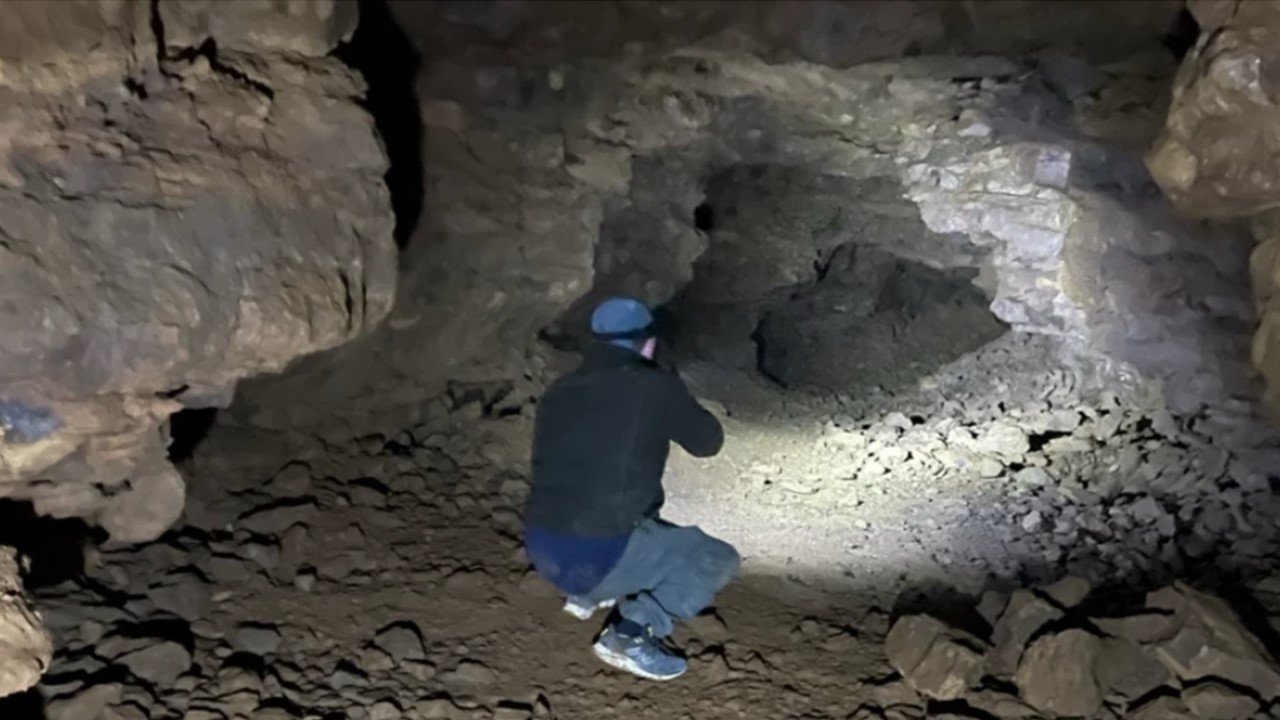
An even more exciting discovery was made, off Queen Street at Bloxham, in March 2026. It was this that led to the recent spate of media reporting: “A tunnel was discovered at the back of the garden of a house, when a digger driver was excavating the soil to put in the concrete footings for a garage. He uncovered a hole of a good size that led into the tunnel.” Green photographed and filmed what was exposed, in the limited time available, before the building contractor resumed work and covered over the break-through. David measured a space that was approximately 40 metres in length, although he was unable to ascertain how or where it was originally accessed due to numerous rockfalls. There were several small side chambers divided by columns of rock. Green has identified the presence of tool marks on the walls which were made with chisels. There were also three groups of neatly stacked stones and several examples of graffiti that appeared to be carved initials. All this would tend to indicate that the discovery represented man-made features.
Reporting the Finds

Picture Source: BBC / BUTS
Soon after the second discovery, on 15 April 2026, Green and his colleagues presented their findings to a meeting of the Bloxham Village History Club. Media interest followed. David spoke to Kayleigh Barker of the BBC on 28 April; the Banbury Guardian published their article on 30 April; and, on 5 May, Green was interviewed live on air by Phil Mercer of BBC Radio Oxford. On the same day as the radio interview, Ethan Gudge, a BBC journalist, released an online article under the headline: ‘Tales of tunnels underneath village prove to be true’. Several other media outlets have subsequently reported the discovery including The Telegraph, The Economic Times, and Heritage Daily.
The piece that seems to have gained the most traction is Gudge’s BBC article, which has been widely shared online. David Green has stated that he has never had any direct contact with Gudge. However, it seems likely that the substance of the article was a composite gleaned from interviews with Gudge’s BBC colleagues and Roseanne Edwards at the Banbury Guardian. Gudge reported that: ‘In the two years since it [BUTS] was first formed, the society has now investigated and uncovered an ever expanding network underneath the quaint village on the edge of the Cotswolds.’
Which sounds great!
The problem is that Gudge concluded his article by stating that the tunnels could have been used: ‘by Catholic clergymen during the English reformation and the dissolution of the monasteries ordered by the then King, Henry VIII.’ Meanwhile, Green, who has actually been inside the underground spaces, thinks otherwise: “I honestly believe the two tunnels we have explored were used for mining purposes”.
Mining Heritage

Queen Street underground space, Bloxham (Picture Source: BUTS)
I’m inclined to agree with David. The size and formation of the space, the side chambers, the presence of pillars supporting the roof of the system, the chisel marks, and the three piles of neatly stacked stones (perhaps related to tidying or ready for removal) seems to point towards a stone extraction mine.
The ferruginous limestone and ironstone at Bloxham are part of a Lower Jurassic formation known as Marlstone, also referred to as Horton Stone or Banbury Ironstone, which weathers to a golden orange-brown colour. It has been used across north Oxfordshire both for walling and dressings in most types of buildings in the region from at least the mediaeval period onwards (Horsfield 2023, 4). An archaeological evaluation at Bloxham has even revealed traces of a large stone quarry pit, close to the BUTS findspot off Queen Street, which probably dated to the eighteenth or nineteenth century, (Thacker 2011, 7, 8, 13, 14, 22). The Clay Cross Ironstone Company opencast workings were still active off the Tadmarton Road, on the edge of Bloxham, during the early twentieth century (Knight 1938, 41).
Meanwhile, in 1980, reports of subsidence on a new housing estate led to an investigation at Cherrys Close in Bloxham. This was carried out by J. M. Steane at the request of Cherwell District Council. The latter recorded the presence of a: ‘Vertical shaft with two tunnels branching off. 1 tunnel 16m long. Further shaft to north.’ The find was interpreted on the Oxfordshire Historic Environment Record as a post-mediaeval ironstone mine. This offers a clear local parallel for the discovery, made in March 2026, at Queen Street.
Although historic stone extraction was usually quarried via the exploitation of outcrops, pitting, or in opencast format (Hislop 2012, 26-29), as it was off Queen Street in Bloxham, there are also instances of underground mines across the country. Mediaeval examples include those at Beer in Devon and Reigate in Surrey (Horner, Parry & Lott 2023, 37; King & Collins 2023, 18). An early modern stone mine is known to have operated at Tittensor (Staffordshire) from at least the seventeenth century (Simpson and Floyd 2023, 20). The Peel Street Caves in Nottingham (Nottinghamshire) were excavated by the sandstone miner James Rouse from 1785 (Waltham 2018, 32-33). In the nineteenth century, stone was exploited from a mine at Box in Wiltshire (Stanier, 2009, 10). Bath stone is still quarried underground at Hartham Park (Somerset). Just 14 miles to the south of Bloxham, hillside adits and shafts were historically used to extract Stonesfield Slate within Oxfordshire (Horsfield 2023, 5).
Tunnels at the BBC

The Fowlmere ‘Tunnel’ (Picture Source: BBC)
In his presentation to the village history club, interviews with the media, and communications with myself, David Green has been consistent in his credible belief that BUTS discovered a stone extraction mine. Unfortunately, Ethan Gudge seems to have omitted this identification in his BBC article in favour of ‘tunnels’ used ‘by Catholic clergymen during the English reformation’. This is a familiar trope from BBC reporting. In May 2023, Auntie Beeb issued the headline ‘House over Reformation tunnel goes on the market’ at Fowlmere (Cambridgeshire). Further research demonstrated that the ‘Reformation tunnel’ was probably a chalk adit mine.
The BBC seem to have form for potentially misleading articles about hidden tunnels. In March 2021, they reported on a ‘secret medieval tunnel’ at Tintern (Monmouthshire). This turned out to be an industrial water conduit for a post-mediaeval mill. Back in July 2006, the national broadcaster reported on ‘Man’s bid for Holy Grail search’ in tunnels alleged to lie beneath Lincoln Cathedral. If the journalist had considered the story in any depth, they would have realised that the claims for the Holy Grail to be hidden below Lincoln originated just a few short months after the release of the film of Dan Brown’s The Da Vinci Code. In the movie, Lincoln Cathedral featured as a location in an imagined story about the hunt for the Holy Grail. The plot seems to have inspired local speculation which the BBC then reported uncritically.
Is this all just innocent fun, though? Potentially not. It is a matter of record that: ‘Trust is the foundation of the BBC – we’re independent, impartial and truthful’. Essentially, the BBC have a self-professed public duty to critically evaluate information prior to reporting. Yet, as an organisation supported by the licence payer, the BBC also seems to feel the need to ensure its content has a substantial viral reach – perhaps to justify its funding. Consequently, the decision to publish potentially misleading content, such as an attempt to connect the Bloxham discovery to persecuted Catholics, may be driven by a desire for website clicks. This is despite an Editorial Policy which claims to prize accuracy.
Gudge’s decision to promote an apparently unsupported angle, linked to Reformation priests, comes across as an unnecessary invention given that Green’s discovery of a stone mine was dramatic enough in itself. Regrettably, what appears to be an over-sensationalised piece of reporting, on the part of the BBC, has had the inevitable viral effect online…
Other media outlets, from across the globe, for example Germany’s Future Zone, have repeated the BBC story, albeit by slightly re-wording the text to ensure that copyright is not infringed. The problem is that many still see the BBC as a figure of authority despite what may be a lengthy history of publishing misleading stories about hidden tunnels. This mangling of reality then gets picked up and further stretched by pseudo-archaeologists such as Graham Phillips. The latter has speculated: ‘It is possible that the mysterious network dates back to pre-Roman times and may have been used by the people who created the nearby Rollrights [sic] Stones and Megalithic culture that built Stonehenge.’ Philips once co-wrote quite a fine book on Arthurian Britain (Phillips & Keatman 1992). However, in more recent years he has descended into what comes across as pseudo-archaeology unmoored from reality – including conjecture about secret societies, the zodiac, and Knights Templar. Phillips’ social media post took its cue to speculate about the Bloxham site directly from the BBC. Such an effect should stand as a warning to the national broadcaster that accuracy matters.
Part 2: The Date of the Discovery
Romans in Bloxham

Poster design from the Roman Bloxham exhibition (Picture Source: Bloxham.info)
Based on the present evidence, it is difficult to assign a date for the site at Bloxham. David Green thinks that the mines could be mediaeval but “we would not rule out Roman occupation.” There is a lot of love for the Romans locally and they were certainly present near the village. An article by, the schoolmaster, W. F. J. Knight (1938, 41-56) detailed excavations of a Romano-British cemetery off the Tadmarton Road, to the north-west of the village centre, which were carried out between 1929 and 1935. My friend and colleague, the archaeologist, Dr Claire Millington even wrote a blog praising a recent exhibition of artefacts, at Bloxham Village Museum, which were recovered during Knight’s labours.
One of Knight’s most intriguing finds was a well which ‘occurred near the middle of the site’ that he described as: ‘circular, about 3 ft. 6 ins. in diameter and nearly 30 ft. deep… carefully faced with dry masonry of dressed stones varying in size, but all of partly rounded shape’. Intriguingly, Knight found the ‘antlers of at least five red deer’ and the ‘frontals and parts of the skulls of red deer’ during his excavation of the fill of the well (Knight 1938, 43).
These finds must have resonated strongly with BUTS when they reported the discovery of a red deer skull during their exploration of the Queen Street site. They discussed Knight’s excavations during the presentation to the village history club: ‘The only reference that I could find on red deer was from 1929 when a famous discovery was made in Bloxham along Tadmarton Road. A Romano-British… burial site of 30 skeletons were discovered plus other artifacts… several red deer antlers were found. So, could this mine be not only medieval but Roman? It could have been used in both times.’
The group are hoping to obtain carbon-14 dating from the skull to find out an approximate date for the death of the animal. Green remains open-minded: “There are so many questions but not enough answers.” A common problem in archaeology! Yet, with full respect to BUTS, I think it is worth raising a few queries regarding the potential for the site to be Romano-British.
Red Deer

Red deer (Picture Source: Lviatour / Wikimedia Commons)
At present, the tentative dating of the mine to the Roman period, by BUTS, is predicated on the presence of a single red deer skull. This has been conceptually linked to the red deer skulls and antlers discovered by Knight in the well off the Tadmarton Road. However, when I spoke to David Green on the telephone, he was not certain of the species identification. This is understandable given the limited time that he had available to spend underground: “I found the skull… I tried comparing it with other animals and the closest match I could find was the red deer, but it could have been another animal.” Assuming that David was correct and a red deer skull was present, then I have three other qualms: 1) the cemetery does not have any clear archaeological relationship to the underground space; 2) Knight’s article concluded that the well may have been mediaeval and the red deer bones were a post-Roman deposit (Knight 1938, 43, 55); and 3) red deer have such a lengthy history of habitat in the British Isles that their presence does not automatically indicate a Romano-British date.
Red deer (Cervus elaphus) have been indigenous to Britain since they migrated from mainland Europe approximately 11,000 years ago. Although early agricultural practices reduced their habitats to south-west England and highland Scotland for a time, they were later a species greatly prized by mediaeval elites. Consequently, the red deer population was carefully encouraged and managed in forest reserves to ensure numbers sufficient for the par force des chiens technique of hunting. This involved the selection of a male deer over the age of five which was chased on horseback, with a pack of dogs, across the countryside for many miles until the tired animal was dispatched at the point of a sword (Griffin 2007, 52-55). Archaeologically, butchered red deer bones have been found in the assemblage recovered from mediaeval contexts at the royal palace at Clarendon (Wiltshire). The archaeologists concluded that they probably belonged to animals hunted specifically by the monarchy within the wider forest beyond the palace parkland (James & Gerrard 2007, 86-87). Elsewhere, late mediaeval and early modern surveys of the royal forest of Sherwood (Nottinghamshire) revealed substantial quantities of red deer: 1,340 in 1532, 1,000 in 1538, 1,263 in 1616, and 1,361 in 1635 (Kirton 2001, 24). Eventually, over-hunting and a loss of woodland habitat drove the red deer to near extinction during the eighteenth century, but numbers have recovered to such an extent that there is currently a population of around 12,500 in England alone.
Meanwhile, back in Bloxham, red deer bones were recovered from the lower fill of a ditch, potentially cut in the early mediaeval period, during the archaeological evaluation off Queen Street by Oxford Archaeology (Thacker 2011, 8-9, 10). This relatively secure archaeological context indicates that, within the village, and close to the Queen Street site, red deer were present during the post-Roman period.
Unfortunately, the context in which the deer skull was discovered within the underground space is less secure. Essentially, it could have been placed there at any point from the (unknown) date when the mine was opened and the (unknown) date when it was closed. It may also not be known if the skull was already an ancient object before it was deposited. Additionally, it should be borne in mind that the skull could potentially have washed into the mine via storm waters at points when it was open or closed to human traffic. Honestly, I’m not trying to be impossibly negative here, but the group may wish to reconsider spending a significant sum of money on carbon-14 dating a skull with low archaeological potential because it was found outside of a secure context.
Romano-British Stone Extraction

Queen’s Crags, Northumberland (Picture Source: Andrew Curtis / Geograph)
With a note of caution raised regarding the use of a deer skull in dating the mine to the Romano-British period, I want to finish this part with a quick discussion on stone extraction during that era. It is acknowledged that stone was quarried widely within the Roman province of Britannia. However, as, the archaeologist, Andrew Pearson (2006, 45) noted in his book on Roman stone quarrying: ‘the majority of ancient quarries can only be identified through petrological studies of stone from surviving Roman buildings – such analyses can rarely, if ever, point to a precise working area… few Roman extraction sites survive in any recognisable form in the present day.’ Pearson (2006, 51-52) indicated that only a small number of quarry sites can be confidently dated to the Roman period including those at Well (North Yorkshire), Chester (Cheshire), Queen’s Crags (Northumberland), and Wilcote (Oxfordshire). Although it is accepted that gold (for example at Dolaucothi, Carmarthenshire) and lead (for example at Machen, Monmouthshire) were extracted from underground mines during the period, Pearson concluded that: ‘No underground stone galleries are known in Roman Britain’ (Pearson 2006, 59).
Whilst I have no firm conclusion to make regarding the date of the potential mine at Bloxham, there currently seems to be a lack of support that it is Romano-British in date. As discussed in the Mining Heritage section of this blog, underground stone mining has a lengthy history within Britain which can be traced from the mediaeval period to the present day. Further fieldwork, preferably established under an archaeological research framework, may help to refine dating at Bloxham.
Part 3: Accounts of Other Tunnels
School, Pub, and Church

St Mary, Bloxham, Oxfordshire (Picture Source: Francois Thomas / Wikimedia Commons)
The two spaces which BUTS accessed may not be alone. Green noted that there is an account of a large cavern which was first discovered at nearby Cumberford Hill in 1908. It was subsequently reopened in 1954. Locally, there is a strong belief that Bloxham may be honeycombed with underground spaces. David told me that the Facebook group discussion, which sparked the formation of BUTS, included many accounts of other tunnels: “A post was put on about the tunnel from Bloxham School to the church.” However, David is sceptical about the practicalities, “I said that would not be possible because it would have to go some distance and then under the brook and then to the Church.”
Green reported that an energetic discussion followed. Some referred to a book by, the local historian, Y. S. Huntriss which alleged that a tunnel entrance was discovered, in the 1920s, within the local pub cellar (the Hawk and Partridge, now closed). The finder insisted that the tunnel led to the church (Huntriss 1983). David reported that “myself and many other persons have been told in their living memory that a couple of persons have walked along that tunnel to the church… so it is very possible a tunnel could go along to the church.”
Meanwhile, Green recalled a school trip to the parish church of St Mary, in the late 1960s, during which the Reverand Bolton, “said that behind the pulpit through the little door there was a tunnel.” The questing zeal of BUTS has led to a re-examination of this area of the church, “we saw evidence of an archway and possible steps going down but the wall was bricked up.” This was subsequently shown to Professor Colin Eddie who is described as ‘an expert in the design and construction of tunnels and underground space’. Green noted that Eddie, “thought that the design of the arch and the steps indicated a tunnel or perhaps a priest hole.”
Ancient Architecture

Early mediaeval crypt at St Wystan’s, Repton, Derbyshire (Picture Source: James Wright / Triskele Heritage)
So, could there be another tunnel in Bloxham? David Green is both hopeful and open-minded: “I do not rule out a tunnel leading from the Hawk & Partridge to the church, but it could be a large cellar.” This note of scepticism is to David’s credit. He is steeped in the history of the village and told me of a newspaper account, from 1845, of an auction of the Hawk and Partridge which referred to the building having three interconnected cellars. Could these be the foundation of the persistent tunnel rumours?
David has been very generous with his time and information, and I am only too aware that I have not had the time or funding to visit Bloxham in person. However, as someone who has spent a substantial amount of his professional career in subterraneous spaces, and has encountered too many stories of underground tunnels to count, much of what Green told me rang a bell. The British Isles have widespread folk traditions concerning hidden tunnels. There is not a single hamlet, village, town, or city in the land which does not have at least one secret passage rumour. In most cases they are said to link historic buildings. There is often a vague notion that the tunnels facilitated either secretive access or allowed an escape route. Despite a significant lack of physical evidence – which has been reported by numerous researchers including Jeremy Errand (1974), Anthony Clayton (2015), and myself (Wright 2024, 13-30) – the belief in secret passages is widely held.
During the early twentieth century, the writer, S. E. Winbolt (1931, 195) noted that: ‘Underground passages are of course, always intriguing, and until the pick, shovel and the light of an electric lamp are brought to bear on them, extravagant legends persist.’ David Green’s group have certainly involved ‘the pick, shovel and the light of an electric lamp’ and have had great success in identifying potential stone extraction mines. However, I would encourage BUTS to be cautious before advocating for tunnels between schools, pubs, and churches.
Most secret passage rumours seem to have their origins in a misunderstanding of perfectly prosaic architectural structures including blocked doors, drains, sewers, water conduits, wells, basements, and cellars. David has already wondered if the story of the pub tunnel could be related to a cellar. At the church, would it not, perhaps, be more likely that the blocked arch and steps could lead to a crypt like those at St Wystan’s at Repton (Derbyshire) or St Mary’s at Lastingham (North Yorkshire). Other ecclesiastical interpretations are, of course, available. I suspect that it is unlikely that Professor Eddie’s comments regarding secret tunnels or priest holes will be supported. Regarding the latter, priest holes were usually a feature of domestic houses of the early modern Catholic gentry. I am unaware of a single example in a parish church. With respect, although the opinion of Professor Eddie may be taken by some as authority, he is a civil engineer with expertise in modern tunnelling techniques and is not a specialist in the architecture of historic buildings.
Tunnels in Folklore

The Hawk & Partridge, the former pub at Bloxham (Picture Source: David Stowell / closedpubs.co.uk)
Nevertheless, the folk traditions of tunnels at Bloxham are highly representative of a national storytelling tradition. Catholic buildings, such as the parish church of St Mary, are frequently said to be connected to hidden tunnels. There are several factors at play. An important element is the forgetfulness of Catholicism nearly five centuries after the English Reformation. Most people do not prioritise a detailed knowledge of mediaeval ecclesiastical architecture and it is easy for many to misinterpret perfectly regular architectural features as the entrance to hidden tunnels. Moreover, the Reformation was an intense period in which the reputation of Catholics was deliberately tarnished and trashed, by the English state, in the minds of the populace. The implication that those subversive Catholics were up to something nefarious remains common. This has led to the widespread, yet entirely misleading, belief that Catholics had networks of hidden tunnels to escape capture or secret passages to access buildings covertly. This is a very common element of post-Reformation folklore. It is particularly the case regarding pubs. Drunkenness was a common accusation against Catholic clerics within Reformation propaganda and the suspicion that bishops, priests, nuns, and monks were sneaking into boozers via tunnels – such as the Hawk and Partridge at Bloxham – is a popular trope in storytelling across the country.
Three other common folkloric tropes are present at Bloxham. The first is that, although the tunnel is claimed to be real, it cannot be accessed as it has been blocked or filled in. Only the entrances are now visible. Secondly, although the tunnels are now blocked some people have claimed that others have been into the tunnels. However, physical evidence was not collected, and the stories are accounts relayed second-hand. Third, there is an element of youthfulness in the storytelling that seems related to exciting ripping yarns and The Boys’ Own Adventure trope. The tale that the school was connected to the church is a classic example. We might also consider David Green’s recollections of being told the story of the church tunnel during a school trip by the vicar – himself, like Professor Eddie, taken to be a figure of authority (another strong trope in tunnel communication). The great cataloguer of secret passages, Jeremy Errand (1974, 105), noted that, ‘The existence of many passages is vouched for only by the memories of boyhood exploration.’
Bloxham seems to have a rich seam of folklore that is familiar from countless other tales across the country: the tunnel between the church and the pub, the suggestion that Catholics may have used it, potential architectural features which are believed to confirm that entrances exist, the suspicion that the tunnel has been blocked, an element of youthful exploration, and repetition or confirmation by apparent figures of authority. I’ve written about such phenomena on many occasions, but for a fuller discussion I refer the reader to Chapter 1: Secret Passages in Historic Building Mythbusting (Wright 2024, 13-30).
Whilst I cannot say for certain that there is no genuine secret access or escape tunnel in Bloxham, I would urge BUTS to try and understand the stories in their folkloric context. The presence of the probable stone mines does not offer proof of other tunnels. If the tunnel between the church and pub does genuinely exist then it would be archaeologically unique… but solid physical evidence of its existence would need to be mapped, photographed and described in a manner that could be presented in a peer-reviewed publication.
To that end, I hope that the Bloxham Underground Tunnels Society will have success in their ventures!
Conclusions

Gimli, son of Glóin, witnesses the halls of Khazad-dûm (Picture Source: WingNut Films / New Line Cinema)
David Green and BUTS have made genuinely fascinating discoveries. It is likely that they have accessed what may be a stone extraction mine of some antiquity. Unfortunately, the BBC reporting seems to have reached into the outer reaches of speculation when Ethan Gudge described the site as a system of tunnels which may have been used by Catholic priests escaping persecution during the Reformation. There was little need to do this as Green’s discovery was already spectacular. Sadly, the BBC seem to have lengthy form for over-sensationalising subterranean history, and this has only served to encourage pseudo-archaeologists to speculate further.
I am deeply obliged to David Green and the Bloxham Underground Tunnels Society. I hope that they can see that I do not intend undue criticism of their project. I am healthily sceptical that the possible mine which they entered is Romano-British in date. Additionally, I have offered some folkloric context for the accounts of tunnels between the school, pub, and church. I wish David and his group all the very best in their endeavours. I also hope that their work will be reported accurately in the future by media outlets.
Acknowledgements
I am grateful to David Green and the Bloxham Underground Tunnels Society for being so open and helpful in describing their discoveries. Additionally, Dr Claire Millington has assisted with her thoughts on the site and offered useful comments on an early draft of this article. Richard Oram was kind enough to make me aware of the discovery of an ironstone mine at Bloxham in 1980.
References
Clayton, A., 2015, Secret Tunnels of England: Folklore and Fact. Accumulator Press. London, Hastings & Cosmopli.
Errand, J., 1974, Secret Passages and Hiding Places. David & Charles. London.
Griffin, E., 2008, Blood Sport: Hunting in Britain since 1066. Yale University Press. New Haven & London.
Hislop, M., 2012, Medieval Masons. Shire. Botley.
Horner, L., Parry, S. & Lott, G., 2023, Building Stones of England: Devon. Historic England. Swindon.
Horsfield, B., 2023, Building Stones of England: Oxfordshire. Historic England. Swindon.
Huntriss, Y. S., 1983, The Town of Bloxham. Self-published. Bloxham.
James, T. B. & Gerrard, C., 2007, Clarendon: Landscape of Kings. Windgatherer. Macclesfield.
King, A. & Collins, P., 2023, Building Stones of England: Surrey. Historic England. Swindon.
Kirton, T., 2001, ‘Clipstone Forest and Shrogges’ in A Celebration of Kings Clipstone – 1000 Years of History. Acorn Maltone. Tuxford.
Knight, W. F. J., 1938, ‘A Romano-British Site at Bloxham, Oxon.’ In Oxoniensia Volume 3. Oxfordshire Architectural and Historical Society. Oxford. pp41-56.
Pearson, A., 2006, The Work of Giants – Stone and Quarrying in Roman Britain. Tempus. Stroud.
Phillips, G. & Keatman, M. 1992, King Arthur – The True Story. Arrow. London.
Simpson, I. & Floyd, P., 2023, Building Stones of England: Staffordshire. Historic England. Swindon.
Stanier, P, 2009, Quarries and Quarrying. Shire. Botley.
Thacker, G., 2011, The Bungalow, Queen Street, Bloxham, Oxfordshire – Archaeological Evaluation Report. Unpublished archaeological report. Oxford Archaeology South.
Waltham, T., 2018, Sandstone Caves of Nottingham. East Midlands Geological Society. Nottingham.
Winbolt, S. E., 1931, ‘St Radegunds Abbey, Dover’, in Archaeologia Cantiana Vol. 43. Kent Archaeological Society. pp187-98.
Wright, J., 2024, Historic Building Mythbusting – Uncovering Folklore, History and Archaeology. The History Press. Cheltenham.
About the author
James Wright is an award-winning buildings archaeologist. He has two decades professional experience of ferreting around in people’s cellars, hunting through their attics and digging up their gardens. He hopes to find meaningful truths about how ordinary and extraordinary folk lived their lives in the mediaeval period.
He welcomes respectful contact through email or on Twitter, Instagram & Bluesky
The Mediaeval Mythbusting Blog is the basis of the book – Historic Building Mythbusting – Uncovering Folklore, History and Archaeology which was released via The History Press in June 2024.
