6 May 2026
I recently gave an online talk which looked at The Surprising Secrets of Ancient Corridors. What do you mean, you missed it!? That’s a pity as folk seem to really enjoy the more obscure reaches of buildings archaeology. The opening section of the lecture examined claims that the corridor was a physical concept invented by, the surveyor, John Thorpe in 1597. I thought that might make a good subject for the blog;* so here we are…
I first came across the notion that John Thorpe (c 1564/65 – 1655) invented the corridor in an article published by The Observer in 2024. It had the headline: ‘Some people’s ancestors are kings or poets. I’m proud my family invented… the corridor’. Within, a descendant of the surveyor, the journalist Vanessa Thorpe, claimed that: ‘an eminent Elizabethan designer and surveyor called John Thorpe, is the man credited with inventing the corridor.’ She went on to note that: ‘Until John Thorpe, rooms in the great houses of England used to lead on, one from another, all grouped around a central entrance hall’. She also indicated that the function of the corridor was to ‘let servants pop in and out of rooms without disturbing the grandees gliding from one salon to another.’
An Early Modern Surveyor
John Thorpe is a shadowy historical figure. In the Oxford Dictionary of National Biography, the eminent architectural historian, Professor Malcolm Airs sketched out what little is known of his life. Thorpe was born at King’s Cliffe in Northamptonshire in 1564/65 and, aged 5, laid the foundation stone at Kirby Hall with his master mason father. He followed a different path and became a clerk in the Office of Works, responsible for royal buildings, between 1583 and 1601. During this time, he often moonlighted as a surveyor for private clients. A good deal of his drawings can now be found in the collection of Sir John Soane’s Museum. From 1601, Thorpe was a self-employed surveyor and worked on buildings including Thornton College (Lincolnshire), Dowsby Hall (Lincolnshire), Audley End (Essex), Aston Hall (Birmingham) and Belvoir Castle (Leicestershire). From 1611, he also acted as assistant to Robert Treswell – the surveyor-general of woods south of the Trent. Thorpe died in 1655 and was buried at St Paul’s in Covent Garden (London).

Aston Hall, Birmingham (Picture Source: Tony Hisgett / Wikimedia Commons)
The claim that Thorpe invented the corridor is widespread. Examples of its repetition include architectural historians (Gomme & Maguire 2008, 126), estate agents, architects, bloggers, and… The QI Elves. Yes, you read that last bit correctly. The researchers for the long-running BBC television programme – QI (which stands for Quite Interesting) – Tweeted the following on 25 July 2020: ‘The first recorded use of a corridor was in 1597, when the architect John Thorpe designed one to allow “independent access to individual rooms”’. So, is this true?
Thorpe’s Drawings
The earliest citation of the 1597 claim, that I have been able to determine, may come from an article by, the architect and lecturer, Robin Evans. In an article entitled Figures, Doors and Passages, published in 1978, Evans (1978, 267-77) noted that: ‘The history of the corridor as a device for removing traffic from rooms has yet to be written. From the little evidence I have so far managed to glean, it makes its first recorded appearance in England at Beaufort House, Chelsea, designed around 1597 by John Thorpe’ (Evans 1978, 271-72).
The collection of Sir John Soane’s Museum contains Thorpe’s drawing of the ground plan for Beaufort House (SM Volume 101/63-64), dated c 1595 – 1603. An online article, published by the museum in connection with an exhibition of Thorpe’s work, noted that it ‘is likely to be a presentation drawing showing a design for the reconstruction of Beaufort House for Sir Robert Cecil, who became 1st Earl of Salisbury in 1605.’ It went on to state: ‘The use of a central corridor was innovative. Combined with the lateral axis of the main entrance, the corridor creates a cruciform plan, a layout favoured by Thorpe for both large and small houses.’ The piece ventured that the corridor was ‘innovative’, in the context of early modern great houses, but did not extent to crediting Thorpe with invention.
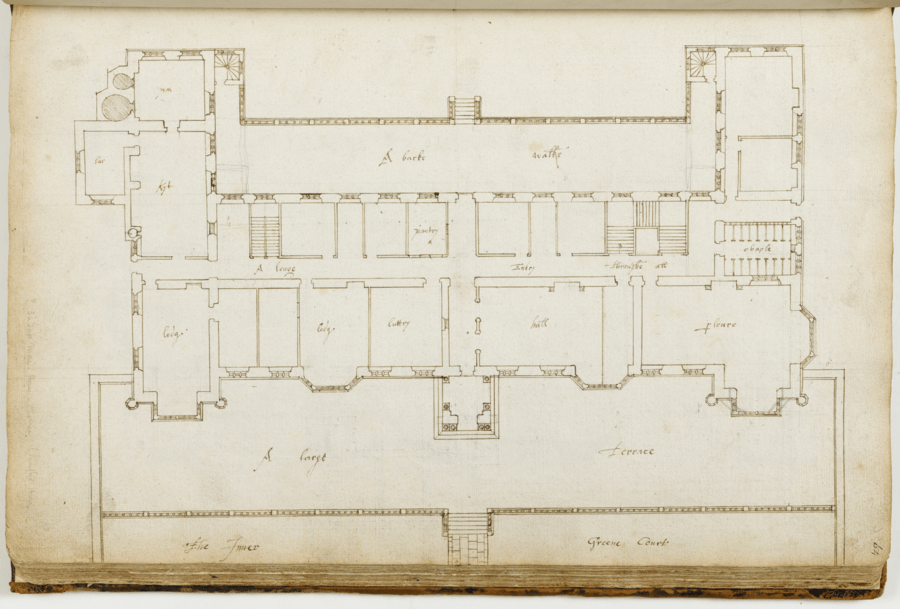

Plan of Beaufort House, Chelsea, London, c 1595-1603, by John Thorpe (Picture Source: Sir John Soane’s Museum SM Volume 101/63-64)
Prior to Evans, commentators tended to stress Thorpe’s innovative thinking in relation to a ground floor plan (SM Volume 101/30) and perspective drawing (SM Volume 101/50) for a building in the form of John Thorpe’s initials: IT (at the time, the letter I was interchangeable for the letter J). Writing in The Journal of the British Archaeological Association for 1895, C. R. B. Barrett described the arrangement: ‘The offices, I, being joined to the main house, T, by a corridor, represented by the hyphen.’ However, rather than the use of a corridor, it was the idea that Thorpe had designed a building in the shape of his initials which was considered remarkable: ‘This is a most singular example of a monogram for a dwelling-house, but unfortunately it was never completed, or even begun’ (Barrett 1895, 64). Such writers did not claim that Thorpe invented the corridor.
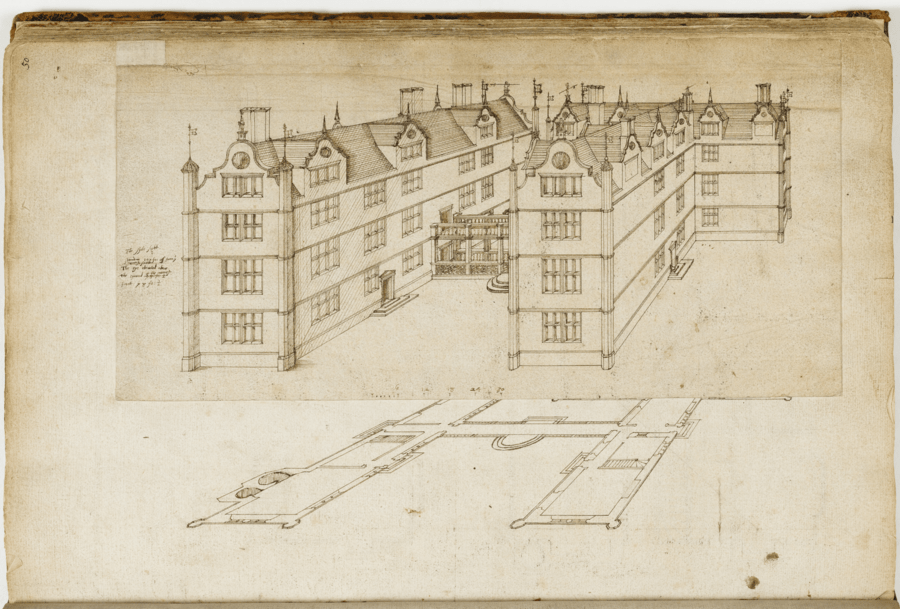

Design for the ground-floor plan of a house in the form of ‘IT’, c 1595-1603, by John Thorpe (Picture Source: Sir John Soane’s Museum SM Volume 101/30)
Instead, the source of the 1597 claim, now widely repeated, seems to have been Robin Evans in 1978. However, even he admitted that he was not on solid ground. Evans (1978, 271-72) prefaced the identification with the phrase: ‘From the little evidence I have so far managed to glean’. This would seem to indicate that he was far from certain given a lack of detailed study. It could be seen as the mid-twentieth century researcher’s equivalent of ‘doing a quick Google’. Unfortunately, later commentators seem to have overlooked Evans’ caveat and concentrated entirely on the section which reads: ‘it makes its first recorded appearance in England at Beaufort House, Chelsea, designed around 1597 by John Thorpe’ (Evans 1978, 271-72). Dogmatic certainty has been upheld over initial ambiguity.
Defining the Corridor
Dig a little deeper in Vanessa Thorpe’s article for The Observer and there are traces of this uncertainty. Despite the section of the headline which reads: ‘I’m proud my family invented… the corridor’, Thorpe also noted that in the mediaeval period ‘some buildings had monastery-style external covered cloisters bordering central courtyards, these were always too nippy for a northern climate. Roman villas in Britain, it’s true, had also sported mediterranean colonnades, open on one side’. Here lies the problem. The 1597 claim for John Thorpe may be guilty of cherry-picking and overstating the evidence. Corridors were clearly in existence before the 1590s.
The definition of the corridor is complex, and the term has been employed in several contexts. The Oxford English Dictionary (OED) points towards a now-obsolete usage to mean: ‘A path that surrounds a fortified castle, town, etc., running along the top of the outer bank of the moat, and defended by a parapet formed by the top edge of the glacis.’ This meaning could be found in fourteenth century Italy, by 1572 in France, and (the earliest citation) in English from 1591. An approximation of this feature may be the Moat Walk surrounding the Yellow Tower of Gwent at Raglan Castle (Monmouthshire), built c 1600 (Kenyon 2003, 54).

Moat Walk around the Yellow Tower of Gwent at Raglan Castle, Monmouthshire (Picture Source: James Wright / Triskele Heritage)
The word also has a domestic definition: ‘A covered passageway, gallery, or cloister connecting one part of a building with another, esp. forming the edge of an inner quadrangle or courtyard.’ This can be found in use in Italy from the 1250s, in French by at least 1602, and in English by 1623. However, so far, we have only looked for the existence of corridors using evidence gleaned from written sources (earliest known citation: 1257) and drawings identified by architectural historians (earliest claim: 1597). If we accept that there are several historic terms for corridors (as exemplified in the OED) – colonnades, cloisters, passages, pentices, balconies or galleries – then buildings archaeology can push these dates back significantly.
Roman Corridors
One commentator on The QI Elves tweet simply said: ‘Didn’t the Romans have corridors?’ Yes, they did. Given that I am far from being a Romanist, I am not going to attempt to identify the earliest Roman example of a corridor. However, it is worth noting that the House of the Faun at Pompeii, dated c 180 BCE, included two colonnaded gardens and a corridor which granted access to the services on the east side of The First Peristyle (Dwyer 2001, 332). Elsewhere, if we want to consider an early example of a corridor in the Roman province of Britannia, Fishbourne Palace (West Sussex) was full of them. Originally built in the mid-first century CE, and remodelled successively in the second and third centuries CE, Fishbourne included numerous open-sided colonnades and enclosed corridors, including one from the principal courtyard to the bath house (Cunliffe 1998).

Floor plan of Fishbourne Palace, West Sussex (Picture Source: Sussex Archaeological Society)
Monastic Cloisters
If we allow that The Observer article may have been primarily dealing with corridors in England (‘Until John Thorpe, rooms in the great houses of England used to lead on, one from another’), there is still the problem that such features could be found in the country during the early mediaeval period. In a book on England’s Abbeys, Philip Wilkinson (2006, 97) noted that cloisters were common across continental Europe by the ninth century and were ‘taken up extensively in England after the reforms of St Dunstan in the mid-10th century.’ Both the OED and Wilkinson were emphatic that cloisters are corridors. The latter noted that cloisters allowed circulation from the church and around ‘the main monastic apartments – including the chapter house, parlour, dormitory, refectory and, in Cistercian houses, the lay brothers’ accommodation’ (Wilkinson 2006, 95).
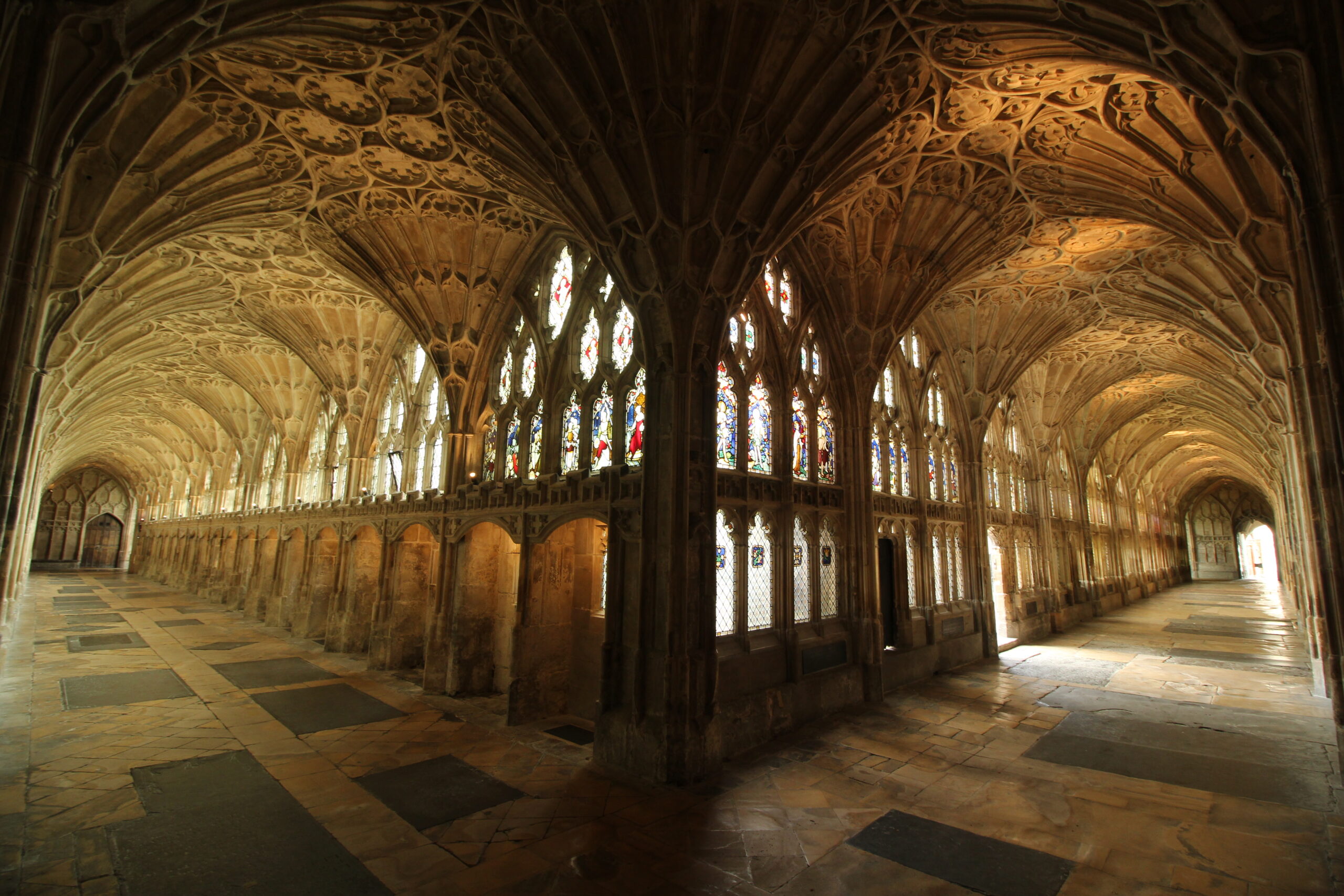
Cloisters were present in England during the late Anglo-Scandinavian phase at St Augustine’s Abbey in Canterbury (Kent) and became an essential component of post-Conquest monasteries such as Rievaulx Abbey (North Yorkshire), where a reconstruction of part of the Romanesque cloistral arcade can be seen (Wilkinson 2006, 97). A roughly contemporary pair of cloisters are featured on Prior Wilbert’s Waterworks Plan of Canterbury Cathedral (Kent), made in the 1160s (Kerr 2012, 205-08). Most Romanesque cloisters have been lost because of Dissolution demolition or due to rebuilding. Consequently, it is cloisters from the Gothic era of architecture which are most well-known in England; such as those of c 1297 – 1430 at Norwich Cathedral (Norfolk) or Gloucester Cathedral (Gloucestershire), built in two phases of c 1350 and c 1381-1412 (Sansbury 2013, 42; Thomson 2011, 39-41).

Cloisters at Norwich Cathedral(Picture Source: James Wright / Triskele Heritage)
Cross Passages
The most common form of corridor in mediaeval England was the cross passage. These corridors led from the front door of domestic houses, directly through the property, out to a garden or courtyard beyond. On one side would be the services – potentially including buttery, pantry, and perhaps a kitchen. On the other would be the hall, with a solar or parlour beyond. Cross passages acted as a functional access between the various areas of the house. They also delineated social separation: lower status services from higher status hall and parlour. Which way people turned on entering a cross passage may have been determined by their social function and status.

Drawings of a three-cell house in which (c) is the cross passage (Picture Source: Vernacular Building Glossary / Vernacular Architecture Group)
Cross passages could be found in domestic houses regardless of status. Therefore, a yeoman house such as Bayleaf from Chiddingstone in Kent (now located at the Weald and Downland Living Museum in West Sussex), dated 1405-30, features a cross passage (Zeuner 1990, 3). So also does the hall range, built c 1325-50, for Sir Richard Vernon IV at Haddon Hall in Derbyshire (Emery 2000, 383-391). At Bayleaf, the cross passage linked the front door and the back garden. At Haddon Hall, the cross passage linked the Lower Court to the Upper Court. In both cases, the services lay on one side of the corridor and the hall on the other.

The cross passage at Bayleaf from Chiddingstone, Kent – the doorways to the services are on the left and the entrance to the hall on the right (Picture Source: James Wright / Triskele Heritage)
An early example of such an arrangement in a non-elite domestic residence, dated by dendrochronology, is Tudor House at Steventon (Oxfordshire), which has a felling date of 1355-56 (Alcock & Miles 2013, 30). Meanwhile, cross passages were still current during the 1640s at places such as Laverock Hall in Keighley, West Yorkshire (Giles 1986, 202). This was despite the growing early modern popularity of the lobby entrance. The new planform consisted of a front doorway which accessed a small lobby, formed by the transverse end of a chimney directly opposite the door, with rooms (usually a hall and kitchen) opening off to the left and right. One of the earliest known examples of this new form was Old Hall Farm House at Kneesall (Nottinghamshire), which was built in the 1520s (Mercer 1975, 60). Nevertheless, the cross passage was clung to in new builds, especially in the north, well into the seventeenth century.

Drawings of a three-cell house in which (c) is the lobby entrance( Picture Source: Vernacular Building Glossary / Vernacular Architecture Group)
Pentices and Galleries
Alternatively, corridors could also be found at secular residences in the form of pentices. These are defined as consisting of a ‘Narrow roof projecting from a wall… also used of a covered way between separated buildings.’ In 1251-52, there is a documented account of Henry III ordering the construction of a pentice ‘at Clipstone from the entry of the king’s chamber to the gable of the hall, and another passage to the new chapel’ (Turner 1851, 236). This corridor may have resembled the fifteenth century pentice at the Hospital of St Cross in Winchester (Hampshire) which links the church and the gatehouse (Emery 2006, 425-28).

Fifteenth century pentice at the Hospital of St Cross in Winchester, Hampshire (Picture Source: James Wright / Triskele Heritage)
Meanwhile, upper chambers were sometimes accessed via open-sided galleries. These were essentially raised pentices that may overhang the ground floor supported on jetties. Such features can be seen surviving from the fifteenth century at Abingdon Abbey in Oxfordshire and Llys a Chastell Tre-tŵr in Powys (Alcock & Tyers 2013, 104; Emery 2000, 669-71). Galleries were also known at mediaeval inns and provided access between the courtyard and bedchambers. Perhaps the best-preserved example of an inn gallery is the one which survives at first floor on three sides of the courtyard at The New Inn at Gloucester (Gloucestershire), a building which has been tree-ring dated to 1432 (Nayling 2002, 79). An open-sided gallery is also known from a similar period at the George Hotel at Dorchester-on-Thames in Oxfordshire (Wright 2024, 172). Elsewhere, a fifteenth century gallery has been infilled at the Bull Hotel in Ludlow, Shropshire (Moran 2003, 163); whereas there is an open-sided example surviving from the early sixteenth century at the George Inn, Norton St Philip, Somerset.

Gallery at The New Inn, Gloucester (Picture Source: James Wright / Triskele Heritage)
Raised Corridors
In high-status dwellings, raised corridors became a marker of prestige. An early example of this is the 13.6-metre-long, vaulted, brick corridor on the second floor of the great tower at Tattershall Castle, dated c 1425-50 (Wright 2021a, 62-63). This linked the staircase to a heated ante-chamber furnished with a latrine. Here, guests of Ralph Lord Cromwell would await summons into the adjacent Great Chamber. On entering, visitors would find themselves at the low end of the chamber with the Lord Treasurer of England at the high end beneath a tester canopy, next to a carved chimneypiece, and illuminated by substantial tracery windows filled with stained glass. The ceremonial nature of this arrangement was intended to heighten the theatricality of access to Cromwell in a manner that may have recalled liturgical procession. Meanwhile, at the summit of the tower there was a covered brick walkway, highly reminiscent of a monastic cloister, which enabled Cromwell to show off views of his landscape of lordship, to his most honoured guests, under cover from the weather (Wright 2021b, 313-16). Posh stuff.

Corridor on the second floor of Tattershall Castle, Lincolnshire (Picture Source: James Wright / Triskele Heritage)

Parapets of Tattershall Castle, Lincolnshire (Picture Source: James Wright / Triskele Heritage)
Elevated corridors, known as long galleries, gathered in popularity at elite houses through the early modern period. Long galleries – such as the five sixteenth and seventeenth century examples at Knole, near Sevenoaks in Kent, or the late sixteenth century instance at Haddon Hall (Derbyshire) – were ostensibly created to provide an internal exercise space for high status occupants (Fleming, Honour & Pevsner 1980, 129). However, they also provided venues for the landowners to show off their artistic patronage via panelling, plasterwork, paintings, glazing, and sculpture. It was the term long gallery which leant itself to the phrase ‘art gallery’.

Brown Gallery at Knole, near Sevenoaks, Kent (Picture Source: James Wright / Triskele Heritage)
Even the humbler corridors which access the upper chambers at Harvington Hall (Worcestershire) – the Mermaid Passage and the Nine Worthies Passage – can be found daubed with impressive survivals of late Tudor painting, dated c 1580 and c 1600 respectively (Anon 2023, 25, 43). This brings us, finally, to the period when John Thorpe is supposed to have invented the corridor.

Nine Worthies Passage at Harvingon Hall, Worcestershire (Picture Source: James Wright / Triskele Heritage)
Conclusions
Since at least the 1970s, it has been suggested that, the surveyor, John Thorpe invented the corridor on a drawing of Beaufort House, made c 1595 – 1603. However, this identification, by Robin Evans, was acknowledged even at the time to be uncertain. The belief that the corridor was invented by Thorpe seems to be based on an architectural historian’s limited view based entirely on surviving documentation for elite houses of the early modern period.
Dig a little deeper, using the discipline of buildings archaeology, and a different picture emerges. From this perspective, there is a wealth of evidence from the Roman, Anglo-Scandinavian, mediaeval, and early modern periods to indicate the presence of corridors – in sacred and secular buildings of both the elites and non-elites – which pre-date Thorpe. Corridors were there, standing in plain sight, in the form of colonnades, cloisters, passages, pentices, balconies or galleries. All are genuine forms of corridors which were in existence across Britain and Europe long before Thorpe. We might not be able to directly name the person who invented the corridor, but we can be sure that the job was done long before 1597.
– – –
* Yes, 1597 is technically after the mediaeval period (c 410 – c 1550) and you might ask why this subject is on the Mediaeval Mythbusting Blog. In answer: 1) my blog, my rules; 2) I’m sticking up for mediaeval corridors.
– – –
Dedication
This blog is dedicated to the memory of my dear friend Nick “Ringo” Southall, who died on this day 11 years ago. He would have been exquisitely puzzled as to why I was interested in writing about corridors. It would have led to an immense barrage of ribbing that would probably have gone on for years. I miss him dearly.

Nick “Ringo” Southall (Picture Source: ENPR)
References
Primary Sources:
Sir John Soane’s Museum
SM Volume 101/30: John Thorpe; Design for the ground-floor plan of a house in the form ‘I T’; Design for or study of the ground floor of a small compact house, 1596-1603
SM Volume 101/50: John Thorpe; Perspective plan and, on additional attached sheet, perspective of a house in the form ‘I T’, 1596-1603
SM Volume 101/63-64: John Thorpe; Plan of Beaufort House, Chelsea, London, 1595-1603
Secondary Sources:
Alcock, N. & Miles, D., 2013, The Medieval Peasant House in Midland England. Oxbow. Oxford and Philadelphia.
Alcock, N. & Tyers, C. (ed.’s), 2013, ‘Tree-ring Date Lists 2013’ in Vernacular Architecture Volume 44. Vernacular Architecture Group / Routledge. London and New York. pp82-111.
Anon, 2023, Harvington Hall. Archdiocese of Birmingham. Birmingham.
Barrett, C. R. B., 1895, ‘Riding Skimmington and Riding the Stang’ in The Journal of the British Archaeological Association New Series Volume I. British Archaeological Association. London. pp58-68.
Cunliffe, B. W., 1998, Fishbourne Roman Palace. Tempus. Stroud.
Dwyer, E., 2001, ‘The Unified Plan of the House of the Faun’ in Journal of the Society of Architectural Historians Volume 60 Number 3. University of California Press / Society of Architectural Historians. pp328-343.
Emery, A., 2006, Greater Medieval Houses of England and Wales, 1300-1500: Volume 3 – Southern England. Cambridge University Press. Cambridge.
Emery, A., 2000, Greater Medieval Houses of England and Wales, 1300-1500: Volume 2 – East Anglia, Central England and Wales. Cambridge University Press. Cambridge.
Evans, R., 1978, ‘Figures, Doors and Passages’ in Architectural Design Volume 48. pp267-77.
Fleming, J., Honour, H. & Pevsner, N., 1980 (third ed.), The Penguin Dictionary of Architecture. Penguin. London.
Giles, C. (ed.), 1986, Rural Houses of West Yorkshire, 1400-1830. Her Majesty’s Stationery Office. London.
Gomme, A. & Maguire, A., 2008, Design and Plan in the Country House: From Castle Donjons to Palladian Boxes. Yale University Press. New Haven & London.
Kenyon, J. R., 2003 (revised ed.), Raglan Castle. Cadw. Cardiff.
Kerr, J., 2012, Monastic Hospitality. Boydell & Brewer. Woodbridge.
Mercer, E., 1975, English Vernacular Houses. RCHME. London.
Moran, M., 2003, Vernacular Buildings of Shropshire. Logaston Press. Logaston.
Nayling, N., 2002, ‘List 125: Tree-ring dates from the University of Wales Lampeter Dendrochronology Laboratory’ in Vernacular Architecture Volume 33. Vernacular Architecture Group. pp78-81.
Sansbury, E., 2013 (revised ed.), An Historical Guide to Norwich Cathedral. Swallowtail. Drayton.
Thomson, C., 2011, ‘The Benedictine Inheritance’ in Gloucester Cathedral – Faith, Art and Architecture: 1000 Years. Scala. London.
Turner, T. H., 1851, Some Account of Domestic Architecture in England, from the Conquest to the End of the Thirteenth Century. J. H. Parler. Oxford & London.
Wilkinson, P., 2006, England’s Abbeys – Monastic Buildings and Culture. English Heritage. Swindon.
Wright, J., 2024, Historic Building Mythbusting – Uncovering Folklore, History and Archaeology. The History Press. Cheltenham.
Wright, J., 2021a, Tattershall Castle: Building a History. Unpublished doctoral thesis. University of Nottingham.
Wright, J., 2021b, ‘Tattershall Castle and the Newly-Built Personality of Ralph Lord Cromwell’ in The Antiquaries Journal Volume 101. Society of Antiquaries of London / Cambridge University Press. London and Cambridge. pp301-332.
Zeuner, D., 1990, The Bayleaf Medieval Farmstead. Weald and Downland Open Air Museum. Singleton.
About the author
James Wright is an award-winning buildings archaeologist. He has two decades professional experience of ferreting around in people’s cellars, hunting through their attics and digging up their gardens. He hopes to find meaningful truths about how ordinary and extraordinary folk lived their lives in the mediaeval period.
He welcomes respectful contact through email or on Twitter, Instagram & Bluesky
The Mediaeval Mythbusting Blog is the basis of the book – Historic Building Mythbusting – Uncovering Folklore, History and Archaeology which was released via The History Press in June 2024. More information can be found here:
