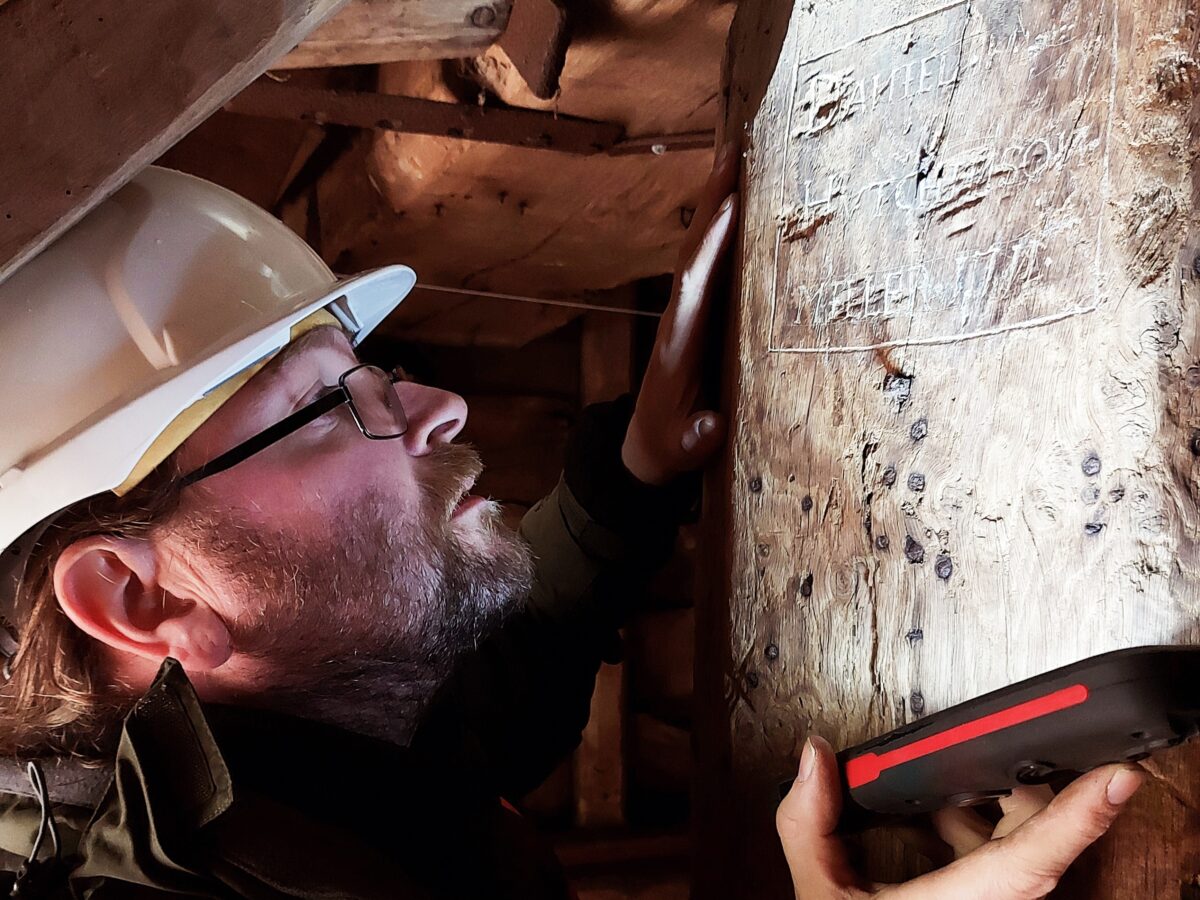
Author: Triskele Heritage

  • Mediaeval Mythbusting Blog #19: How to Date & Phase a Building

    Mediaeval Mythbusting Blog #19: How to Date & Phase a Building

    24 January 2023

    Understanding the correct dating of historic buildings is important. Structures are rarely left untouched over the centuries, and they are altered according to the needs of their occupants. For example, the late sixteenth century London topographer, John Stow summarised the changing use of a building which once stood on the corner of Old Jewry and Lothbury:

    “…this house, sometime a Jews’ synagogue, since a house of friars, then a nobleman’s house, after that a merchant’s house, wherein mayoralties have been kept, and now a wine tavern” (Wheatley 1956, 249)

    Detail from the Woodcut map of London, 1561 (reproduced c 1633). The plot on the corner of Old Jewry and Lothbury is highlighted in blue. Picture Source: British History Online.

    The various functions of synagogue, friary, lord’s residence, merchant’s house, mayor’s home, and pub would have led to structural modifications. Such changes can be traced in extant buildings through archaeological survey. Buildings archaeology demands a close analysis of the historical and physical evidence to understand development over time. However, most historic buildings have never been researched in detail. Despite this, specific dates of origin are commonly repeated even though the evidence is thin.

    This blog article will look at why errors of dating creep in and how to find reliable sources of information for dating mediaeval and early modern houses.

    History of Research

    A part of the problem of dating ancient homes is connected to how they have been studied. British architectural history developed in three broad stages. Initially, from the late seventeenth century, there was a fascination for ecclesiastical architecture. By the later nineteenth century castles, great houses and palaces began to get a look in. The study of timber-framed domestic and agricultural buildings (often referred to as vernacular architecture) did not become prominent until the mid-twentieth century. It is the dating of these non-elite structures which is often the most inaccurate.

    Thatched barn at Dale Abbey, Derbyshire. Listed as being “Probably C18”. Picture Source: James Wright / Triskele Heritage.

    There were very few vernacular buildings listed in the first editions of Nikolaus Pevsner’s The Buildings of England series. Although Pevsner was concerned with ecclesiastical, elite, and civic buildings – vernacular structures held little interest for him. This was symptomatic of many architectural historians, in the early- to mid-twentieth century, who saw little significance in non-elite structures. However, an uptick in the demolition of such buildings during the 1950s and 1960s led to a burgeoning interest in the study and protection of vernacular architecture which was led by researchers and campaigners including Ronald Brunskill, Maurice Barley and Dan Cruikshank. Eventually a gradual halt was put on the wilful devastation starting with a nationwide survey of historic buildings ordered by the British government in 1968. This led to something of a race as inspectors tried to protect buildings through statutory listing before they were pulled down. Rural areas were not well-served and it was not until a second survey in the 1980s that many agricultural buildings attained a degree of protection.

    Heritage Organisations

    The second half of the twentieth century saw the foundation of specialist organisations focused on the protection, curation and understanding of historic buildings. The Vernacular Architecture Group was founded in 1952. Architectural museums were developed at Avoncroft, Worcestershire (1963); Singleton, West Sussex (1967); and Chalfont St Peter, Buckinghamshire (1976). In 1983 English Heritage, latterly Historic England, were formed to act as national curators of assets including listed buildings.

    Weald & Downland Living Museum, Singleton, West Sussex. Picture Source: James Wright / Triskele Heritage.

    There can be little reasonable criticism of the mid-twentieth century desire to protect historic buildings at risk. However, the legacy has proved to be problematic as further detailed research has demonstrated that many buildings were inaccurately dated. During listing surveys time spent on site was minimal, most properties were assessed only from the street and entries were extremely brief. It is common to find vernacular buildings, where the timber-framing was not substantially visible from the street, assigned wholesale to the early modern period. This fed into the widespread mid-twentieth century belief that few lower status buildings survived from the mediaeval period due to what was understood at the time as a national “Great Rebuilding” in the late sixteenth and seventeenth centuries. Although many houses were built or remodelled during this period the picture is more complicated and developments did not occur at the same rate in all regions at the same time. Additionally, many mediaeval buildings did survive.

    An example of inaccurate dating is 392 Picklersleigh Road, Great Malvern (Worcestershire), known as Lydes House. It was first listed in May 1979 as a remodelled seventeenth century house. The listing entry is brief and only deals with external features. However, after an assessment of the building was requested from Triskele Heritage, by the landowners in June 2021, it was revealed that the primary build was a mediaeval cruck frame and that the house had been reorganised during the early modern period. Subsequently, this was confirmed and refined by the Oxford Dendrochronology Laboratory who dated the cruck to 1447-77, with a later phase of construction in 1625-35.

    Lydes House, Great Malvern, Worcestershire. Picture Source: James Wright / Triskele Heritage.

    Dendrochronology

    The accuracy of dendrochronology was the subject of another Mediaeval Mythbusting Blog, in January 2022, which demonstrated that felling dates are a strong indicator for the period of construction. The science of tree-ring dating has proved invaluable to the better understanding of timber-framed buildings. For example, 22-24 Kirkgate, Newark (Nottinghamshire) was listed as being late fifteenth century, yet dendrochronology later provided a felling date of 1337. Elsewhere, 40 Westhorpe, Southwell (Nottinghamshire) was listed as seventeenth century, yet tree-ring data indicated a felling range of 1332-57 – a significant disparity of approximately 250-350 years.

    Although dendrochronology has proved that errors in listings are common, we must not go too hard on the mid-twentieth century inspectors. Given that time was short and most buildings could only be assessed, stylistically, from the public highway inaccuracies were perhaps inevitable. The external appearance of Lydes House is wholly early modern or later and there is no indication that its primary build is mediaeval from the roadside. A more detailed internal survey demonstrated its mediaeval origin, which was then confirmed by dendrochronology. Lydes House is not an isolated case and it is frequently the roof structures, often invisible from the roadside, which give us clues to the real age of a building.

    22-24 Kirkgate, Newark, Nottinghamshire. Picture Source: James Wright / Triskele Heritage.

    Roof Structures

    Roofs have the potential to reveal so much about a building. When they are left relatively intact roofs can be highly diagnostic for dating. No. 4 Blacksmiths Lane lies at the heart of Kelham (Nottinghamshire) and was listed as a seventeenth century building in August 1981. From the roadside precious little information is present – the ground floor of the building is brick, the first floor rendered and the tiled roof is hipped to the south. However, a survey of the property (Wright 2019) has demonstrated the survival of a three-bay, timber-framed, mediaeval hall house. The common rafter roof structure was found to be entirely in situ and blackened from a period, before the insertion of the upper floors, when smoke from open fires drifted up to soot the timbers. Stylistic evidence from the jointing of the wall plate (which features edge-halved and bridled scarfs with over-squinted abutments) demonstrated that the house was probably constructed in the early fifteenth century (Hewett 1980, 268).

    The more surveys that are carried out by buildings archaeologists, the more the listing dates are challenged. Fieldwork by Triskele Heritage in another Nottinghamshire village – Wollaton – has complemented the findings at Kelham. Ivy Cottage was conventionally dated to the eighteenth century by reference to its Neo-Gothick brick façade. However, the potential for an earlier date was noted by the inspector. This was subsequently proven through the identification of a remodelled queenpost roof structure that potentially dates to c 1550-1600.

    Ivy Cottage, Wollaton, Nottinghamshire. Picture Source: James Wright / Triskele Heritage.

    Stylistic Dating

    Although dendrochronology has the potential to provide scientifically accurate felling ranges or dates, there may be cases where it cannot be deployed due to limited project budgets. In other cases the samples may not yield dates. This can happen where timbers do not have either the sapwood or bark present; species are not indigenously grown oak; the wood is rotten; the trees were grown in open environments such as parkland; the master chronologies are not available for particular regions; or there simply are not enough growth rings present to be statistically accurate. Further information on dendrochronology can be gleaned from the Nottingham Tree-ring Dating Laboratory website. The variables are significant and not every timber can be sampled and analysed successfully. In such situations it may only be possible to date a building stylistically.

    Stylistic dating relies on a careful assessment of the development of a building and the recording of primary architectural features which are reliably datable. Such features may include in-situ doors, windows, fireplaces, panelling, staircases and roofs. We have already touched on the potential of roofs, but it must be stressed that their dating by stylistic methods will vary according to both time and place.

    Crownpost roof at St Mary’s Guildhall, Boston, Lincolnshire. Picture Source: James Wright / Triskele Heritage.

    For example, dendrochronology tells us that the presence of a crownpost roof in Yorkshire might be expected in the years c 1280-1450; whereas the same design appears in Essex at around the same time but was still in use until c 1570. Meanwhile, clasped side purlin roofs were constructed in Yorkshire from c 1325 whilst they did not become widespread in Essex until c 1525. During a survey of a house in Sible Hedingham, Essex, Triskele Heritage revealed that the property had a clasped side purlin roof over the hall range whilst the crosswings had crownpost roofs. These are two distinctly different styles of construction with quite different periods of construction. The earliest phases of the building are the two late fifteenth century crosswings, which were dated from a combination of the roof structure and the stud-to-stud “Colchester” bracing. Meanwhile, the central hall range was rebuilt c 1600 and can be dated by a combination of the roof structure, ovolo-moulded windows, small-square panelling and wall paintings.

    Clasped purlin roof at Knole, Sevenoaks, Kent. Picture Source: James Wright / MOLA.

    Stylistic dating is often accurate to only a half century or so but can still be an important mechanism for refining the dating of buildings which have previously been assessed from their exterior.

    Unlisted Buildings

    There are numerous buildings which, for a variety of reasons, may not have previously been identified as historically significant. Rapid archaeological assessments of such structures may demonstrate their potential through stylistic dating. An assessment in Barnacle (Warwickshire) revealed that a building, which appeared to be a late nineteenth century property from the roadside, was in fact a timber-framed hall house of c 1500 during internal inspection. A property in Collingham (Nottinghamshire) – 6 Westfield Lane – demonstrated evidence for a partial timber-frame that probably dated to before c 1550. During work in Wollaton (Nottinghamshire), the Admiral Rodney pub was found to contain a single timber-framed bay, at first floor level, which contained a bridging beam with a chamfer stop that might be expected during the early modern period (Hall 2005, 158-63). Directly behind the pub is another unlisted building – Middleton Cottage – which yielded an in-situ stone window surround with a cill dated from its mullion profile to the later sixteenth or earlier seventeenth century (Hall 2005, 72-74).

    Admiral Rodney, Wollaton, Nottinghamshire. Picture Source: James Wright / Triskele Heritage.

    The evidence for the dating of these buildings, and therefore their historic significance, was not apparent from the roadside during the twentieth century listing surveys. It took internal assessments to understand that the properties were much older than previously understood. We can be reasonably certain that there are still many ancient buildings hidden in plain sight which await accurate identification.

    Older or Younger?

    Numerous surveys may have proven that some vernacular buildings are older than their listings indicate. Yet we must not overstate the potential for overturning existing estimates. Many other surveys have corroborated the listings. For example, work by Triskele Heritage in Haskayne (Lancashire) on a building listed as seventeenth century was able to further refine the period of construction to c 1630-60 on stylistic grounds.

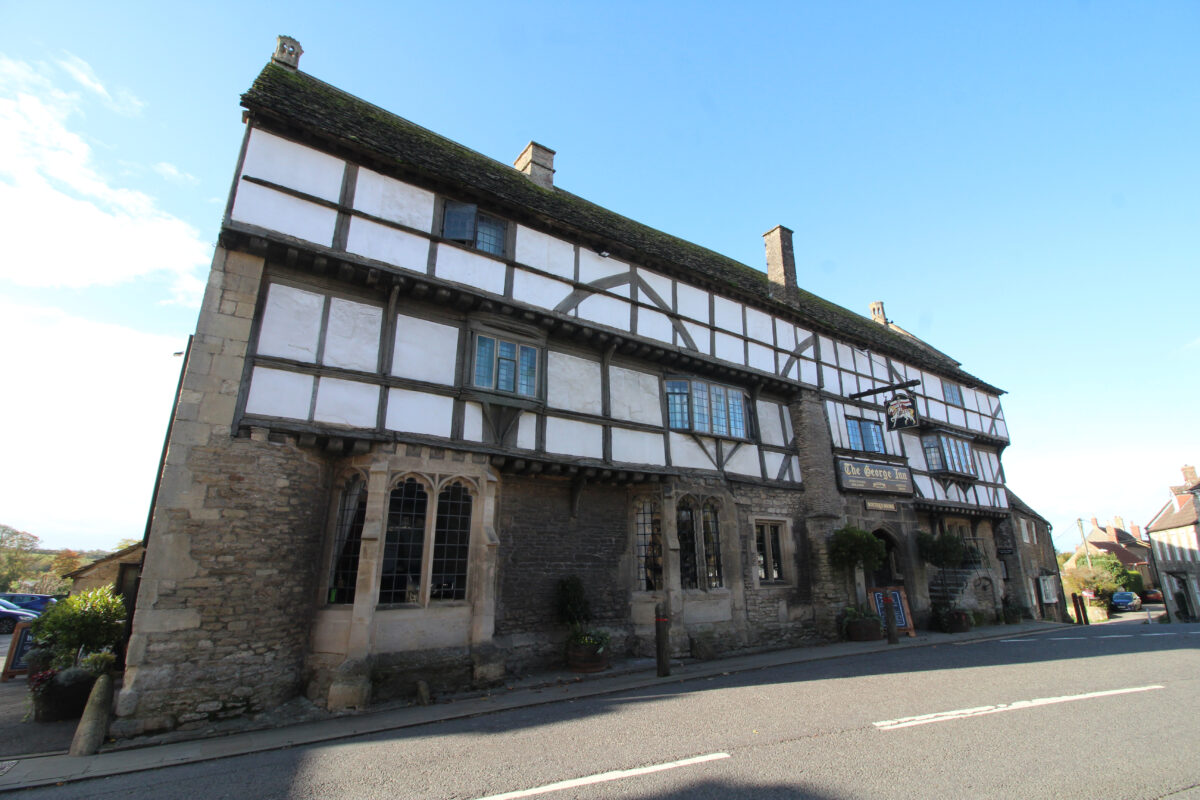
    Yet there is a class of building routinely estimated as far older than the evidence can verify: public houses. It is remarkably common to see ancient dates printed on pub signs. Examples of this include: Ye Olde Fighting Cocks (St Albans, Hertfordshire; 793), the Bingley Arms (Bardsey, West Yorkshire; 953) and Ye Olde Trip to Jerusalem (Nottingham; 1189). Yet the real architectural dating of all three buildings is well-understood. Ye Olde Fighting Cocks started off life as a monastic dovecote, built c 1400, which was re-sited and turned into a house c 1600 and did not open its doors as a pub until c 1756. In Bardsey, the Bingley Arms is entirely a mid-eighteenth-century building – it even has a datestone of 1738. Finally, all of the Trip (including its famous caves) was constructed from the later seventeenth century onwards. There is a certain misty-eyed romanticism surrounding a pint in an old English boozer which has led to some rather tall tales being told about their dates of origin – a subject which has been covered in another Mediaeval Mythbusting Blog on the search for Britain’s oldest pubs.

    Trip to Jerusalem, Nottingham. Picture Source: James Wright / Triskele Heritage.

    Another group of historic buildings reckoned as being older than can be verified are those within the brochures of estate agents. To give an example, the Manor House at Chipping Norton (Oxfordshire) was listed for sale by Savills via Rightmove in February 2022 as being a fifteenth century building. This is despite dendrochronology, published in 2017, which gave felling dates for the primary structure as summer 1677, summer 1679 and spring 1680 – suggesting a single campaign of building between 1677 and 1680 (Alcock & Tyers 2017, 83).

    Quite why pubs and estate agents habitually claim that buildings are older than they really are can only be speculated on…

    Uploading Ongoing Research

    Listed building descriptions can be accessed online. The various countries in the British Isles have their databases available to view: National Heritage List for England; Canmore (Scotland); Cadw (Wales); HERoNI (Northern Ireland); and the National Inventory of Architectural Heritage (Ireland). Within England the process for updating listings, in the light of new research, is somewhat labyrinthine. Typographical errors can be altered by the minor amendments team. However, for anything more detailed an application must be submitted for a full amendment. Unfortunately, this is a slow process which is used sparingly. A colleague at Historic England recently stated that: “We are aware it is a bit cumbersome, but it’s a result of the legislation and legal status of listed buildings that any significant change needs to be signed off by the Department for Culture Media and Sport.” Consequently, listing descriptions often lag behind new research.

    Listings are not the only port of call for understanding the dating of a building. Each county also has a historic environment record (HER) which is a database of heritage assets including listed and non-listed buildings. There is a statutory requirement for HERs to be staffed and maintained, usually by an employee of a local authority, and much (but not all) of their data is available via the Heritage Gateway website. This means that any new information on a building which comes to light (including survey reports, published articles, sources, images, mapping, archives etc.) can be added to the publicly accessible database. The entries are usually available for personal research, free of charge, either via the Heritage Gateway or through an in-person visit, but commercial requests (usually connected to planning applications) incur a fee to cover officer time. However, a colleague working as a HER Officer has also noted that: “All HERs are massively different, to get a clear handle you probably want to reach out to see how individual offices work.”

    New research is also made available to the public via the Archaeology Data Service, OASIS or individual project websites or publications. Furthermore, the Vernacular Architecture Group maintain an annually updated list of buildings positively dated by dendrochronology which is free to access. The new volumes of Pevsner’s The Buildings of England are greatly expanded on their predecessors. The latest crop of editors are very diligent to ensure that recent research is incorporated. Finally, it is not widely appreciated that historic building reports often make their way into the public arena through local authority planning portals (associated with planning applications). These documents can offer a wealth of information about the current state of knowledge of a building and can be accessed freely online via local authority websites.

    Hyperlinked screenshot of the Vernacular Architecture Group’s Tables of Tree-ring Dated Buildings in England and Wales website.

    Ultimately, there is no one single repository of information on the dating of historic buildings and a researcher should always attempt to cast the net wide to ensure that the most up to date research is captured. In cases where there is no consensus, or where data is not forthcoming, contacting the HER Officer, county archaeology society, archives, or local civic society may open up further leads.

    Conclusions

    The age of a building has a great impact on assessments of its significance which can, in turn, effect planning decisions which are made about the future of the structure. If a building is inaccurately dated inappropriate interventions may be made due to a lack of understanding.

    The specific dating of a property is not always an easy piece of information to access. Historic building listing descriptions are sometimes inaccurate. Online sources should always be authenticated against solid research and publication. Never trust anything on Wikipedia which does not have a citation – and, even then, check the sources for accuracy. Just because a website says that a building is seventeenth century does not mean that it necessarily is that date.

    It is always worth doing the detective work to understand the age of a building – because there are lots of mediaeval buildings which are genuinely hidden in plain sight. Buildings archaeology and dendrochronology are the key to accurate dating.

    References

    Alcock, N. & Tyers, C., 2017, ‘Tree-ring Date Lists 2017’ in Vernacular Architecture Vol. 48. Vernacular Architecture Group / Taylor & Francis.

    Hall, L., 2005, Period House Fixtures and Fittings, 1300-1900. Countryside Books. Newbury.

    Hewett, C. A., 1980 (1997, ed.), English Historic Carpentry. Phillimore. Sussex.

    Wheatley, H. B., 1956 (1980 ed.), Stow’s Survey of London. Everyman. New York.

    Wright, J., 2019, ‘The Fox Inn, Main Road and 4 Blacksmith Lane, Kelham, Nottinghamshire – Archaeological Statement of Significance’ in Beresford, M., Kelham Revealed – Archaeology Report. MB Archaeology. Unpublished archaeological report.

    About the author

    James Wright (Triskele Heritage) is an award-winning buildings archaeologist who frequently writes and lectures on the subject of mediaeval building myths. He has two decades professional experience of ferreting around in people’s cellars, hunting through their attics and digging up their gardens. He hopes to find meaningful truths about how ordinary and extraordinary folk lived their lives in the mediaeval period.

    He welcomes contact through Twitter or email.

    The Mediaeval Mythbusting Blog blog is the basis of a forthcoming book – Historic Building Mythbusting – Uncovering Folklore, History and Archaeology which will be released via The History Press on 6 June 2024. More information can be found here:

  • Investigating Mediaeval Churches

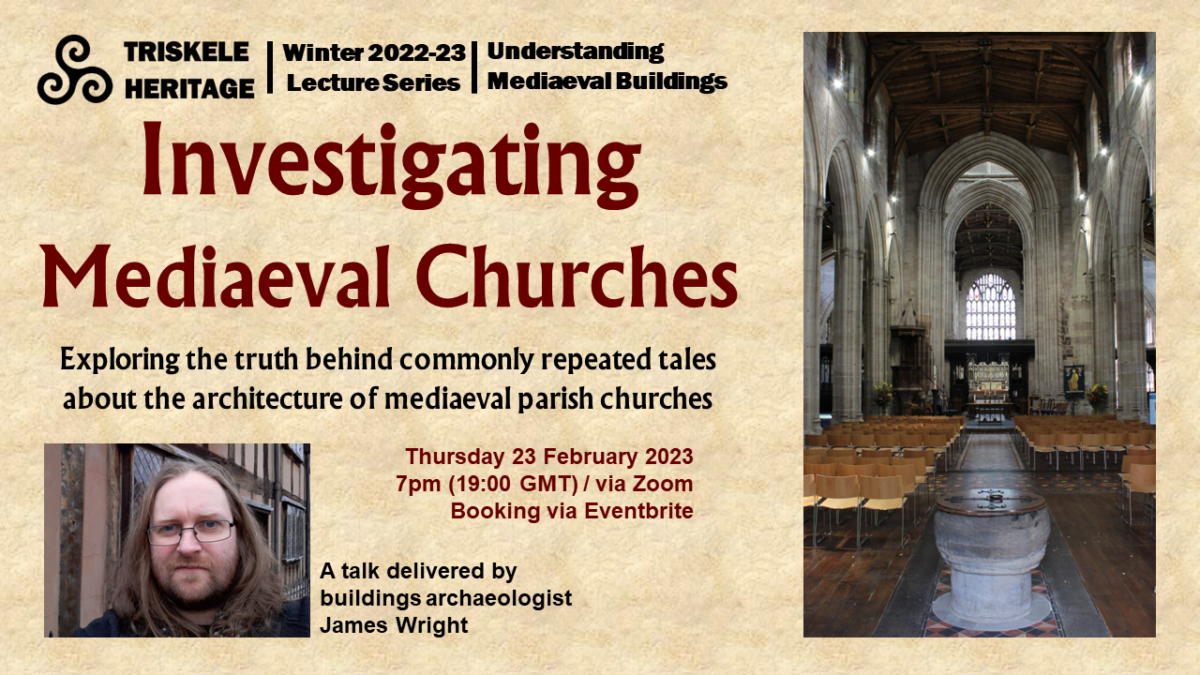
    Investigating Mediaeval Churches

    Mediaeval parish churches are some of the oldest and most loved buildings in the British Isles. However, relatively few of them have been archaeologically surveyed and many unverified stories have grown up around them. This talk will look at some of the commonly repeated tales about the architecture of churches, which are widely assumed to be true, but which ultimately fall into the realm of folklore and myth.

    These stories include doorways apparently blocked to keep the Devil out, churches alleged to be aligned to the sunrise on their saint’s day and windows said to allow lepers to watch the mass. These are tales repeated in good faith but are not based in the lived reality of the mediaeval world. Instead, we will look at the how churches were used before the Reformation. By applying contextual archaeological and historical evidence the architectural functions of churches will be investigated and unlocked.

    The speaker, James Wright (Triskele Heritage), is an award winning buildings archaeologist. He has two decades professional experience of ferreting around in people’s cellars, hunting through their attics and digging up their gardens. He hopes to find meaningful truths about how ordinary and extraordinary folk lived their lives in the mediaeval period. He is the author of the popular Mediaeval Mythbusting Blog.

    All you need to do is register via Eventbrite and – when the time for the talk rolls around – grab your favourite beverage of choice, get comfy and enjoy.

    The event will take place at 19:00 GMT on Thursday 23 February 2023 .

    Booking is now available via Eventbrite:

    This lecture is crowdfunded through donation. It will be the debut of a new bespoke talk. There is no minimum donation so its possible to contribute as little or as much as you want. Your donation is your ticket and you will be sent a link to access the event by Eventbrite.

    Please note that this live event will not be recorded and made available online afterwards.

    If you have a question about the event – in the first instance please see our FAQs section. The answer will almost certainly be in there.

    *** If you have any problems accessing the events please email with your booking reference to james@triskeleheritage.com ***

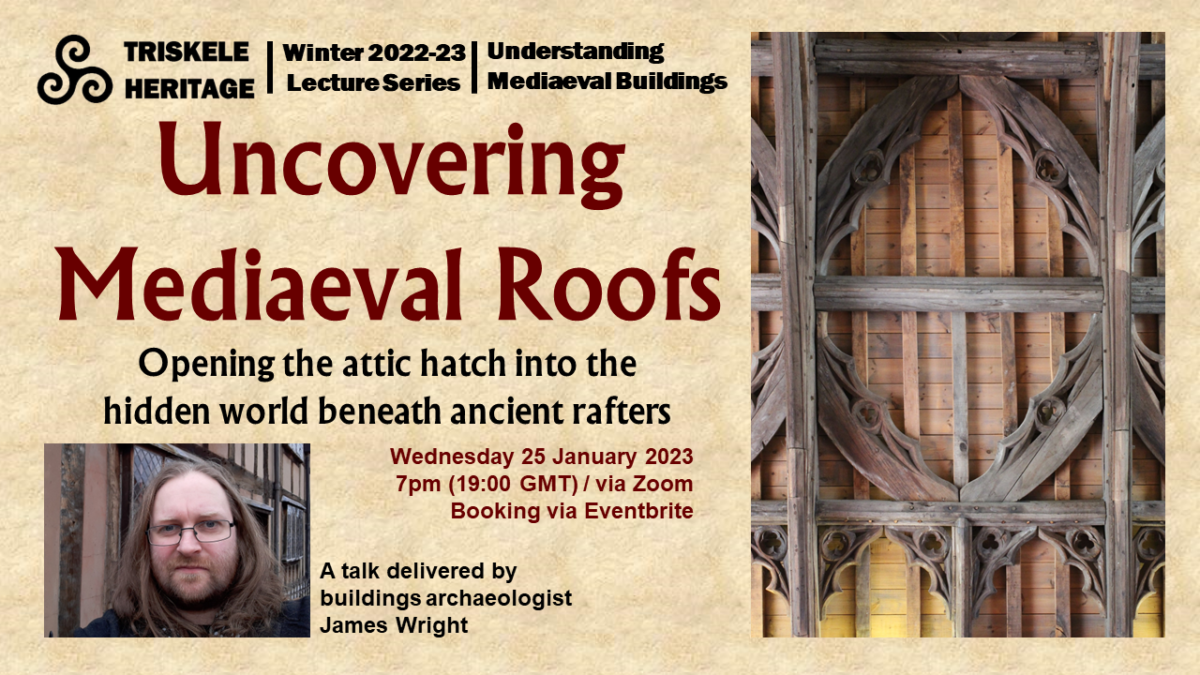
  • Uncovering Mediaeval Roofs

    Uncovering Mediaeval Roofs

    Opening the attic hatch into the hidden world beneath ancient rafters

    Attics are dark and enigmatic places. Yet in ancient buildings they offer the chance of illumination when trying to understand the historic development of a structure. Roofs are often the least altered element of a building and retain more of their original fabric than any other part of a property. For researchers they offer a hugely significant repository of data which can be understood and interpreted.

    This online event will open the attic hatch on the lost, hidden and fascinating world of mediaeval roofs. We will look at how roofs are constructed, the changes in design across time and place, the functions of roof spaces in the past, and some of the startling archaeological discoveries that are made up in the rafters.

    The speaker, James Wright (Triskele Heritage), is an award winning buildings archaeologist. He has two decades professional experience of ferreting around in people’s cellars, hunting through their attics and digging up their gardens. He hopes to find meaningful truths about how ordinary and extraordinary folk lived their lives in the mediaeval period. He is the author of the popular Mediaeval Mythbusting Blog.

    All you need to do is register via Eventbrite and – when the time for the talk rolls around – grab your favourite beverage of choice, get comfy and enjoy.

    The event will take place at 19:00 GMT on Wednesday 25 January 2023 .

    Booking is now available via Eventbrite:

    This lecture is crowdfunded through donation. It will be the debut of a new bespoke talk. There is no minimum donation so its possible to contribute as little or as much as you want. Your donation is your ticket and you will be sent a link to access the event by Eventbrite.

    Please note that this live event will not be recorded and made available online afterwards.

    If you have a question about the event – in the first instance please see our FAQs section. The answer will almost certainly be in there.

    *** If you have any problems accessing the events please email with your booking reference to james@triskeleheritage.com ***

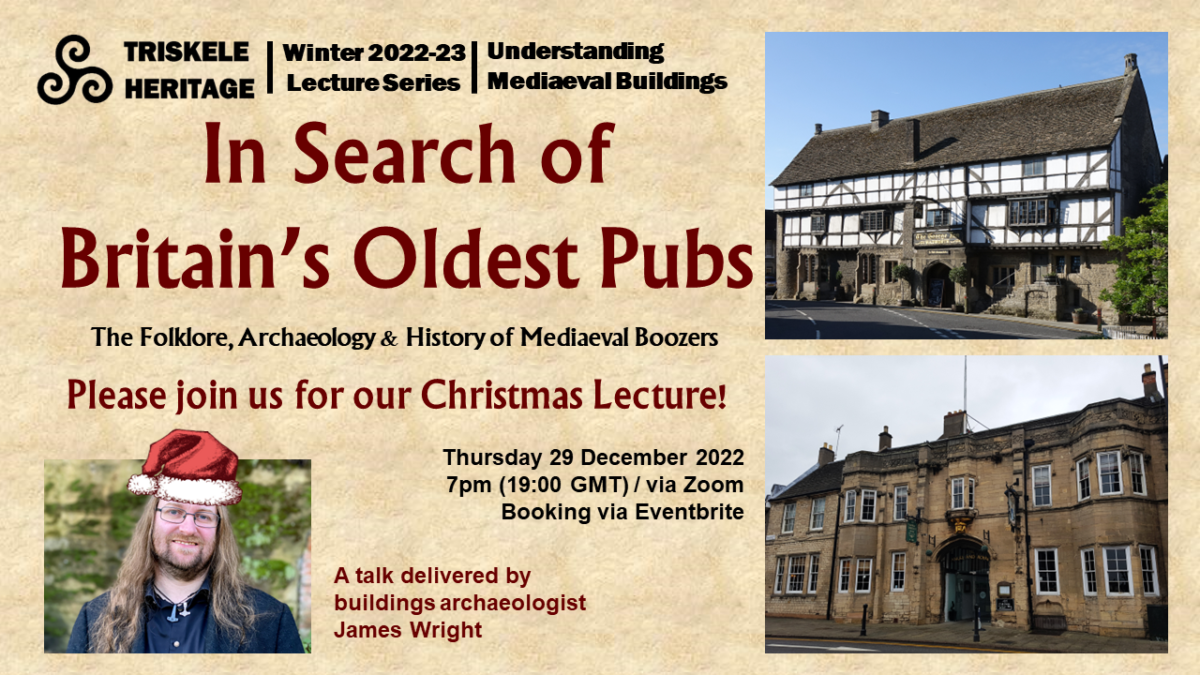
  • In Search of Britain’s Oldest Pubs

    In Search of Britain’s Oldest Pubs

    Numerous claims are made to be Britain’s oldest pub from all corners of the isles. Pubs have been the beating heart of communities for centuries and there are firm regional rivalries when it comes to competing for the very oldest boozer. Is it ever possible to come close to identifying which establishment has been serving up the beers for the longest?

    Using a combination of archaeological and documentary evidence, this talk will delve deeply into the historical development of British pubs through the mediaeval period. Can we begin to define the physical characteristics and date of pubs from their architecture? The claims of well-known buildings will be put to the test and those of more obscure pubs brought to the fore. KJust where is Britain’s oldest pub?

    The speaker, James Wright (Triskele Heritage), is an award winning buildings archaeologist. He has two decades professional experience of ferreting around in people’s cellars, hunting through their attics and digging up their gardens. He hopes to find meaningful truths about how ordinary and extraordinary folk lived their lives in the mediaeval period. He is the author of the popular Mediaeval Mythbusting Blog.

    All you need to do is register via Eventbrite and – when the time for the talk rolls around – grab your favourite beverage of choice, get comfy and enjoy.

    The event will take place at 19:00 GMT on Thursday 29 December 2022 .

    Booking is now available via Eventbrite:

    This lecture is crowdfunded through donation. It will be the debut of a new bespoke talk. There is no minimum donation so its possible to contribute as little or as much as you want. Your donation is your ticket and you will be sent a link to access the event by Eventbrite.

    Please note that this live event will not be recorded and made available online afterwards.

    If you have a question about the event – in the first instance please see our FAQs section. The answer will almost certainly be in there.

    *** If you have any problems accessing the events please email with your booking reference to james@triskeleheritage.com ***

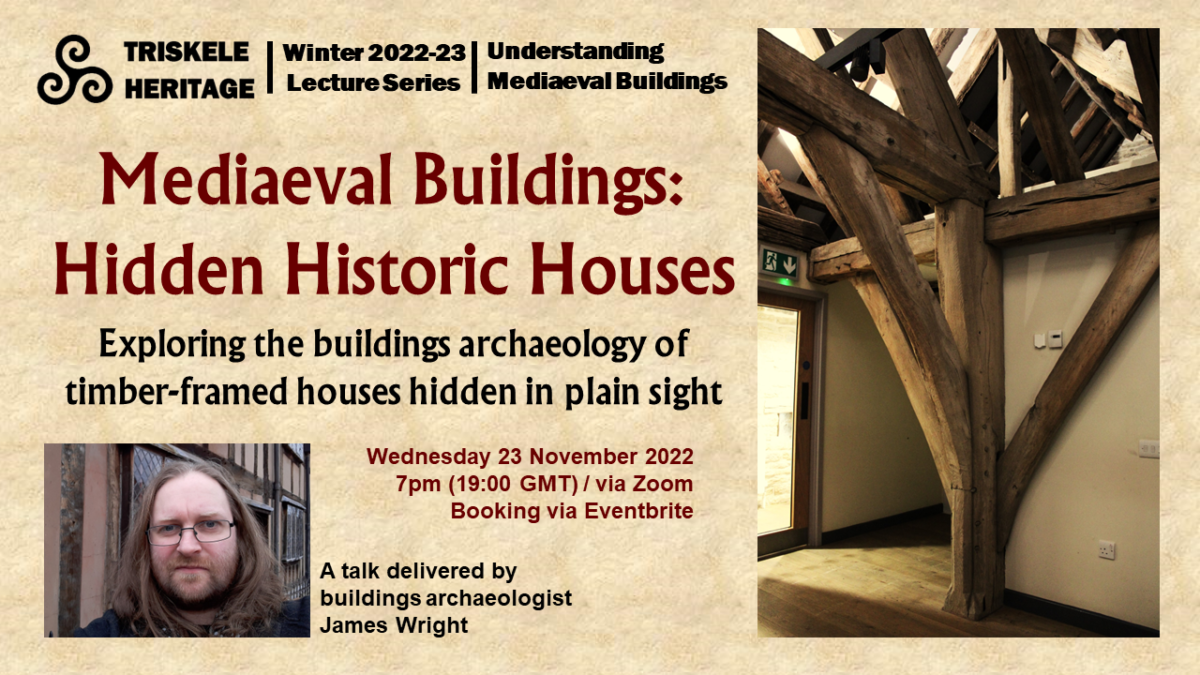
  • Mediaeval Buildings: Hidden Historic Houses

    Mediaeval Buildings: Hidden Historic Houses

    The second in the Triskele Heritage 2022-23 Winter Series of Lectures: Understanding Mediaeval Buildings.

    The vast majority of historic buildings have never been researched. Many well-known or high-status structures have not been studied in depth. There are literally thousands of mediaeval and early modern timber-framed buildings which are hidden in plain sight.

    This talk will use buildings archaeology to open the doors of ordinary-looking houses standing in towns, villages and the countryside to show how there is a fabulous wealth of unknown or unidentified historic buildings standing in virtually every settlement. We will look at why so many ancient buildings have gone unnoticed, the evidence for later facades masking much earlier fabric and how to date historic structures.

    The speaker, James Wright (Triskele Heritage), is an award winning buildings archaeologist. He has two decades professional experience of ferreting around in people’s cellars, hunting through their attics and digging up their gardens. He hopes to find meaningful truths about how ordinary and extraordinary folk lived their lives in the mediaeval period. He is the author of the popular Mediaeval Mythbusting Blog.

    All you need to do is register via Eventbrite and – when the time for the talk rolls around – grab your favourite beverage of choice, get comfy and enjoy.

    The event will take place at 19:00 GMT on Wednesday 23 November 2022 .

    Booking is now available via Eventbrite:

    Due to our licensing agreement with Zoom tickets for each event will be limited to 495 places. This will be a live event. It will not be recorded and made available online afterwards. If you have a question about the event – in the first instance please see our FAQs section. The answer will almost certainly be in there.

    *** If you have any problems accessing this event please email with your booking reference to james@triskeleheritage.com ***

  • Mediaeval Mythbusting Blog #18: Sex, Stonemasons & the Sacred

    Mediaeval Mythbusting Blog #18: Sex, Stonemasons & the Sacred

    26 September 2022

    In 1517, a flamboyant new gatehouse was under construction at Canterbury Cathedral. Built in a late-flowering example of the Perpendicular Gothic style, the Christchurch Gateway features twin turrets flanking a gate portal and every facet is decorated with panel tracery, armorials, and figure sculpture. In among this decorative exuberance is a carving of a woman… but this is no ordinary female. She is shown, emerging from foliage, unashamedly naked with her head and spine provocatively arched backward. Her breasts are prominently pushed forward and upwards. Meanwhile, her legs are spread wide, and her vulva is clearly and unapologetically on display. Her form is deliberately voluptuous, and her posture is explicitly sexual.

    The sculpture has caused some red-faced discussion by modern commentators attempting to rectify the apparent pornographic content with the sacred context of the building. Lauren MacDougall of Kent Live concluded that “It doesn’t feel very Christian” and went on to note that: “The story goes that the church were trying to get out of paying what was due the stonemason… He finally accepted a payment lower than what was originally agreed, but got his revenge by putting in this rude carving.”

    Naked lady on the Christchurch Gateway (Credit: Ian Scammel / Kent Live)

    Cathedrals and Churches

    Canterbury is far from alone in housing such naughty imagery. At Norwich Cathedral the bosses of the rib vaulted cloisters feature religious scenes such as the Crucifixion, Christ’s Ascension and Mary the Queen of Heaven. Elsewhere, there are more earthly moments including a pair of raucous musicians, a group of gossiping townsfolk and a feast. However, dotted among these images of heaven and earth are altogether more disturbing views. A nude man disappears into foliage, a bearded fellow is openly presenting his bare posterior and a half-naked man is ripping at the clothing of a maligned woman.

    It is not just cathedrals either. So many parish churches have figures engaged in all manner of grotesque behaviour. At Wiggenhall (Norfolk) a gargoyle has a visibly erect penis. At West Knoyle (Wiltshire) a monstrous chap is licking his own testes. Meanwhile, at Ewerby (Lincolnshire) a gurning man appears to be masturbating.

    Man ripping at a woman’s clothing, Norwich Cathedral (Credit: James Wright / Triskele Heritage)

    Speculation

    In a self-published book, Demon Carvers and Mooning Men: The East Midlands School of Church Carving, Lionel Ward follows Lauren MacDougall’s misgivings about such imagery in a sacred context: “Why… would a church pay for this work? Well, the answer is that I don’t think they knowingly did. It is well known that the master mason would often be paid a fixed price for the whole job, even sometimes to include procuring the stone. If the master had labour being freed up towards the end of a project he could easily put men to decorative work. All the evidence is that it was mediaeval practice throughout the land to give the masons a free hand on decorative carving.”

    Elsewhere, regular posts on social media forums such as the Medieval and Tudor Period Buildings Group draw attention to the plethora of scandalous images found in ecclesiastical architecture. Speculation on how naughty carvings came to exist inevitably follows. Many draw attention to the widespread story of the disgruntled stonemason who had not been paid properly taking sculptural revenge. Others point to the “well-known anti-establishment views” of craftspeople, masonic humour, pornographic intent and possibly even the survival of pagan fertility cults throughout the mediaeval period.

    Sheela-na-gig

    The latter is commonly assumed to be true. However, there is little-to-no evidence of genuine pagan beliefs during the high mediaeval period, outside of very limited areas on the extreme edge of north-eastern Europe. Reference is inevitably be made of the famous sheela-na-gig carvings of female forms which hold open exaggerated vulva. Candy Bedworth has asked if “Sheela Na Gig is generally believed to be a pre-Christian deity or fertility symbol… Is this the Earth goddess who both births us, and then takes us in death? The figures are often depicted in a birthing position. There are suggestions that they are a folklore talisman used for promoting a successful birth. They may have been comical in-jokes by stone-masons, or a magical protection used to scare away evil. Are these the last defiant images, left as a reminder of the power of women? Power stolen by the misogynist politics of the Christian Church?”

    Sheela-na-gig from Easthorpe; now at Colchester Castle Museum, Essex (Credit: James Wright / Triskele Heritage)

    However, as the historian Francis Young has noted: “The Romantic notion of paganism as a cult of conscious resistance to institutional Christianity is not a meaningful idea in the context of the Middle Ages themselves.” Despite this, the sheela is certainly a contentious image which has given church authorities cause for ethical rumination. During the early twentieth century, the vicar of Easthorpe (Essex) removed one such carving, and donated it to the Colchester Castle Museum, as he thought it too obscene to keep in the church. Meanwhile in an essay on sheelas, the pseudonymous author, Nora Bone referred to the motif as “the undefinable terror twat” due to the mystery and moral panic that it is capable of provoking among excitable and prudish parishioners. However, these sculptures cannot be described as pornographic as they are far from titillating or arousing.

    A more measured view has been taken by Theresa Oakley. She offers us a mediaeval context in which to view sheela-na-gig imagery and points out that they may be material evidence of a form of Christian theology known as negative mysticism: “which consciously employed a strategy of disarrangement as a way of finding God… to find God, therefore, one has to enter darkness. This is a darkness caused by excessively blinding light, a darkness of deep knowledge rather than of ignorance” (Oakley 2009, 65). Essentially, the further from the sanctified, the better the chance of finding salvation and redemption. In Biblical terms, this is the equivalent of Jesus heading to the desert to fast for 40 days and 40 nights prior to his temptation by the devil. Notably, he apparently came back from the nadir stronger and even more convinced of his message to the world (The New Testament – Matthew, Chapter 4: Verses 4-11).

    Oakley (2009, 84) goes on to state that: “sheelas are part of the sacred. They alert us to that which cannot be seen and hide a complexity of meaning which cannot be accessed by the limited view that they are fertility symbols, images of lust, or were intended to scare off the devil.” So, if it is possible to find the spiritual in the very antitheses of Christian imagery, can this help us to explain why highly sexualised artwork was so very popular in the sexually repressed mediaeval church run by (allegedly) celibate clerics?

    Popularity

    Man exposing himself at All Saints Hereford (Credit: James Wright / Triskele Heritage)

    Most church buildings probably had at least one example of sexual imagery, and some had many. Not all survive, but there is still no shortage of examples spanning the eleventh to the sixteenth centuries. There is a man clutching his toes and presenting an exaggerated anus at Easton-on-the-Hill (Northamptonshire). Another man is simultaneously dancing and masturbating at Bratton Clovelly (Devon). The example of the lad exposing his genitals, by lifting his legs far above his head, at All Saints Hereford became an internet viral sensation in 2021.

    Was the church aware of the proliferation of such carvings? Are we to believe Oakley’s assertion that sexual sculptures were part of a now-obscure branch of Christian thinking? Is it not the case that the prosaic explanation that they were the result of crafts-people peeved at their treatment by the church more likely?

    Well, most of these figures are highly visible and would have been even more so when they were still brightly painted during the mediaeval period. Yet there is not a single archival reference to a complaint or court case involving a resentful stonemason who was prosecuted for carving such an image. Given that the Catholic church was (and remains) notoriously litigious, this lack of evidence for legal cases against such frequent imagery stretches the story of the angered mason to breaking point.

    Mediaeval Artistic Commissions

    Vaulting boss featuring a naked man in foliage at Norwich Cathedral (Credit: James Wright / Triskele Heritage)

    Sexual imagery must be put into the wider context of how artwork was patronised and commissioned by the church in mediaeval Europe. During the Second Council of Nicea, in 787, it was decreed that: “the composition of religious pictures is not left to the inspiration of artists, but depends on the principles laid down by the Catholic Church and religious tradition. Art alone is the painter’s province, the composition belongs to the Fathers.” This meant that the church’s own people picked the themes which were to be represented in their buildings. Artists were left with narrow parameters in which they could express themselves according to the media of their chosen trade.

    This eighth century practice was still alive and well, in 1306, when Ralph Baldock, the bishop of London, ordered the prior of Holy Trinity Aldgate to lead an enquiry as: “We have heard on trustworthy authority that one Tidemann of Germany hath sold, some time since, to Geoffrey, Rector of St. Mildred’s in the Poultry, a certain carved crucifix with a cross-beam, which doth not represent the true form of the cross” (Coulton 1956, 473). Here, a German merchant had sold a non-conformist representation of the Crucifixion that was causing some alarm for the authorities. The church duly sprang into action – it was not going to stand by and let something like that be placed within one of its buildings. So, if a carving of the Cross could provoke such a response, why do we never hear of outrage by clerics at apparently pornographic carvings in their buildings – many of which were in plain sight?

    Licence and Encouragement

    The answer to the last question is probably that there were no complaints. Sexual imagery was liberally and gladly patronised by the mediaeval church. The notions that stonemasons were knocking out last-minute rude carvings because there was a bit of money left over in a project; that they were anti-establishment members of a covert pagan fertility cult; or that they had been diddled out of wages, just do not stack up.

    Doorway to the Chapter House at Westminster Abbey (Credit: Wikimedia Commons)

    Sculpture was (and remains) expensive. In the mid-1250s, the sum of 53s 4d was paid out, probably to the master mason William Yxeworth, for two life-sized statues of Mary and the Archangel Gabriel at the Annunciation. They still stand in the spandrels above the door into the chapter house of Westminster Abbey. At this period, a master mason might expect to be making somewhere around £10 per annum and those two statues would have constituted around 25% of Yxeworth’s annual income (Lethaby 1906, 155). Although most sexual imagery is not of the same size and intricacy as the Westminster statues, it does still represent a significant investment in time, labour, and materials. These pieces were not created rapidly or in secret. They were deliberate commissions.

    Functions Within Churches

    We’ve already seen that sheela-na-gig sculptures have been linked to negative mysticism and may have been part of an intangible spirituality. There is no reason why similar notions cannot be applied to other sexual sculptures. Equally, there may be further explanations that can be proposed in certain cases.

    St Michael the Archangel, Laxton, Nottinghamshire (Credit: James Wright / Triskele Heritage)

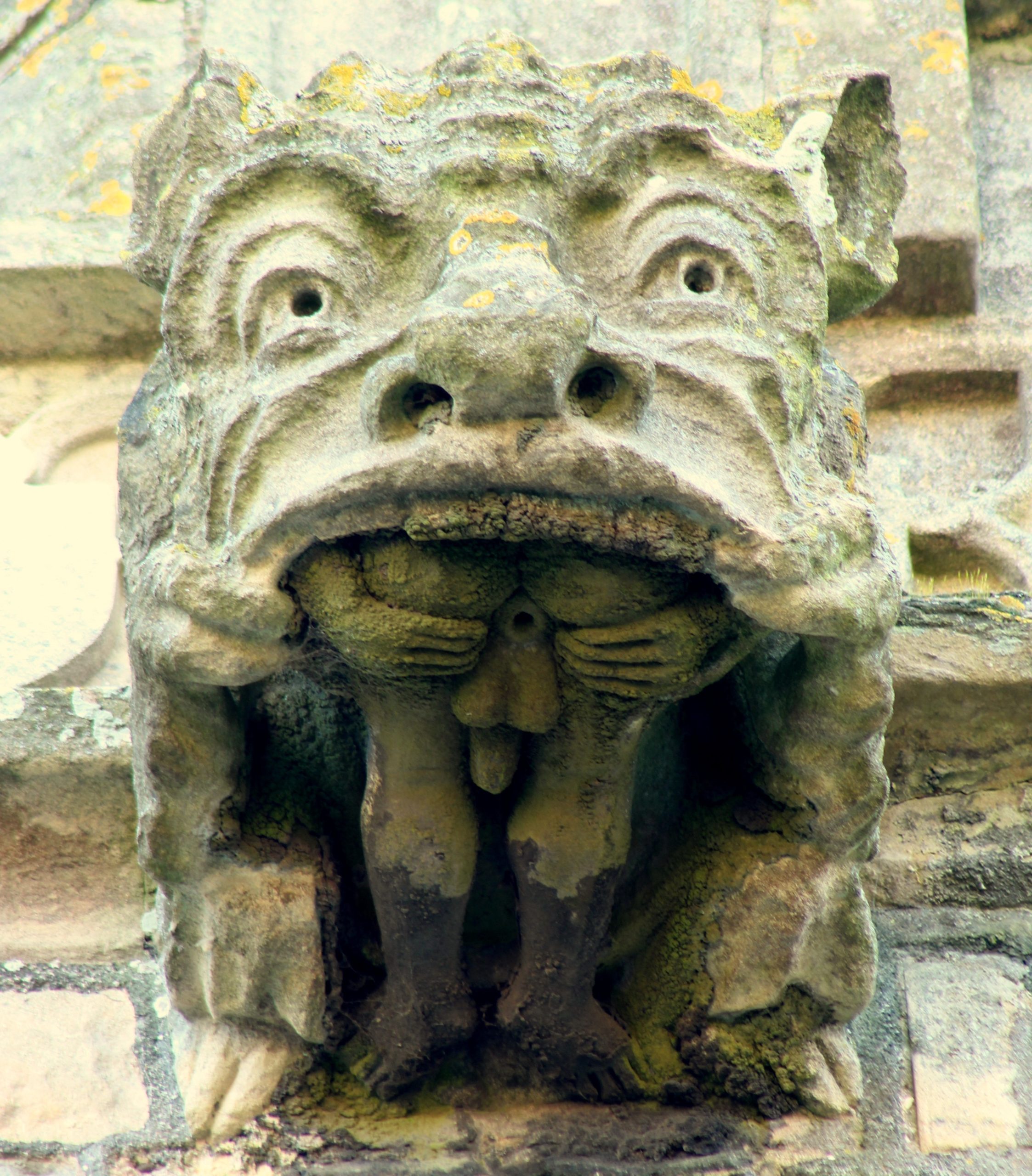
    The village of Laxton (Nottinghamshire) is famous for its substantial motte and bailey castle, and for being the last manor in Europe to be farmed on mediaeval open field principles. It also has a very fine fifteenth century parish church dedicated to St Michael the Archangel. Between the clerestory and the parapet of the north elevation of the nave is a cornice dotted with seven grotesque carvings. The fourth from the west is perhaps my favourite sculpture from the entire mediaeval period.

    The carving is of a demon with an oversized head featuring pointed ears, a bulbous nose and distended brow ridges. Its clawed fingers are pulling open the centrepiece of the sculpture – a wide mouth… and a figure lies within it. The individual is, unequivocally, a male figure shown from the waist down and from behind. He is bending over and parting his bum cheeks with his hands to reveal his open sphincter, a pendulous pair of testicles and an engorged member. Subtle, it is not!

    Carving of a demon consuming a naked man at St Michael the Archangel, Laxton, Nottinghamshire (Credit: James Wright / Triskele Heritage)

    The Laxton demon is a variation of a type of carving known as a “mouth-puller”, in which the figure hooks its fingers or claws into the corners of its mouth to open it widely. Alex Woodcock (2012, 34) has noted that interpretation of “mouth-pullers” varies. Some could be the pained expressions of one suffering toothache. Others may be connected to personifications of the vices, such as lust or anger. Anthony Weir and James Jerman (1986, 102) thought that they were a visual reference specifically connected to lust and adultery as mentioned in a passage of the book of Isiah: “But draw near hither, ye sons of the sorceress, the seed of the adulterer and the whore. Against whom do ye sport yourselves? Against whom make ye a wide mouth, and draw out the tongue? Are ye not children of transgression, a seed of falsehood. Enflaming yourselves with idols under every green tree, slaying the children in the valleys under the cliffs of the rocks?” (The Old Testament Isiah, Chapter 57: Verses 3-5).

    The motif could be read as a visual warning to parishioners not to behave like the adulterous pagans in Isiah. Similarly, another common mediaeval sculptural motif was the wild man. He was frequently depicted as a very hairy human with long hair, beard and a club, and represented the uncivilised barbarism that should be avoided by the chivalrous and the godly (Hayman 2010, 11). Mouth-pullers, wild men and carnal or scatological nudes were perhaps part of a normal sculptural tradition to show the reverse of what was expected of the virtuous Christian in sculpture. Here, negative mysticism may meet moral teachings.

    Wild men flanking an armorial on a chimneypiece frieze at Tattershall Castle, Lincolnshire (Credit: James Wright / Triskele Heritage)

    Other examples of “mouth-pullers” are known, regionally, at Clifton (Nottinghamshire) and Oakam (Rutland) but neither of these feature a naked man within the mouth. Remarkably, the Laxton sculpture faces directly onto the main village street and is highly visible. The fact that the demon seems to be consuming the naked man is reminiscent of the Mouth of Hell – an essential image in Doom paintings.

    This scene was familiar to mediaeval folk as commonly illustrated over the chancel arch in churches. Surviving examples can be seen at Stratford-upon-Avon (Warwickshire), Salisbury (Wiltshire) and Coventry (West Midlands). The image of sinners being consumed by demons or in the fires of Hell may have acted as a moral warning: do not engage in licentious behaviour or you will be sent to Hell for all eternity (Woodcock 2012, 36).

    Doom painting at St Thomas, Salisbury, Wiltshire. Note the Mouth of Hell in the bottom right corner. (Credit: Nessino / Wikimedia Commons)

    Satirical Comedy

    So far, the elephant in the room has been humour. In fact, humour is altogether absent from most po-faced academic literature on the subject. Instead, many sculptures, including the Laxton carving, could be described as extremely funny. To the rakish or scatological person, the mooning man at Cottesmore (Rutland), the exhibitionist grasping his testicles in both hands with a tongue lolling out at Colsterworth (Lincolnshire), and the man licking his own sphincter on the soffit of the tie beam at Stoke Golding (Leicestershire) are absolutely hilarious.

    Man licking his sphincter on the soffit of a tie beam at St Margaret, Stoke Golding, Leicestershire (Credit: James Wright / Triskele Heritage)

    Much mediaeval humour was very earthy, and this kind of visual imagery should come as little surprise to anyone familiar with the poetry of Geoffrey Chaucer:

    This Nicholas was risen for to pisse,
    And thoughte he wolde amenden al the jape;
    He sholde kisse his ers er that he scape.
    And up the wyndowe dide he hastily;
    And out his ers he putteth pryvely
    Over the buttok, to the haunche-bon


    Which can be translated as:

    This Nicholas had risen for a piss,
    And thought that it would carry on the jape
    To have his arse kissed by this jack-a-nape.
    And so he opened the window hastily,
    And put his arse out there, quietly,
    Over the buttocks, showing the whole bum

    (Geoffrey Chaucer, The Canterbury Tales: The Miller’s Tale – Lines 690-695)

    Illustration of Robin the Miller, from The Miller’s Tale, playing bagpipes (Credit: Henry E. Huntington Library and Art Gallery / Wikimedia Commons)

    Humorous, Chaucerian, imagery in churches could have acted as a soft conduit between the pulpit and the populace. Rather than hectoring parishioners in the nave, priests sanctioned the use of ribald imagery such as the Laxton carving. This imagery helped to instil mockery at the man misbehaving in the street whilst also gently warning that there could be punishment ahead in the afterlife. Satire has always been a powerful medium for diffusing serious abuses.  

    Conclusions

    Although the story of the disgruntled stonemason, that carved rude sculptures to get one over on the church authorities, is extremely popular it is not based on verifiable evidence from the mediaeval world. The tale is perhaps predicated on three elements. Firstly, a lack of understanding at just how common sexual imagery was in the mediaeval church. Secondly, a lack of mediaeval theological and cultural context. Thirdly, assumptions of morality based on Victorian and modern concepts.

    The fact that highly visible, carnal sculpture was so abundant in the mediaeval world can be coupled to a distinct lack of legal prosecutions brought against stonemasons and carpenters. This in itself acts as a significant piece of evidence that the imagery was sanctioned. Meanwhile, we have access to many actual edicts by the church which indicated that they monitored the content of artwork very closely indeed.

    Naked man in the cloisters of Norwich Cathedral (Credit: James Wright / Triskele Heritage)

    Instead, we must look to what functions such imagery played within the mediaeval church. Sexual motifs may have been related to negative mysticism and a sense of intangible spirituality – taking the viewer to a dark place to find the true light of Christianity. The sculptures could act as moral warnings – expressions of how not to behave. Equally, the use of satirical humour has always had a great strength in undermining behaviour: “Blimey! That carving of the naked man up there doesn’t half remind me of what happened after Old Baldrick drank all that strong ale! What a plonker!

    As ever, the mediaeval mind was extremely complex, and images could work on several levels at once. We must be careful not to bring modern morality to bear on mediaeval subject matter. As L. P. Hartley (The Go-Between, 1953) memorably stated: “The past is a foreign country: they do things differently there.”

    Postscript

    Whilst compiling this article, it occurred to me that all of the cited sculptures lie within either Grade II* or Grade I listed buildings. The very fact that such carvings survive will be a strong part of the assessment of significance for these buildings. Rude imagery has literally helped to protect these structures!

    References

    Bedworth, C., 2020, ‘The Intriguing Tale of Shocking Sheela Na Gig and its Art References’ in Daily Art Magazine: https://www.dailyartmagazine.com/sheela-na-gig-art/
    [Accessed 26/09/2022]

    Bone, N. [pseudonym], 1998, ‘Sheela-na-gigs’ in Towards 2012. Unlimited Dream Company.

    Coulton, G. G., 1956, Social Life in Britain from the Conquest to the Reformation. Cambridge University Press. Cambridge.

    Hartley, L. P., 1953, The Go-Between, Hamish Hamilton. London.

    Hayman, R., 2010, The Green Man, Shire. Oxford.

    Lethaby, W. R., 1906, Westminster Abbey & the King’s Craftsmen : A Study of Mediaeval Building. Duckworth. London.

    Oakley, T., 2009, Lifting the Veil: A New Study of the Sheela-Na-Gigs of Britain and Ireland. British Archaeological Reports Series 495. Archeopress. Oxford.

    Wall, L., no date, Demon Carvers and Mooning Men: The East Midlands School of Church Carving. Self-published ebook.

    Weir, A. & Jerman, J., 1986 (1993 edition), Images of Lust – Sexual Carvings on Medieval Churches. Routledge. London.

    Woodcock, A., 2012, Gargoyles and Grotesques. Shire. Botley.

    Young, F., 2020, ‘The Myth of Medieval Paganism’ in First Things
    https://www.firstthings.com/article/2020/02/the-myth-of-medieval-paganism
    [Accessed 26/09/2022]

    About the author

    James Wright (Triskele Heritage) is an award-winning buildings archaeologist who frequently writes and lectures about mediaeval building myths. He has two decades professional experience of ferreting around in people’s cellars, hunting through their attics and digging up their gardens. He hopes to find meaningful truths about how ordinary and extraordinary folk lived their lives in the mediaeval period.

    He welcomes contact through Twitter or email.

    The Mediaeval Mythbusting Blog blog is the basis of a forthcoming book – Historic Building Mythbusting – Uncovering Folklore, History and Archaeology which will be released via The History Press on 6 June 2024. More information can be found here:
  • Mediaeval Mythbusting Blog #17: Britain’s Oldest Pub

    Mediaeval Mythbusting Blog #17: Britain’s Oldest Pub

    29 August 2022

    This post features two guest blogs on the subject of tracking down Britain’s oldest pub.

    The first was published by History Extra in August 2022. A big thanks to Elinor Evans for commissioning the piece. The text can be found by clicking the link below:

    In Search of Britain’s Oldest Pub

    The second was uploaded to Historic England‘s blog Heritage Calling during December 2022. Thanks to Jack O’Halloran for commissioning the text. The piece can be found by clicking this link:

    What is the Oldest Pub or Inn in England?

    About the author

    James Wright (Triskele Heritage) is an award-winning buildings archaeologist who frequently writes and lectures on the subject of mediaeval building myths. He has two decades professional experience of ferreting around in people’s cellars, hunting through their attics and digging up their gardens. He hopes to find meaningful truths about how ordinary and extraordinary folk lived their lives in the mediaeval period.

    He welcomes respectful contact through email or on TwitterInstagram & Bluesky

    The Mediaeval Mythbusting Blog is the basis of the book – Historic Building Mythbusting – Uncovering Folklore, History and Archaeology which was released via The History Press in June 2024. More information can be found here:

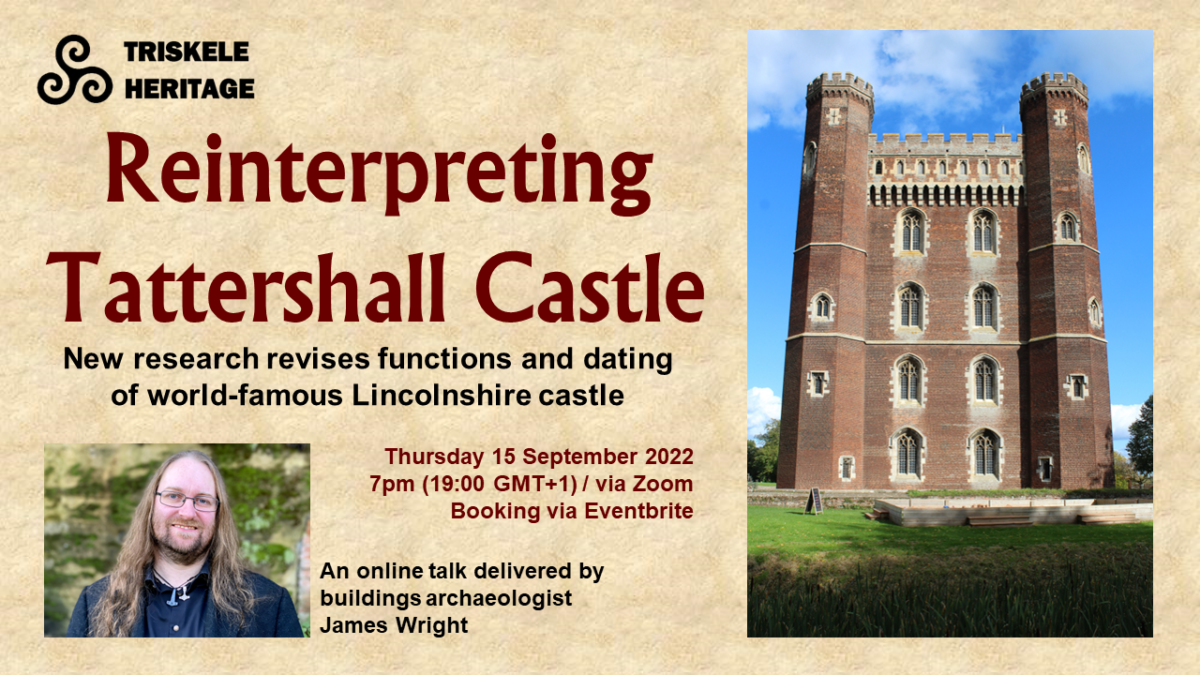
  • Reinterpreting Tattershall Castle

    Reinterpreting Tattershall Castle

    A one-off online talk looking at new research which has revised the functions and dating of the world-famous Lincolnshire castle.

    Tattershall Castle (Lincolnshire) is one of the most famous and iconic fifteenth century castles in the world. Owned by the National Trust since 1925, the site was excavated and conserved during the 1910s by Lord Curzon and the architect William Weir. However, much of what was understand then about Tattershall came from a time when English castle studies were in their infancy.

    A four-year research project, carried out by buildings archaeologist James Wright, has challenged the interpretation of Tattershall using modern techniques to reassess the site. This fully illustrated talk will look at how fundamental errors were made when describing the functions of spaces including the “Stables”, “Guardhouse”, “Kitchens”, “Parlour” and “Tiltyard”. New evidence offers alternative insights into how these parts of the castle originally functioned during the mediaeval period.

    The science of dendrochronology was incorporated into the project and has helped to refine the construction dates for the castle. A shift of just 15 years has revolutionised the place of Tattershall in English architectural history. The building is now thought to be part of the genesis of a style which lasted for two centuries and inspired later work at Eton College, Oxburgh Hall and Hampton Court Palace.

    The research project, which is the subject of this talk, was supervised by the University of Nottingham and the National Trust. It was funded by the Arts and Humanities Research Council.

    The speaker, Dr James Wright (Triskele Heritage), is an award winning buildings archaeologist. He has two decades professional experience of ferreting around in people’s cellars, hunting through their attics and digging up their gardens. He hopes to find meaningful truths about how ordinary and extraordinary folk lived their lives in the mediaeval period. He is the author of the popular Mediaeval Mythbusting Blog. His doctoral research was on Tattershall Castle.

    All you need to do is register via Eventbrite and – when the time for the talk rolls around – grab your favourite beverage of choice, get comfy and enjoy.

    The event will take place at 19:00GMT+1 on Thursday 15 September 2022 .

    Booking is now available via Eventbrite:

    Due to our licensing agreement with Zoom tickets for each event will be limited to 495 places. This will be a live event. It will not be recorded and made available online afterwards. If you have a question about the event – in the first instance please see our FAQs section. The answer will almost certainly be in there.

    *** If you have any problems accessing this event please email with your booking reference to james@triskeleheritage.com ***

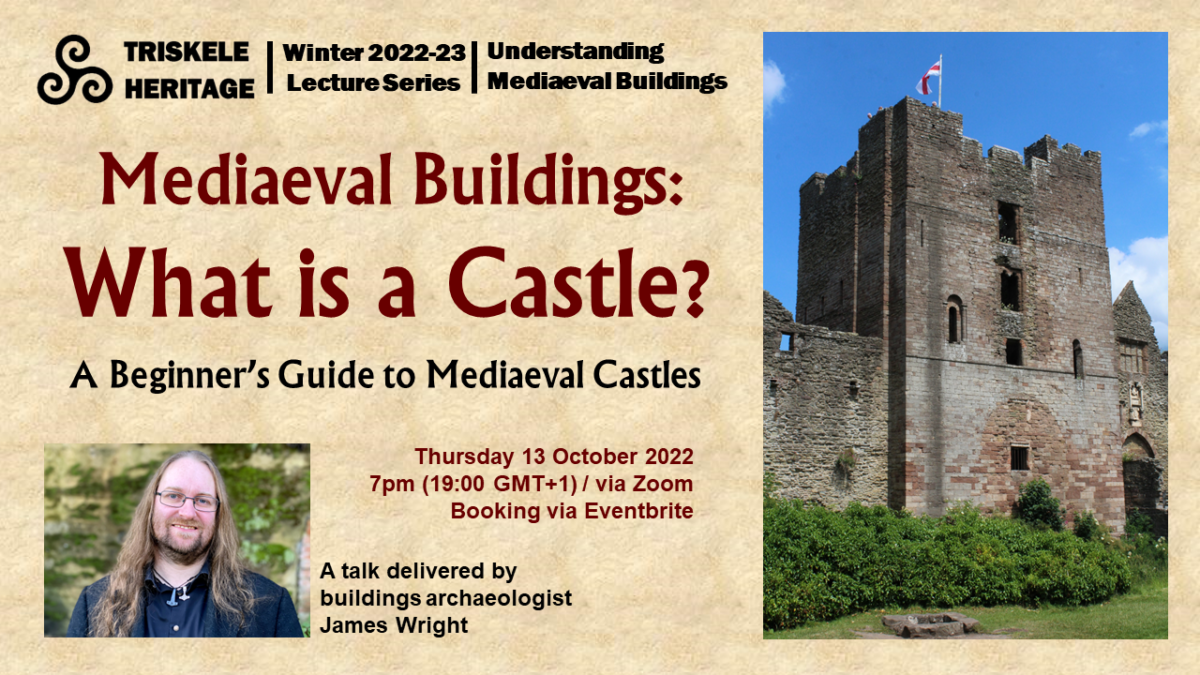
  • What is a Castle? A Beginner’s Guide to Mediaeval Castles

    What is a Castle? A Beginner’s Guide to Mediaeval Castles

    The first in the Triskele Heritage 2022-23 Winter Series of Lectures: Understanding Mediaeval Buildings.

    Mediaeval castles are diverse. No two are identical. Stretching across several centuries of use, their design changed radically from their arrival in Britain during the late Saxon period until they faded away in the mid-sixteenth century. It may be surprising to learn that quite how we define these buildings is hotly contested.

    For most people, castles are militarily defensive fortifications that may have also contained the residences of lords within. However, this interpretation masks a huge complexity of functions. This talk will look at the chronological, social, economic, political and construction issues surrounding castles in an attempt to define and explain these incredible structures.

    The speaker, James Wright (Triskele Heritage), is an award winning buildings archaeologist. He has two decades professional experience of ferreting around in people’s cellars, hunting through their attics and digging up their gardens. He hopes to find meaningful truths about how ordinary and extraordinary folk lived their lives in the mediaeval period. He is the author of the popular Mediaeval Mythbusting Blog.

    All you need to do is register via Eventbrite and – when the time for the talk rolls around – grab your favourite beverage of choice, get comfy and enjoy.

    The event will take place at 19:00 GMT+1 on Thursday 13 October 2022 .

    Booking is now available via Eventbrite:

    Due to our licensing agreement with Zoom tickets for each event will be limited to 495 places. This will be a live event. It will not be recorded and made available online afterwards. If you have a question about the event – in the first instance please see our FAQs section. The answer will almost certainly be in there.

    *** If you have any problems accessing this event please email with your booking reference to james@triskeleheritage.com ***

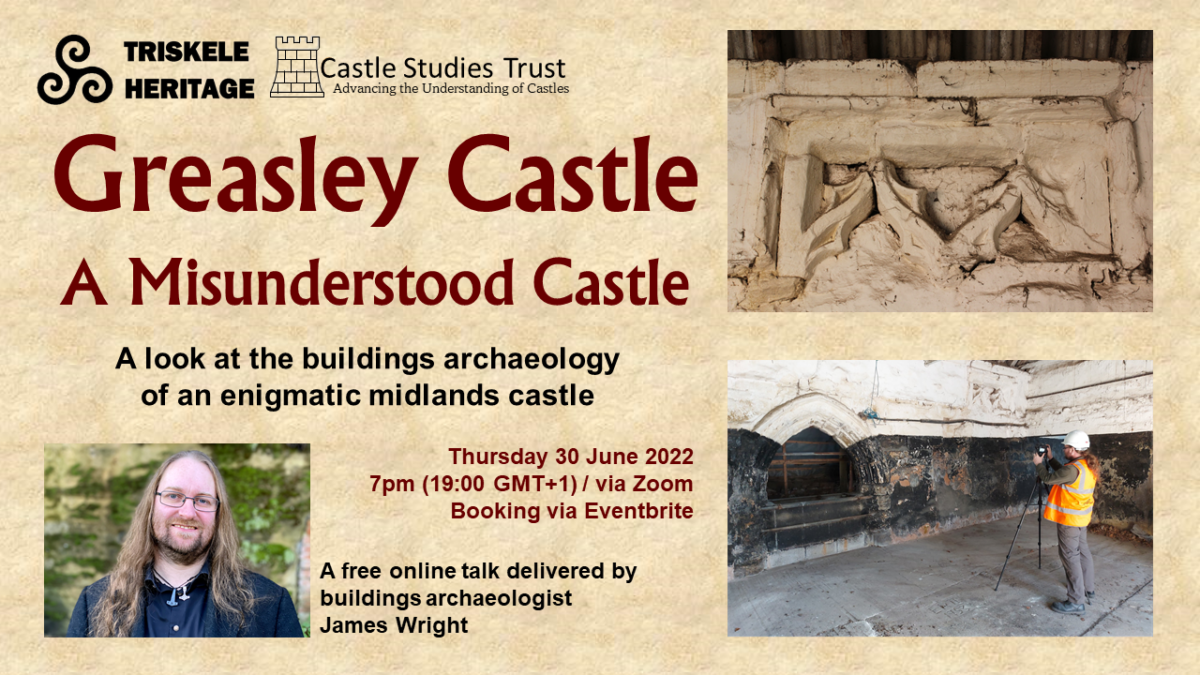
  • Greasley Castle: A Misunderstood Castle

    Greasley Castle: A Misunderstood Castle

    A one-off online talk looking at the buildings archaeology of enigmatic Greasley Castle (Nottinghamshire) – once the home to one of Richard III’s commanders.

    During 2021, the remains of Greasley Castle were surveyed by Triskele Heritage. The aim of the project was to try and unpick traces of a mid-fourteenth century courtyard castle, built for Nicholas, 3rd Baron Cantelupe, from the later post-mediaeval farmyard buildings. The work was funded by the Castle Studies Trust.

    This talk outlines the findings of the buildings archaeology survey. For the first time it is possible to understand the structure, layout, size and phasing of Greasley Castle. Surprisingly, the castle once had a great deal in common with other contemporary sites including Haddon Hall (Derbyshire) and Strelley Hall (Nottinghamshire). The story of the castle is one of the meteoric social rise of the Cantelupes family, the loss of the site by one of Richard III’s captains after Bosworth and its gradual transformation into a working farm.

    The speaker, James Wright (Triskele Heritage), is an award winning buildings archaeologist. He has two decades professional experience of ferreting around in people’s cellars, hunting through their attics and digging up their gardens. He hopes to find meaningful truths about how ordinary and extraordinary folk lived their lives in the mediaeval period. He is the author of the popular Mediaeval Mythbusting Blog.

    All you need to do is register via Eventbrite and – when the time for the talk rolls around – grab your favourite beverage of choice, get comfy and enjoy.

    The event will take place at 19:00GMT+1 on Thursday 30 June 2022 .

    Booking is now available via Eventbrite:

    Due to our licensing agreement with Zoom tickets for each event will be limited to 495 places. This will be a live event. It will not be recorded and made available online afterwards. If you have a question about the event – in the first instance please see our FAQs section. The answer will almost certainly be in there.

    *** If you have any problems accessing this event please email with your booking reference to james@triskeleheritage.com ***